
A Mother’s Story from COP31: “I’m Yasmina, a Mother of Two”
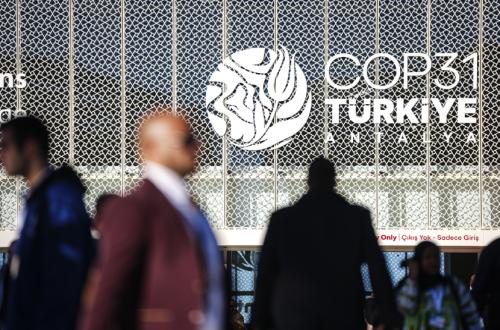
Over the past week at COP31, I have spoken on several stages: in a press conference room, at a warm restaurant in Anadolu Park, in a care pavilion and in front of a podcast microphone. The audiences varied: journalists, policymakers, educators and students.
But one thing kept recurring across all those stages. At the end of two different sessions, I was asked almost the same question, and my answer was almost the same. It did not come from data or reports, but from my heart as a mother.
This article is about that answer.
Two sessions, one question
The first session was a recording of the Climate Curious podcast from TED Countdown on Thursday (12 November) at Countdown House in Anadolu Park. Deesha and I discussed how caregivers, especially mothers, are already leading climate solutions in Indonesia. The questions were simple but pointed: What do you actually do? What are the obstacles? What do you believe now that you did not believe before? And what is the smallest action listeners can take today?
The second session was the It Takes a Village panel in the Green Zone at COP31 on Saturday (14 November), organised in collaboration with Mom Loves Taiwan and Our Kids’ Climate. The session was open to anyone interested in family-led movements and was streamed live on Facebook.
On stage, the four of us took turns telling our stories. Jasmine from Mom Loves Taiwan opened and moderated the session. Teresa Xavier spoke from the perspective of Our Kids’ Climate. I shared the story of PERI BUMI in Indonesia, followed by Maya Mailer from Mothers Rise Up in the UK. The message was clear: it takes a village to raise a child, and now it takes a village to protect the air that child breathes.
Mothers moving the world
Teresa and Maya spoke about the movements they have built, accompanied by a short video about children’s lungs exposed to polluted air. Since its establishment in 2019, Our Kids’ Climate has grown into a network of parents in more than 50 countries. OKC supports parent and mothers’ organisations around the world through fellowships, small grants and mentoring.
Through its Our Kids’ Air campaign, OKC established the Clean Air Circle in 2024 to help community leaders in Ecuador, Ghana, India, Mexico, Poland, South Africa and the United States develop local clean-air campaigns. In Ecuador, for example, families installed air-quality monitors near schools, childcare centres and parks themselves, in what was described as the country’s first community-led air-monitoring project.
The movement has also shown that it can mobilise large numbers of people. Ahead of COP26, OKC collected letters from nearly 500 parent groups in 44 countries calling for an end to new fossil fuels and delivered them directly to the COP president at the time. In 2025, the European Lung Foundation recognised OKC for its contribution to protecting children’s respiratory health worldwide.
Teresa then told us about New York. Installing solar panels there has long been complicated and expensive, particularly for families renting flats who do not have their own roofs. Mothers joined calls to make clean energy accessible to every family. One mother of two from the Bronx wrote for a newspaper and installed solar panels on her own balcony as part of the campaign. In June 2026, New York State’s legislature finally passed the SUNNY Act: residents may install small solar panels on balconies or windows and plug them into a standard socket, without complicated approval from the electricity company. A door that had been closed is now almost open, and mothers helped push it that way.
Maya, from the UK’s Mothers Rise Up, brought a story from her own city. Since 26 October 2026, nearly a kilometre of Oxford Street, London’s best-known shopping district, has been closed to vehicles. Visitors now walk, and use public transport to get there. This is part of London’s long-term effort to clean up its air, including its Ultra Low Emission Zone (ULEZ), which restricts the most polluting vehicles.
The results can be seen in children’s bodies. A study published in The Lancet Public Health in August 2026 followed more than 3,400 children aged six to nine from 84 primary schools in London between 2018 and 2022. After the ULEZ was introduced and nitrogen dioxide pollution fell, lung growth among London children accelerated compared with children in comparison cities. The proportion of children with clinically impaired lung function fell from 14 per cent to 9 per cent.
Imagine that: children’s lungs actually grew better because the city chose clean air. This is what mothers are fighting for, and it is proof that their efforts are worthwhile.
Jasmine then spoke about Mom Loves Taiwan. Its journey began in 2013, when a group of mothers formed an alliance to monitor nuclear power in Taiwan. In 2022, its mission expanded into a climate movement, guided by the belief that home is where climate action begins. Its programmes impressed me.
They took children to Taiwan’s Presidential Office for a Children’s Climate Conference, where they could ask policymakers questions directly and propose solutions. In Yuanli, Miaoli, they supported children’s participatory budgeting: children’s proposals to install solar panels on the roofs of public buildings and schools were actually funded. They are now preparing a new programme, a fellowship for climate-conscious parents in Taiwan, with its first action planned for April 2027, to coincide with Children’s Day.
Listening to this, I thought of the beginnings of PERI BUMI five years ago: small, full of questions, but driven by the same love.
When my turn came, I spoke about the mothers of PERI BUMI. I told the story of a mother in Martapura, South Kalimantan, who did not wait for a major programme when the haze arrived; instead, she invited her neighbours to sew masks for street sweepers and vegetable sellers. I spoke of a mother in Purwakarta who began composting with her neighbours, after which a local circular asked every household in her area to manage its own waste. One woman, one neighbourhood, one rule changed.
Last year, 97 per cent of mothers in our programme adopted at least three new habits, household waste sent to landfill fell by nearly 12 per cent, and five local policies changed because mothers asked for them.
Our conclusion on stage was the same: mothers are key drivers of change. But those driving change also need fuel. Mothers need full support: time and trust, small grants that reach community groups directly, childcare and flexible working arrangements, reliable information, and someone willing to listen.
Source: jawawa.id (https://jawawa.id/newsitem/a-mothers-story-from-cop31-im-yasmina-a-mother-of-two-1794743492)
Originally published by Republika (https://opini.republika.co.id/berita/toj8dt475/cerita-ibu-dari-cop31-saya-yasmina-ibu-dari-dua-anak), translated from Indonesian