
A Look Inside Brickmaking, Still Going Strong in Indonesia’s Economy
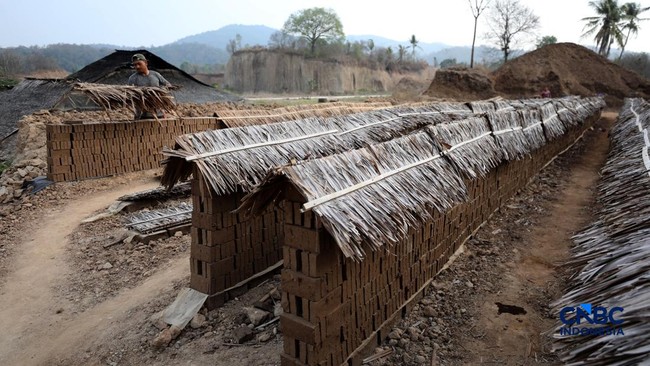
Red-brick production has become a productive economic activity for some residents of Serang, Banten. Workers made red bricks in Setu village, Wariginkurung district, Serang, Banten, on Sunday (25 October 2026). The bricks sell for Rp260 each.
Despite the growing popularity of innovative lightweight bricks, the profitable red-brick business continues to thrive, as red bricks remain an important component in building construction.
Setu village is one of the centres of the red-brick industry, which has been established there for more than a decade. Visitors to the area can see thousands of red bricks stacked at a lio, a traditional building used for making bricks and storing clay.
The raw material is clay sourced from the area around Bulakan village. It is first ground in a machine commonly known as a molen until soft enough to make moulding easier.
The clay is then shaped in the same machine into the familiar form of a brick. Workers carry the freshly moulded bricks to an open area to dry.
Once dried, the bricks are placed in a kiln consisting of two to four levels. The lowest level holds the firewood used as fuel, while the second level is used to stack the bricks.
The bricks are fired for around three to four days. Workers monitor and tend the fire around the clock to ensure it does not go out or become so intense that it scorches the bricks.
The final stage is cooling. The bricks are left to stand for two days so their temperature can stabilise and they can cool down.
A worker who has been in the industry for about three years said production could range from hundreds to tens of thousands of bricks a day. “It depends on the supply of clay. If there’s a lot of clay, we can make a lot. In a day, [we can make] 20,000 bricks,” he said.
At the site, the worker responsible for carrying the bricks out to dry is joined by three colleagues, each with a separate role: preparing the clay mixture, moulding the bricks and carrying them.