
A Look at a Community Internet School in a Remote Corner of Sulawesi
Palu (ANTARA) — At midday in Toro village, Kulawi district, Sigi regency, Central Sulawesi, the sun was directly overhead, its heat beating down. Yet a gentle breeze across the rice fields and hills brought the characteristic calm of the countryside.
In one corner of the village, in Bola hamlet, stands a school. Its simple L-shaped building has three main rooms and a dirt assembly ground scattered with small stones. But this simplicity has not dampened the enthusiasm and ambitions of pupils at Alkhairaat Toro Private Islamic Elementary School (MIS).
Soon, the call to prayer rang out from a loudspeaker at a nearby mosque, signalling that pupils and local residents should prepare for the midday prayer.
After praying together, the pupils returned to school one by one to continue their lessons. That afternoon was different: their tired faces quickly lit up with excitement.
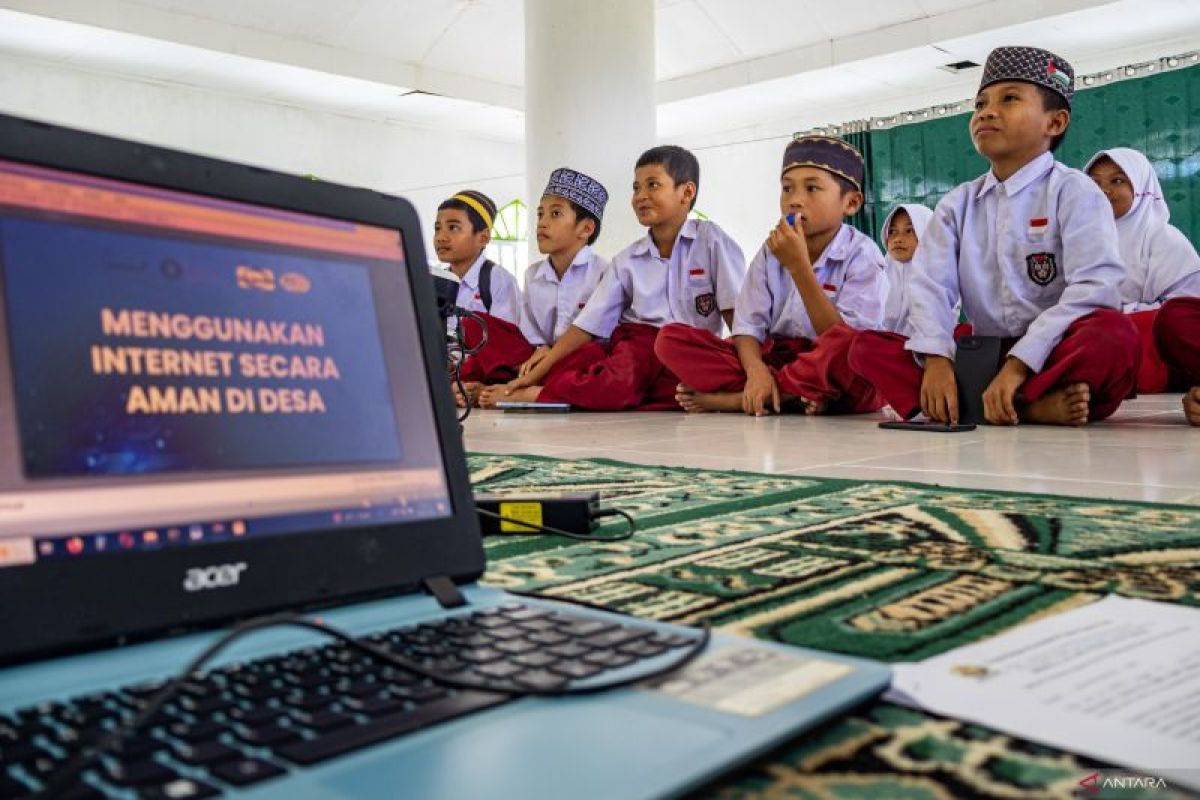
They were told that their next lesson would not involve looking at a blackboard as usual. Instead, they would use a projector to learn about digital literacy and responsible internet use.
For them and the people of Toro generally, internet access and digitalisation are like a “gift”. Residents of this village in a hilly valley have only truly enjoyed internet connectivity in recent years, through the Community Internet School. Although they had heard of the internet before, their understanding of it and ability to use it had been limited.
Fitri, the Community Internet School’s coordinator, said that a session on responsible internet use was initially planned for the school. But at the same time, their hamlet was scheduled to lose power.
Undeterred, the 27-year-old and several colleagues approached the mosque committee for permission to use its space and facilities. Equipped with a laptop and projector, they went ahead with the digital education session for children.
The lessons covered a range of digital literacy topics, including how to recognise and guard against hoaxes, safe and healthy internet use, and the potential dangers of misusing technology.
Fitri said the Community Internet School was established in 2024 by local young people who wanted to build a digital village in their hometown. The initiative grew out of collaboration between Fitri and her colleagues and two non-profit organisations, Roa Jaga Roa and Common Room.
The three parties formally established the Community Internet School. At the outset, its eight organisers received training in basic knowledge and technical skills, including operating internet services and installing network cables.
When she started the Community Internet School, Fitri lacked confidence. Technical work such as installing internet cables is often associated with men, she said. But she overcame her doubts in pursuit of one goal: to help Toro progress and become a model digital village in Sigi regency and even Central Sulawesi.
Her determination was driven by sympathy for village children who struggled to access knowledge and information from the outside world.
When practical exams required a computer or an internet connection, children from Toro had to travel about 85 kilometres to Palu. The journey was not only long but also difficult, involving a rough, potholed road through dense forest.
That was why Fitri and the Community Internet School’s members set out to bring Toro into line with other villages across Indonesia, particularly in internet access and digitalisation.
Fitri and her colleagues have since built an internet network and made a significant difference to the village.
Households whose members once went door to door to sell goods are now increasingly skilled at marketing their products through online marketplaces and social media. In education, children no longer need to travel to Palu for exams because their school is connected to the internet.
Tourism and culture have also received a boost. Residents can now promote Toro’s natural and cultural assets to an international audience. Farmers, meanwhile, are learning to search online for information on the right planting season, fertiliser choices and modern farming techniques.
“Even motorbike mechanics here sometimes watch YouTube tutorials on how to repair motorcycles,” Fitri said.
She said these advances depended on using the internet wisely, safely and appropriately. However, she acknowledged that Toro still needs better facilities and infrastructure to become truly self-sufficient and eliminate areas without coverage.
Internet education
As one of the Community Internet School’s founders, Fitri feels responsible for ensuring that Toro residents stay safe online and are protected from the harmful effects of internet misuse.
To prevent online fraud, online gambling and the spread of harmful content, the Community Internet School has made internet education one of its priorities.
Fitri said some residents lost as much as Rp1 billion to online fraud in 2025. Learning from that case, she and the organisers stepped up digital literacy efforts to prevent further victims.
“The education is producing results. In several hamlets we have visited, there have been no further victims of online fraud,” Fitri said.
Local teachers have warmly welcomed the Community Internet School. Nurlia, a teacher at Alkhairaat Toro, said it had been a great help. Before the group was established, teachers had to travel to neighbouring villages, or even Palu, just to get a reliable internet connection.
One tangible benefit, Nurlia said, was that teachers could more easily prepare learning materials and use digital teaching tools with their pupils.
She also praised the Community Internet School organisers for their commitment to educating village children without any financial reward.
Nurlia said the organisers’ digital literacy lessons had made a considerable difference to the children. Thanks to the training, they were beginning to understand how to use the internet responsibly.
“Children can now, to some extent, distinguish good information from bad,” Nurlia said.
Nevertheless, Nurlia recognises that dangers remain behind the screen. The school therefore strictly prohibits pupils from bringing mobile phones to school.
For certain lessons, however, pupils may use devices under close teacher supervision. To strengthen protection against the internet’s harmful effects, the school also teaches parents to enable two-step verification on their children’s devices.
Parents are also encouraged to use parental-control apps to monitor their children’s digital activity at home.
Wahyu Agus Pratama, head of the Central Sulawesi Communication, Informatics, Encryption and Statistics Office (Diskominfosantik), described Toro as an example of good practice in establishing a digital village.
He said the Community Internet School aligned with the provincial government’s Berani Berdering programme, a policy initiative intended to extend internet access to remote areas.
In 2026, the Central Sulawesi Provincial Government allocated Rp10.3 billion to Berani Berdering. It aims to connect 150 villages this year. Sigi and Tojo Una-Una regencies have each been allocated coverage for 15 villages, while other regencies will each receive a quota of 12 villages.
The larger allocations for Sigi and Tojo Una-Una were made because both regencies had recently been removed from the list of underdeveloped areas.
Wahyu hopes the Community Internet School in Toro will continue to develop the village’s potential and work in step with the Berani Berdering programme.
Source: jawawa.id (https://jawawa.id/newsitem/a-look-at-a-community-internet-school-in-a-remote-corner-of-sulawesi-1792032740)
Originally published by Antara (Indonesian) (https://www.antaranews.com/berita/5787401/menilik-sekolah-internet-komunitas-dari-pelosok-tanah-celebes), translated from Indonesian