
A Long Night for 640 Evacuees on Sukun Island after the NTT Earthquake
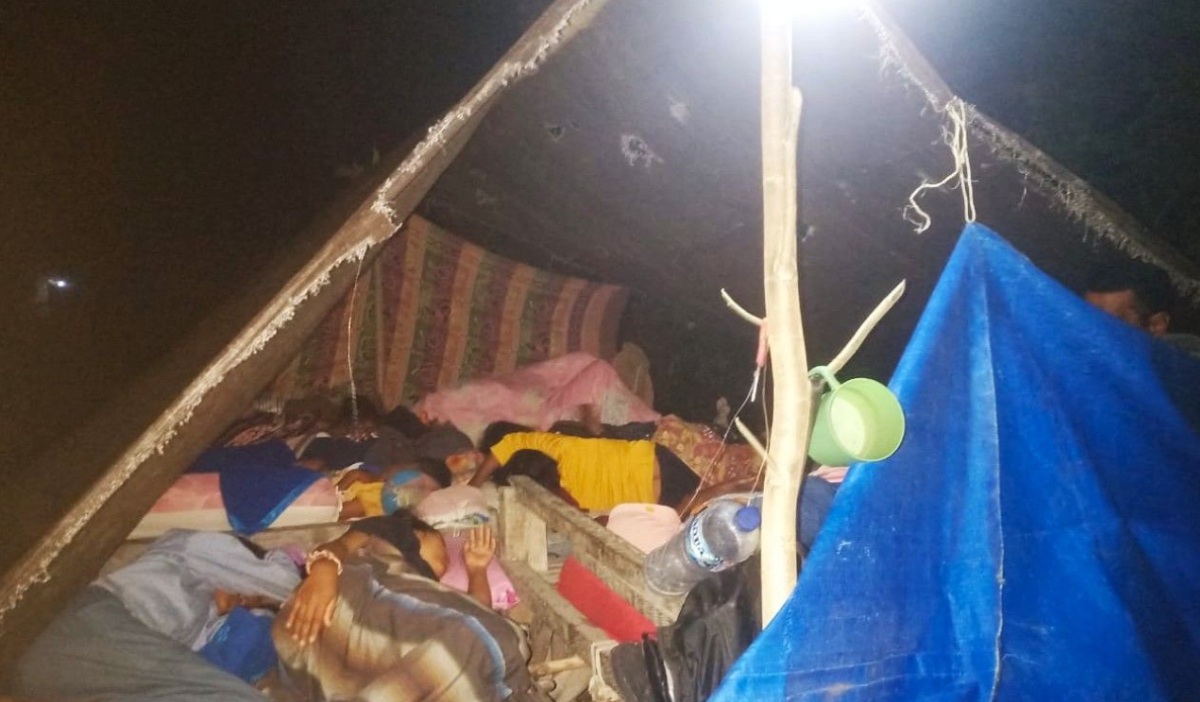
Lamp light reflects off the blue tarpaulin walls of tents erected on the highlands of Sukun Island, Samparong Village, Alok District, Sikka Regency, East Nusa Tenggara (NTT). Inside, residents lie close together. Children, women and men sleep on mats with whatever bedding they could gather.
Some clutch belongings they managed to bring from their homes when they fled following the magnitude 7.7 earthquake on Saturday morning (15/8). In fact, their houses are still standing. There have been no reports of severe damage, only light cracks in a number of buildings.
But for residents, cracks in the walls are not the only reason to leave. The aftershocks that continue to be felt have also shattered their sense of safety. So on the higher ground, emergency tents have been erected. A total of 640 residents from 310 families are now sheltering there.
At night, the tents become a shared sleeping space. There are no rooms, no adequate partitions. Everyone lies close together, trying to rest after days filled with vigilance.
“They are staying in tents, on the highlands, around the hilly area,” former Samparong Village Head Darmsyah Putra told Media Indonesia.
Meanwhile, in one corner of the evacuation site, two women sit on the ground. In front of them, pots and cooking utensils are arranged among buckets, jerry cans and plastic containers. Under makeshift lighting, they prepare food for their families.
The open ground has become a cooking area. Nighttime is now when they complete tasks that were previously done at home. Such scenes show how the earthquake has changed life on Sukun Island in an instant.
Day and night are now spent outside their homes. Emergency tents serve as sleeping quarters, while open spaces are used for cooking and carrying out daily needs.
However, the problems facing residents did not arrive only with the earthquake. Amid the displacement, the most urgent need is actually drinking water and clean water. That need has grown even greater as hundreds of people gather and live together at the evacuation site.
“The urgent need for the people of Sukun Island is a shortage of drinking water, including sanitation facilities. Water for drinking and clean water is indeed the basic constraint in Samparong,” said Darmsyah.
For the residents of Sukun Island, water shortages are not a new problem. Before the earth shook, they were already accustomed to facing limited drinking water and clean water. The earthquake has only made the old problem worse.
At the evacuation site, water is needed for almost everything: drinking, cooking, bathing and washing. When all residents are in the same place, that need becomes far greater.
Five days after the earthquake, on Wednesday night (19/8), logistics from the Sikka Regency Disaster Management Agency (BPBD) were sent to Sukun Island using a boat owned by residents. Food supplies were transported across the sea to the island.
But the need for clean water and drinking water has not been fully addressed, nor has the communications problem. “If we want to make a phone call, we have to climb the hill,” he explained.
Sukun Island is a single island whose entire territory makes up Samparong Village. It lies about 54 nautical miles from Maumere and about 32 miles from Palue Island. The distance and geographical conditions mean access to the island is not always easy, especially in emergency situations.
On the island, residents also live with limited mobile phone network coverage. A base transceiver station (BTS) that was available a few years ago is no longer functioning. When they need a signal, residents must find higher ground.
“There is no Telkomsel transmitter. Indeed, two or three years ago there was a BTS, but the problem is it could not function optimally, and it has even been deactivated,” said Darmsyah.
These limitations became a serious problem when the earthquake struck. Information about the condition of residents and the needs of evacuees cannot always be conveyed immediately. In an emergency, when communication is one of the primary needs, residents must instead search for a signal at the top of a hill.
Darmsyah hopes the telecommunications network problem on Sukun Island will receive attention. For residents, a signal is no longer merely a need for talking with family, but also a way to convey news and request help when an emergency arrives.
The night continues over the hills of Samparong Village. Inside the tents, residents try to sleep. Outside, some are still preparing food and tidying up their families’ needs. The lamp light is one of the markers of life amid the darkness of the night.
Source: jawawa.id (https://jawawa.id/newsitem/a-long-night-for-640-evacuees-on-sukun-island-after-the-ntt-earthquake-1787223063)
Originally published by Media Indonesia (https://mediaindonesia.com/nusantara/924008/malam-panjang-640-pengungsi-di-pulau-sukun-setelah-gempa-ntt), translated from Indonesian