
A Diploma's Journey Across the Republic
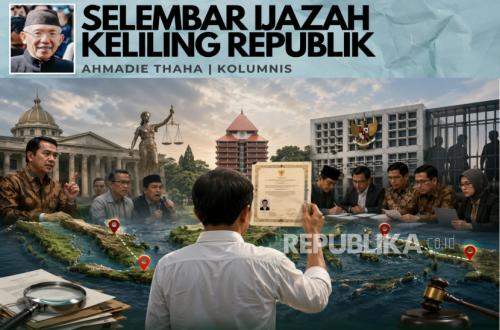
Some diplomas are done with their purpose the moment their owners graduate. Others, decades after being issued, must still attend a kind of supplementary course that has been running for more than two years, and it is unclear when it will end.
The diploma entered the public sphere. It then became a matter at the police station, the general court, the administrative court, the Central/Regional Information Commission, was mentioned at the Constitutional Court, and has now reached the Election Organiser Ethics Council (DKPP).
If documents could complain, perhaps the diploma in the name of Joko Widodo would have already requested academic leave. Its latest chapter took place on Tuesday, 21 July 2026. The DKPP held a hearing for case Number 11-PKE-DKPP/VII/2026.
The complainant this time is Bonatua Silalahi. Those reported are KPU Chair Mochammad Afifuddin along with five KPU members: Yulianto Sudrajat, August Mellaz, Betty Epsilon Idroos, Idham Holik, and Parsadaan Harahap.
To be clear: the DKPP is not adjudicating whether Jokowi’s diploma is genuine or fake. DKPP Chair Heddy Lugito stressed that the examination concerns the personal ethical conduct of the KPU commissioners over alleged violations. However, the entry point to the case remains that old item: Joko Widodo’s candidacy documents.
Bonatua is questioning the diploma sheet as one of the documents used by Jokowi since his candidacies for Mayor of Surakarta in 2005 and 2010, Governor of DKI Jakarta in 2012, and President in 2014 and 2019.
Among the issues raised by Bonatua is a legalised photocopy of the diploma which allegedly does not include the legalisation date, the identity of the signing official, as well as the management and handover of the archive to the archival institution.
Note the word ‘allegedly’. This is important so that we do not pre-empt the trial. The DKPP is examining whether there was an ethical violation in the management of the document, not acting as a forensic laboratory for the diploma.
Yet therein lies the great irony. A question that initially seemed simple about a diploma has grown into a tree of cases with branches spreading everywhere. There are criminal, civil, public information disputes, state administration, archival matters, and now election organiser ethics. The diploma is just one sheet. The case file might already require an entire filing cabinet.
In fact, UGM leadership has repeatedly conveyed its official position. They state that Joko Widodo is recorded as a student of the Faculty of Forestry at UGM with student number 80/34416/KT/1681, entering in 1980 and graduating on 5 November 1985. Officials of the Faculty of Forestry at UGM also assert that the diploma and his thesis are genuine.
But apparently, in Indonesian political life, a statement from the institution that issued the diploma does not automatically stop the diploma from wandering. This polemic is like a lizard: one tail of the problem is cut off, and another grows in its place.
When the question of whether he attended university was answered, the question moved to the thesis. From the thesis, it shifted to the typeface. From there, it moved again to the legalised photocopy, the legalisation date, the civil servant ID number of the signatory, the existence of the archive, and the handover of the archive to ANRI.
Some of these questions are certainly legitimate to ask. The candidacy documents of a public official must indeed be orderly and verifiable. Democracy precisely requires an administration capable of answering even the most fussy person with data, not annoyance.
Bonatua himself is trying to seek truth and justice by pursuing a number of legal avenues. He brought the matter through an information dispute, so that in January 2026 the Central Information Commission declared that the copy of Jokowi’s diploma used as a requirement for the 2014–2019 and 2019–2024 presidential candidacies is open information.
In a different case against ANRI, the Information Commission previously stated that the requested document was not yet controlled or documented by ANRI.
So the problem now is bigger than the question of whether Jokowi’s diploma is ‘genuine or fake’. The question is: why does a country need such a long legal journey to explain the history of one document that has been used repeatedly in the candidacy of a public official?