
A Dignity Nearly Toppled
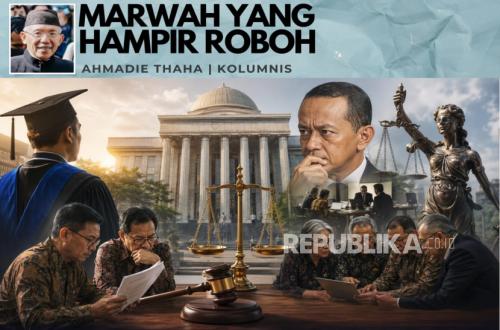
In a village, elders once taught their children a simple lesson. If the scales at the market begin to cheat, do not only blame the trader. Check also who made the scales. For a faulty scale makes every transaction appear valid, when in truth it is flawed.
A university operates on the same principle. It is the scale of knowledge. Once its scales become unsteady, what is at stake is not merely a diploma, but the entire public’s trust in the educational institution that issued it.
Therefore, the Supreme Court’s decision to grant Universitas Indonesia’s appeal in the ethical sanctions case against the promoter and co-promoter of Bahlil Lahadalia’s dissertation is not just a procedural victory. It marks the end of a long chapter that has shaken Indonesia’s academic world since late 2024.
After passing through a series of tortuous processes—from an internal investigation, the rector’s decision, a lawsuit to the Administrative Court, the plaintiffs’ victory at the first level, to the cassation appeal—this case has finally obtained legal certainty. The ruling is now legally binding, serving as the culmination of the search for justice through the path taken.
Many people mistakenly perceive this case as concerning only one political figure. In reality, the core issue is far larger. What has been at stake from the beginning is not merely Bahlil’s name, but whether a university still possesses the right and the courage to guard the fences of its own academic integrity.
When a higher education institution imposes ethical sanctions on two promoters and a co-promoter based on an internal mechanism, can that decision be overturned so easily without considering the academic autonomy guaranteed within the higher education system?
That is precisely where the importance of the Supreme Court’s ruling lies. The highest court was not assessing the quality of the dissertation’s content nor determining which scientist was correct. What was confirmed is that Universitas Indonesia has the legitimate authority to enforce ethical rules born from its own institutional mechanisms.
This Supreme Court ruling serves as an important message to all higher education institutions that maintaining academic quality is not merely a right, but an obligation.
The case, which began in 2024, leaves behind no small irony. Universitas Indonesia is a campus that for decades has been a symbol of Indonesia’s academic excellence. Yet it was from there that the public witnessed how a doctoral education process could raise serious questions.
The Board of Professors’ investigation found alleged violations in Bahlil’s dissertation, including dishonesty in the use of data, an accelerated academic process, and a conflict of interest between the student and his supervisors.
It was these findings that subsequently led to administrative sanctions against the promoter and co-promoter, while Bahlil, as a student, was required to revise his dissertation and his doctoral degree was suspended.
Interestingly, when the Administrative Court’s previous ruling annulled those sanctions, the unease actually came from within UI itself. More than three hundred professors submitted an amicus curiae. They were not defending a person or attacking another party. They were defending a principle.
If a university loses the authority to enforce its own ethics, then every future academic violation need only be brought to an administrative court to erase the sanctions. The campus would be reduced to an ordinary lecture building, no longer a home of knowledge.