
A Digital Resolution for Santri in the Digital Age
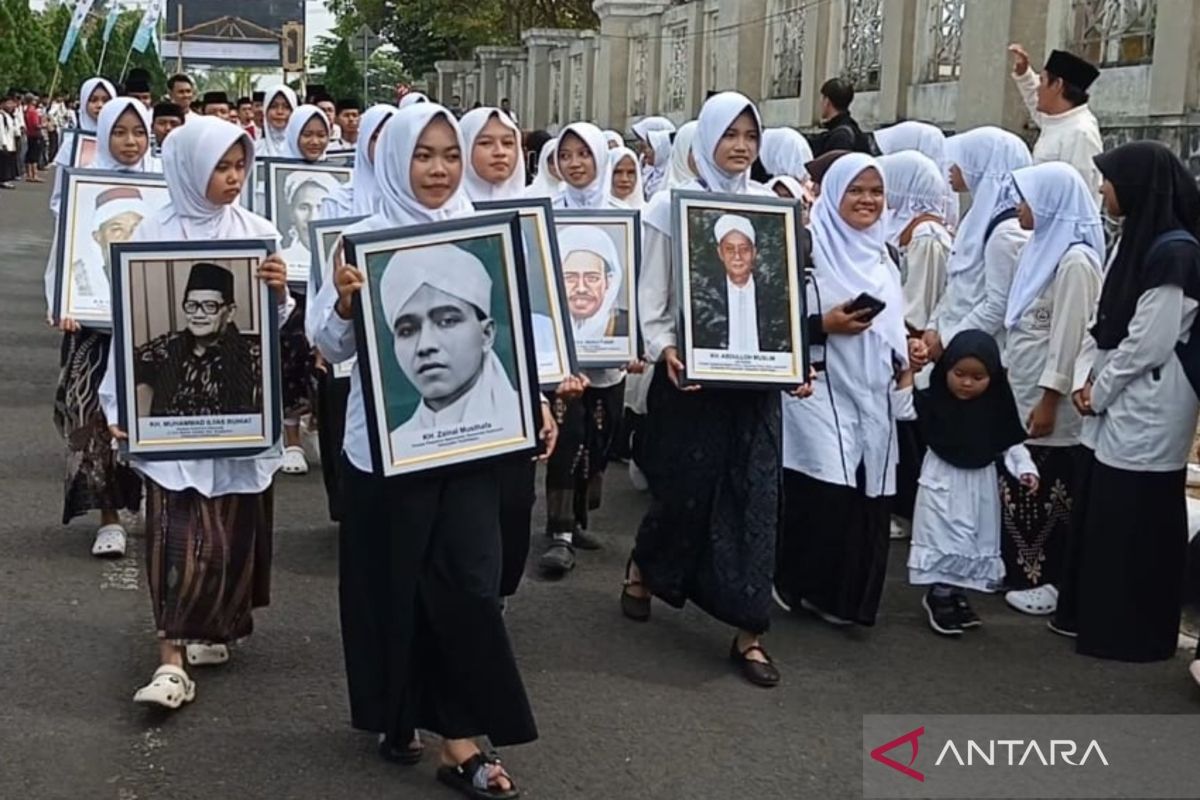
Jakarta (ANTARA) - National Santri Day (HSN) is commemorated in Indonesia every year on 22 October. The observance began in 2015, under Presidential Decree No. 22/2015 on National Santri Day.
The decree states that HSN aims to commemorate the role of santri in fighting for and defending Indonesia’s independence. The proposal came from the pesantren community itself, to honour the contribution of santri to independence and to emulate and continue the role of ulama and santri in striving for the Unitary State of the Republic of Indonesia (NKRI).
National Santri Day was first proposed by Pesantren Babussalam in Banjarejo village, Malang, East Java, in 2014, during a visit by Joko Widodo, who was not yet president. Jokowi promised the santri that he would pursue their proposal to designate 1 Muharram as National Santri Day.
On the same day, Jokowi signed a commitment to establish National Santri Day on the proposed date. The Executive Board of Nahdlatul Ulama (PBNU) proposed another date, 22 October, because it was linked to the history behind the fatwa and Jihad Resolution issued on 22 October 1945.
PBNU’s proposal referred to the jihad fatwa and Jihad Resolution issued by KH Hasyim Asy’ari to defend Indonesia’s independence after the country was attacked again by Allied forces. Once president, Jokowi designated 22 October as National Santri Day through Presidential Decree No. 22/2015, dated 22 October 2015.
On the jihad fatwa and Jihad Resolution that underpin National Santri Day, KH Abdul Hakim Mahfudz (Gus Kikin), PBNU’s general chairman for 2026–2031 and the great-grandson of KH Hasyim Asy’ari, said that Hasyim issued the fatwa twice, before and after the Jihad Resolution.
Gus Kikin said the first jihad fatwa was issued on 17 September 1945, two days before the Dutch flag was torn down at the Yamato Hotel (now the Majapahit Hotel) in Surabaya on 19 September 1945. The Allies wanted to reassert their control after Japan’s defeat in the Second World War, which meant Indonesia would “return” to its former colonial rulers under the Treaty of Vienna.
The Jihad Resolution was then formulated by ulama at the HBNO building (now the Surabaya PCNU building) on 22 October 1945. It prompted four days of fighting, from 27 to 30 October, which killed General Mallaby and led the Allies to issue an ultimatum demanding that the people of Surabaya surrender immediately.
The second jihad fatwa, issued on 9 November 1945, urged people not to surrender and prompted them to travel to Surabaya ahead of the Battle of 10 November. The fighting continued through 100 days of guerrilla warfare, after which the Allies withdrew. This was followed by the Round Table Conference, which ultimately recognised Indonesia’s independence.
Gus Kikin recounted this history at the launch of the 2026 National Santri Day programme by the East Java PWNU at Pesantren Sunan Bejagung in Tuban on 11 October 2026. He also described the keys to the santri’s success in the independence struggle: unity, deliberation, reminding one another, trusting each person’s expertise and helping one another.
“These principles of success were also set out by NU from the outset through its Qanun Asasi, or foundational constitution, in 1926–1930, and the idea behind MIAI, which brought 13 organisations together in a federation on 21 September 1937, including in the struggle for independence. The essence is togetherness,” he said.
The role of santri in independence, commemorated through National Santri Day since 2015, highlights their contribution to the struggle and to the realisation of the ideals of independence and development through unity and the Jihad Resolution.
A digital Jihad Resolution
In today’s digital context, the role of santri is no longer a physical Jihad Resolution but a digital one. Acting chair of the East Java PWNU’s executive board, KH Firjaun Barlaman (Gus Firjaun), said santri are needed in the digital technology era to bring technology together with morality.
Santri, he said, have always played a role in Indonesia without being asked. Their contribution is needed now just as it was during the independence struggle, because technology without morality can become a disaster. Gus Firjaun delivered the message at the launch of the East Java PWNU’s 2026 National Santri Day programme at Pesantren Sunan Bejagung in Tuban on 11 October 2026.
Santri have at least five roles in the digital era: spiritual, intellectual, entrepreneurial, leadership and global. The spiritual role involves providing a foundation of faith and good character in the digital age, since technology without morality can become a disaster.
The intellectual role concerns santri’s contribution across fields of knowledge, including healthcare, innovation and digital literacy, so that people do not remain merely consumers of technology made elsewhere. The entrepreneurial role involves building independent businesses rather than depending on others.
The leadership role means becoming leaders who are not only eloquent but also possess the integrity and morality Indonesia needs, rather than pursuing office without a vision. The global role means extending santri’s reach beyond regional and national boundaries to the international stage.
Together, these five roles position santri as important figures in shaping the digital era, which in santri terminology is called Yaumul Harj, or an uncertain and chaotic time. They can bring religious knowledge and morality to an age in which not only technology, but people too, should advance.
In this context, santri are needed to pursue what might be called a digital Jihad Resolution: a commitment to digital piety, ensuring that the digital era is not defined solely by technological progress, but also by moral responsibility. This is particularly important amid misleading framing, hoaxes, bullying and the careless use of unverified content.
Pesantren, the “homes” of santri, now have a Directorate General of Pesantren, formally established under Presidential Regulation No. 18/2026. This enables more independent policy-making and implementation in pesantren education, preaching and empowerment, including the use of technology to extend the benefits of knowledge and preserve tradition rather than replace human character and responsibility.
Technology can also strengthen pesantren’s areas of expertise, including Arabic studies, writing, preaching and Islamic literacy. Santri could develop Arabic-learning applications, library management systems, or tools to document manuscripts and cultural heritage, rather than allowing technology to weaken pesantren’s standing, as the allegations of bribery at NU’s 35th congress at Pesantren Tambakberas in Jombang from 27 to 31 August 2026 were said to have done.
Surabaya PCNU chairman Ir KH Masduqi Toha said allegations reported to the Corruption Eradication Commission (KPK) by PCNU Sekadau in West Kalimantan—concerning alleged bribes of Rp40 million—and PCNU Nias—concerning alleged bribes of Rp250 million—as well as claims by Gus Lilur that the alleged bribes came from Nusron Wahid of the Ministry of Agrarian Affairs and Spatial Planning/National Land Agency, were untrue. He also denied claims that congress participants had been confined at the Surabaya Hajj Dormitory. “The bribery allegations mention US dollars, but there were no dollars at the congress. The claim that participants were confined at the Hajj Dormitory is also false; it was simply used to accommodate participants who arrived early, while the venue at the pesantren was not ready,” he said.
Santri’s moral tradition, a strength of pesantren, can distinguish technology education, including artificial intelligence (AI) education. AI can generate text, summarise reading, translate languages and answer questions quickly, but santri’s good character can help them question answers that may not be accurate. AI can present false information, mix facts with speculation or ignore context. That is the digital Jihad Resolution for the present era.