
A Digital Doomsday
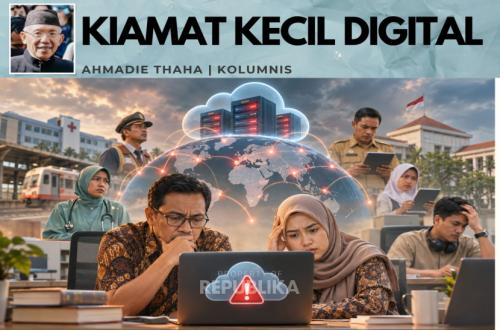
Imagine waking up one morning, opening your computer, and finding that you cannot access your email. Documents will not open. Online meetings fail. Your calendar has disappeared. Your AI assistant cannot work.
You try to contact the IT department, but its staff are facing the same problem. Now imagine this happening simultaneously in 74 countries.
That is what happened on 12–13 November 2026. A major disruption to Microsoft services left millions of users struggling to access Outlook and several Microsoft 365 services.
Teams, Copilot, SharePoint and other services dependent on related infrastructure were also affected. Reports of outages came in from 74 countries and territories in the space of about an hour.
Hospitals, companies, government institutions and various public services felt the effects. A world that had seemed permanently connected suddenly lost some of its communication tools.
What is alarming is that the incident did not begin with a cyberwar. No hacker launched an attack. Microsoft found that a number of servers had experienced problems and were unable to handle user requests.
As the remaining servers took on a heavier load, some of them also ran into trouble. Attempts to bring servers back online were not always successful, as those that recovered became overwhelmed by incoming requests.
We may not need to understand all the technical complexities. The bigger question is much simpler: why can modern life be so disrupted just because one technology company runs into problems?
We tend to think of Microsoft as a collection of products. Outlook for email, Word for writing, Excel for calculations, Teams for meetings, OneDrive for storing documents and Copilot for helping with work.
But these services form an interconnected ecosystem. When part of its foundation fails, other services are dragged down with it. This is what is known as a cascading failure.
Imagine a city with thousands of homes, all supplied with water through a single main pipeline. The homes may be different, their owners may be different, and their residents may have different needs. But if the main pipe breaks, they all face a problem.
That is what our digital dependence looks like today. In the past, companies managed their own computers and servers. If equipment broke down, the impact was limited to that organisation.
Today, many companies, schools, hospitals, universities and even government institutions entrust their digital operations to cloud service providers.
That choice makes sense. It is more cost-effective, easier to manage, and the providers have expertise and facilities that ordinary organisations would struggle to match.
But that convenience comes at a cost we rarely consider. We are handing more and more control to fewer and fewer technology providers.
Amazon, Microsoft and Google control much of the global cloud infrastructure market. They have become something like the main motorways of global digital traffic. When one of them suffers a disruption, the effects can cross national borders and reach every sector of life.
Source: jawawa.id (https://jawawa.id/newsitem/a-digital-doomsday-1794703841)
Originally published by Republika (https://opini.republika.co.id/berita/toina5415/kiamat-kecil-digital), translated from Indonesian