
A Difficult Choice: Optimising the Operational Role of Indonesia's Aircraft Carrier
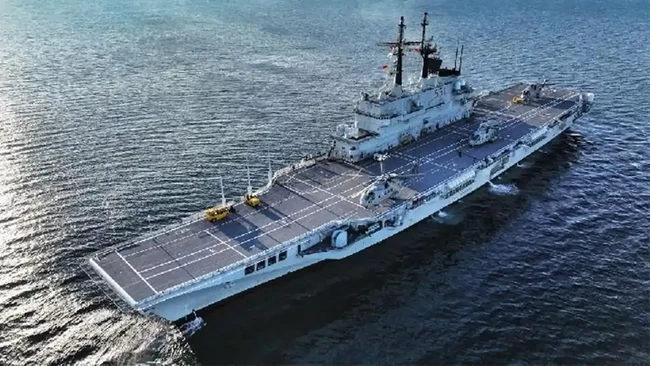
The plan to procure the former Marina Militare vessel ITS Giuseppe Garibaldi is one of Indonesia’s defence modernisation programmes that has sparked debate. Issues under discussion include whether Indonesia needs an aircraft carrier, its position within the Indonesian Navy’s operational concept, the logistical support capabilities required, and the vessel’s age, having served in the Italian Navy from 1985 to 2024. Such debate is natural, as defence falls within the public domain involving state funds. Moreover, on 12 September 2025, Finance Minister Purbaya Yudhi Sadewa approved a Financing Source Determination (PSP) of US$450 million to support the carrier acquisition programme.
Regardless of the pros and cons surrounding the acquisition of ITS Giuseppe Garibaldi, there are several matters the Ministry of Defence and the Indonesian Navy must anticipate before the transfer agreement between Indonesia and Italy is signed. Such anticipation is crucial so that Indonesia has a clear plan for utilising the light carrier once the transfer is executed. This is important because the Indonesian Navy has never operated an aircraft carrier, and the planned use of the former Italian carrier must be based on realistic, not merely ambitious, considerations. What should Indonesia anticipate before Italy officially transfers the 180-metre-long, 33.4-metre-wide carrier?
First, heavy maintenance. ITS Giuseppe Garibaldi last underwent heavy maintenance in 2014, so it must undergo another heavy maintenance phase before being operated by the Indonesian Navy. Funding for the carrier’s heavy maintenance is already covered within the US$450 million PSP, leaving the Ministry of Defence to decide which contractor will receive the contract for this activity. Considering the construction history of ITS Giuseppe Garibaldi and the heavy maintenance activities performed during its service with the Italian Navy, it would be both logical and wise for the Ministry of Defence to award the heavy maintenance contract to Fincantieri. It is an undeniable fact that besides the Italian Navy, Fincantieri is the party that knows precisely the technical condition of ITS Giuseppe Garibaldi’s various subsystems. Indonesia should leverage Fincantieri’s experience and knowledge by awarding the maintenance contract so the Indonesian Navy can still use the carrier until 2040. Furthermore, no shipyard in Indonesia has the facilities to support the heavy maintenance activities for this carrier. The US$450 million foreign loan for ITS Giuseppe Garibaldi should not be squandered on poorly targeted heavy maintenance.
Second, the carrier’s operational concept. It is important to understand that ITS Giuseppe Garibaldi is a light carrier with a 14,000-ton displacement, not comparable to a 100,000-ton United States aircraft carrier. During its service with the Marina Militare, besides helicopter operations, the carrier supported AV-8B Harrier jet fighter operations using a short take-off and vertical landing (STOVL) scheme. Considering the carrier procurement plan does not include the purchase of STOVL-capable fighter aircraft, the most realistic operational concept for Indonesia is to employ ITS Giuseppe Garibaldi as a helicopter carrier. The idea from a few parties to convert the carrier into an Unmanned Aerial Vehicle (UAV) carrier must be approached with extreme caution, given that the unmanned aircraft carrier concept has never been tested by any navy in the world. Moreover, it is an empirical fact that the Indonesian Navy does not yet possess the capability or experience to operate fixed-wing land-based UAVs. Without this capability and experience, it is highly risky for the Indonesian Navy to suddenly leap into operating a UAV carrier, as launching and landing fixed-wing UAVs on a carrier deck is not a capability that can be built overnight. Behind an idea that a small group views as brilliant, the former carrier purchased by Indonesia should not become a guinea pig for a new and completely untested concept.
Third, preparing the operational concept. The Indonesian Navy must develop a carrier operational concept aligned with Indonesia’s national interests, as the Navy is an instrument of the state. Referring to national interests, the deployment of Indonesian Navy forces beyond sovereign territory is conducted for defence and broader diplomatic purposes. In line with the ongoing modernisation of the Indonesian Navy through various ocean-going warship acquisition programmes, the presence of the former Italian carrier can be utilised to develop a defence operational concept based in the exclusive economic zone through joint operations. Indonesia must also prepare a carrier operational concept for diplomatic purposes, including non-combatant evacuation operations (NEO) for Indonesian citizens in flashpoint areas such as Taiwan and the Middle East. NEO using an aircraft carrier equipped with air assets.