
A cloth of remembrance for the victory at Sunda Kelapa
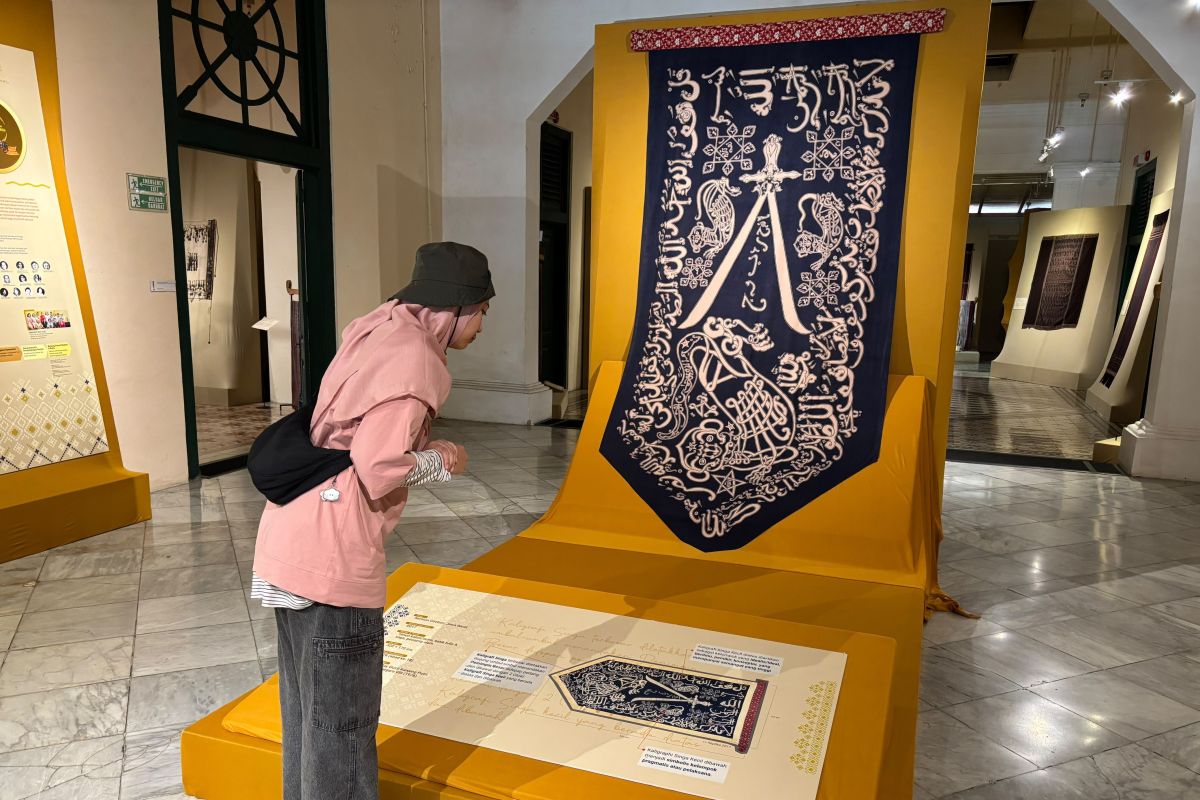
The Caruban Nagari banner of the Cirebon Palace, a symbol of both power and spirituality, holds significant value for Jakarta, formerly known as Sunda Kelapa. This cloth, laden with meaning, bears witness to the glorious victory of the war commander Fatahillah over the Portuguese at Sunda Kelapa. On 22 June 1527, a combined fleet from the Islamic kingdoms of Cirebon, Demak, and Banten, comprising 1,967 soldiers under Fatahillah’s command, succeeded in expelling the Portuguese fleet from Sunda Kelapa. The Caruban Nagari flew at the forefront of that battle.
The Caruban Nagari banner is made of white and blue cotton with one tapered end. It features calligraphy of a large lion and smaller lions, along with Surah Al-Ikhlas, Al-An’am verse 103, and Ash-Shaff verse 13, plus the sword of Zulfikar. The large lion calligraphy is placed at the tip of the banner, signifying a great leader, positioned in front of the sword and guarded by two smaller lion calligraphies at the top and bottom of the cloth. The small lion at the top is interpreted as representing an idealistic, knowledgeable, thoughtful, and conceptual group with high spirits, while the lion at the bottom symbolises a pragmatic group. The Quranic verses on the Caruban Nagari signify help and victory that is near. Additionally, there are geometric ornaments in the form of stars, meaning light and guidance, and an eight-directional flower symbolising life and purity.
Nearly two and a half centuries later, in 1776, a replica of this historic cloth was made, measuring 322 x 172 cm, using the hand-drawn batik technique. The cloth was then donated by Gusti Kanjeng Putri Mangkunegara VIII in 1976 to the Jakarta Textile Museum and is one of the 500 inaugural collections and a source of pride for the museum. However, given the cloth’s age, the original collection is not permanently displayed in the exhibition hall but is stored specially to preserve it. To allow the public to see the banner’s form, the Textile Museum created a duplicate in 2011, measuring 310 x 196 cm.
The public can view this collection through the textile exhibition ‘Menjaga Warisan untuk Masa Depan’ (Safeguarding Heritage for the Future) at the Textile Museum, running until 30 August 2026. This exhibition is also held to celebrate the 50th anniversary of the museum and the Wastraprema Association. The Caruban Nagari is displayed alongside around 49 selected and prominent textile collections that hold historical significance for the nation and the Textile Museum, plus 12 special collections from the pioneer of ulos diversity, Torang Sitorus.
Among these collections is the Gajah Birawa long cloth from Surakarta, Central Java. Measuring 250 x 106 cm, it was made by R.A. Soemoharjomo, the mother of Tien Soeharto. The decorative pattern, called Gajah Birawa, consists of elephant, deer, and bird motifs flying among valleys. The elephant on the right faces left, while the elephant on the left faces right, as if mirroring each other. The elephant is considered a mighty and powerful animal, once used as a mount by kings and nobles.
On another side, there is the Bulu Hayam long cloth from Garut, West Java, measuring 264 cm x 105 cm, made in the 1950s, which was a grant from the family of Ali Sadikin. The Bulu Hayam (chicken feather) pattern, typical of Garut, is inspired by the beauty of chicken feathers. The pattern is arranged geometrically, forming curves resembling chicken feathers. The interior is filled with various isen-isen (ornaments) with Garut’s characteristic colour palette of cream, brown, and blue, and shapes resembling fish scales. This motif is also known as Sapu Jagat.
Not far from that cloth is the Tumurun Sri Narendra long cloth from Surakarta, measuring 250 x 105 cm, a grant from KRT Hardjonagoro (Go Tik Swan). This cloth features a Parang Rusak Gapit background created by Go Tik Swan Panembahan Hardjonagoro in 1978, as a pisungsun (gift) for Sri Susuhunan Pakubuwana XII on the occasion of his 32nd jumenengan (coronation anniversary, four windu on the throne). The decorative pattern is taken from the Surakarta royal emblem of a sun shining over the world, symbolising that a king must be a role model for his people.
Nearby, there is also the Sawunggaling long cloth, which serves as a visual attraction for visitors, according to the exhibition guide. This cloth from Surakarta, measuring 256 x 106 cm, features a fighting rooster motif, symbolising heroism, patriotism, nationalism, and romanticism. Dominated by red inspired by chicken blood, this noble work by Go Tik Swan Panembahan Hardjonagoro from the 1950s was made on the orders of Indonesia’s first president, Soekarno. At that time, the President desired a batik that embodied the values of patriotism, nationalism, and romanticism. Thus was created a batik design combining classical batik motifs with coastal colouring. Coastal batik, which developed along the northern coast of Java, such as in Pekalongan, Cirebon, Lasem, and Madura, has more dynamic and free motifs, bright colours, and is strongly influenced by foreign cultures due to trade interactions with China, India, Arabia, and Europe.
Not only batik, the exhibition also presents songket, tapis, and ulos, which are evidence of the beauty of the archipelago’s textile diversity. Visitors do not merely admire the beauty of textiles created by the nation’s artisans; they also gain an understanding of the cultural values, philosophy, and historical journey contained in each piece of cloth. As stated by the Head of the Art Museum Management Unit of the DKI Jakarta Culture Office, Sri Kusumawati, every textile tells a long story of cultural preservation built through the spirit of mutual cooperation, care, and love for the nation’s textile heritage. Therefore, it is hoped that through the ‘Menjaga Warisan untuk Masa Depan’ exhibition, the public, especially the younger generation, will become more familiar with and love the nation’s textile heritage, so that the spirit of preservation can continue in the future.
Source: jawawa.id (https://jawawa.id/newsitem/a-cloth-of-remembrance-for-the-victory-at-sunda-kelapa-1787788292)
Originally published by Antara (Indonesian) (https://www.antaranews.com/berita/5712765/selembar-kain-pengingat-kemenangan-di-sunda-kelapa), translated from Indonesian