
A Century Old, Dutch-Era Geothermal Well Is Still Active
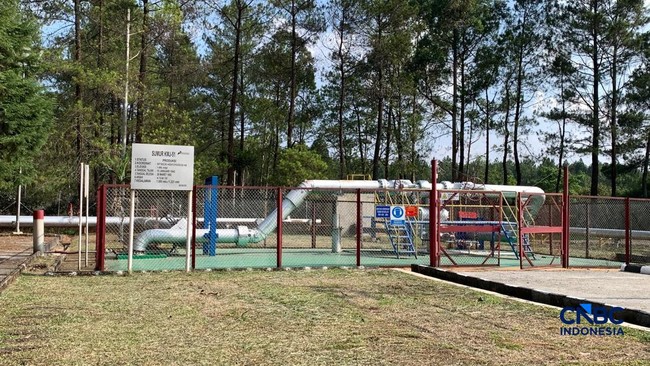
Bandung, CNBC Indonesia — A geothermal well dating back to the Dutch colonial era in the Kamojang area of West Java is still emitting steam despite reaching 100 years of age. The well is one example of Indonesia’s long history of geothermal energy use.
Known as Kamojang-3, the well was first drilled in 1926. A century later, the geothermal resource in the area remains active and is still being developed to support national energy needs.
Andi Joko, Operations Director of PT Pertamina Geothermal Energy (PGE), said Kamojang was a historic site in the development of geothermal energy in Indonesia.
“The first Kamojang-3 well was drilled in 1926, at the Kamojang Crater, and it may still be seen emitting steam just as it did 100 years ago,” he said during a field visit and discussion on geothermal development in Kamojang, West Java, on Tuesday (20 October 2026).
He said the well demonstrated the potential for geothermal energy to be used over the long term. Although the first drilling took place in 1926, commercial geothermal power generation at Kamojang began only in 1983.
Kamojang currently has five geothermal power plant units. Three are operated by PLN Indonesia Power, while the other two are operated by PGE.
“The plants in this area are still operating at a high utilisation rate to meet electricity demand, particularly on Java,” he said.
Why can geothermal energy last so long?
Professor Lambok M. Hutasoit, a professor at the Bandung Institute of Technology’s Faculty of Earth Sciences and Technology, explained that geothermal energy comes from heat inside the Earth, which warms water in underground rock formations. A geothermal system has three main components: a heat source, a reservoir where geothermal fluids accumulate, and the fluid itself, in the form of water or steam.
Professor Lambok said rainwater plays an important role in sustaining geothermal systems. Rainwater that seeps into the ground can reach deeper rock layers and be heated by the Earth’s internal heat.
“Where does the water come from? Rainwater. It enters the ground and is then heated by magma,” Lambok explained at the same event.
Once heated, the water becomes part of the geothermal system and can be used as an energy source. Lambok said geothermal energy has an advantage because heat from within the Earth is available over a very long period.
The natural supply of water also helps sustain the system. However, he stressed the importance of protecting water-recharge areas so geothermal energy can continue to be used.
He said recharge areas are where rainwater enters the underground system, making it important to monitor changes in environmental conditions there.
“Recharge areas must be protected. They must not be disturbed, and their capacity to absorb water must not be reduced,” he said.
Lambok also said geothermal energy has an advantage over some other renewable sources because it can provide a more stable supply. Unlike solar power, whose output is affected by the intensity of sunlight, geothermal power does not depend directly on daily weather conditions.
“Geothermal is stable,” he said, comparing the characteristics of geothermal and solar energy.
Because of these characteristics, geothermal energy can help provide a sustainable supply of electricity, he said.
Kamojang, a witness to Indonesia’s energy history
Tina Talisa, Special Staff to the Vice-President for Community Economic Empowerment and Social Development, said Kamojang was historically significant as the starting point for geothermal development in Indonesia.
“The beginning of geothermal energy in Indonesia was in Kamojang. It is now a century old,” Tina said.
She said the century-old well illustrated the potential of Indonesia’s energy resources. However, geothermal development, she added, was not just about generating electricity.
Power plants should also benefit local communities and the surrounding environment. Tina emphasised the importance of collaboration among government, companies, academics and communities to ensure geothermal development remains sustainable.
Kamojang is now not only a power-generation site but also an educational centre for geothermal energy through the Geothermal Information Center (GIC). Visitors can learn about how geothermal energy forms and how it is used to generate electricity.
A century after the first well was drilled during the Dutch colonial era, Kamojang remains an important part of Indonesia’s geothermal development. While the historic well continues to emit steam, the area is still being used to generate electricity and support activities in surrounding communities.