
A Century of the Gontor Spring
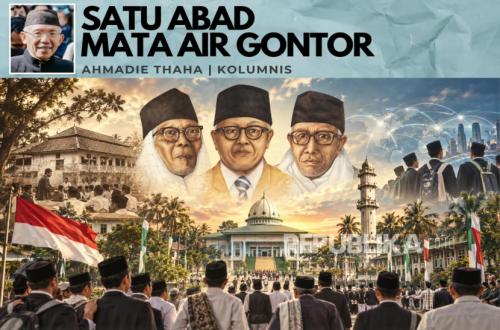
In Ponorogo, banners are fluttering, the grounds are fully prepared, stages are set, and the roads leading to Pondok Modern Darussalam Gontor are filled with the signs of a grand celebration. Students, teachers, committees, and alumni are working in a rhythm perhaps only understood by those who have lived in a pesantren. While the bustle might appear chaotic, it moves with true discipline.
Gontor is welcoming its hundredth year. Indeed, one hundred years is not merely a nice number to print on a banner; a century is a long enough span to witness significant change and transition. The peak of the Gontor centenary celebrations takes place from 18–20 September, with a thanksgiving reception and a grand reunion as the main agendas. President Prabowo Subianto has been invited to attend the climax of the event.
In addition to the President, several former vice presidents, ministers, leaders of Islamic organisations, kiai, pesantren caretakers, and ambassadors from friendly nations have also been invited. The scale of the preparations demonstrates that this is no small family reunion.
The series of events leading to the peak did not begin yesterday. There have been the Mahrajan al-Qur’an, the Intellectual Ulama Cadre Olympics, marching band competitions, sports, student film and music festivals, language championships, alumni tournaments, grand tabligh, and exhibitions. National pesantren kiai seminars and various alumni reunions have also taken place in various regions.
At the peak of the event, the khatmul Qur’an and prostration of gratitude (sujud syukur) involve elements of the boarding school, the campus, the alumni boarding school, and alumni, not all of whom are present physically. Therefore, those gathering at Gontor are not just people who once wore sarongs, peci, or scout uniforms in the same place. What is gathering is a network of memories, ideas, and service that has spread to various corners.
Gontor possesses alumni who have become ulama, teachers, lecturers, professors, bureaucrats, entrepreneurs, politicians, journalists, diplomats, pesantren caretakers, and community leaders. Some of them have established their own pesantren.
These alumni-led pesantren then produce further alumni, who in turn establish the next pesantren. Thus, an informal network is formed that we might imagine as the ‘parents, children, grandchildren, and even great-grandchildren of Gontor’.
In a family tree, such relationships are recorded through names and lineage. In the world of education, it often progresses through teachers, students, methods, curricula, books, traditions, and role models. An alumnus might not display the Gontor name at the gates of their pesantren, but they carry the teaching methods, the dormitory system, language discipline, student organisation, and educational outlook. The names may differ, but the traces remain easily recognisable.
This is where the meaning of Gontor’s hundred years transcends the age of an institution. It has become a sort of educational river. Its spring is located in a village in Ponorogo, but its flow finds many tributaries. Some irrigate pesantren, some enter universities, some flow into the bureaucracy, some into the business world, and some into societal spaces that were never designed in the original map. Interestingly, this river was not born from stagnant water; it was born from the courage to pursue renewal.