
A Century of Gontor: Preserving the Anchor of Tradition, Rowing the Oars of Global Transformation
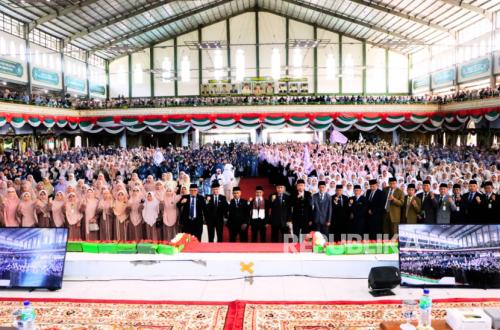
Time passes swiftly, yet the traces left upon the land of Darussalam remain eternal. Ahead of the peak celebrations for the 100th anniversary of Pondok Modern Darussalam Gontor, my memories suddenly return to the days of standing beneath the shadows of its iconic mosque minarets.
As someone fortunate enough to have sought knowledge and been a student there—even if only for a short time—there is an emotional vibration difficult to describe with words. My fate is similar to Muhaimin Iskandar (Cak Imin) and thousands of other alumni who may not have completed their studies until the final year, yet we all agree on one thing: we continue to partake in the same blessings.
Gontor has never differentiated between those who graduate and those who only stay briefly. The character instilled has already permeated our very marrow. Looking at Gontor on the threshold of its second century is not merely about celebrating the number one hundred. It is a moment of contemplation on how an educational institution, born from the womb of a small village in Ponorogo, has been able to transform into a centre of modern Islamic civilisation.
From a small prayer room, Gontor has now expanded into a giant institution with 21 branches across Indonesia, educating 16,000 active students, overseeing 18,000 souls when including teachers, and moving dynamically to reach an ecosystem of 22,000 people, including students and lecturers of the University of Darussalam (UNIDA) Gontor.
To understand the greatness of Gontor today, we must go back to 1926. Amidst the grip of Dutch colonialism and the stagnation of societal thinking, three brothers—KH Ahmad Sahal, KH Zainlamuddin Fananie, and KH Imam Zarkasyi—known as the Trimurti, laid the first stone of a radical vision.
At that time, pesantren in Indonesia generally only taught classical Islamic texts (kitab kuning) using traditional methods. The Trimurti broke those barriers. They became pioneers of modern boarding schools in their era by incorporating general subjects and geography into the pesantren curriculum.
This step initially triggered controversy and was viewed cynically by traditionalists. However, the Trimurti remained steadfast. Their philosophical foundation was that the Pondok is a field of struggle, not a place to seek a livelihood. It was this total sincerity of the Trimurti that serves as Gontor’s eternal fuel.
They did not bequeath this boarding school to their descendants as family property, but instead endowed it as a waqf (endowment) to the Muslim community in 1958. This was an unparalleled breakthrough in Islamic law and management at the time, ensuring that Gontor belongs forever to the community, not to a dynasty.
One of Gontor’s most contemporary unique features is its steadfastness in standing above and for all groups. Gontor accepts students from any mass organisations (ormas) without ever affiliating with any specific political party or organisation. In Gontory, the identities of “I am NU” or “I am Muhammadiyah” merge into one: I am a Gontor student.
Historical and sociological analysts of Islam would be fascinated by the unique fact that the two largest Islamic organisations in Indonesia were once led simultaneously by Gontor alumni. The late KH Hasyim Muzadi led Nahdlatul Ulama (NU), while Prof. Dr. KH Din Syamsuddin led Muhammadiyah. This phenomenon serves as authentic proof that Gontor produces unifiers of the community, not dividers.
From its cosmopolitan curriculum, intellectual giants and cultural figures who colour the nation’s direction have also emerged. We know Nurcholish Madjid (Cak Nur), who bridged Islam and Indonesian identity; Prof. Dr. Amin Abdullah, who revolutionised the integration-interconnection of sciences at UIN; and the charismatic cultural figure Emha Ainun Nadjib (Cak Nun), who teaches humanity through art. Gontor is a human laboratory that liberates the mind without uprooting the foundations of faith.