
A Century of Anak Krakatau: The History of Eruptions from 1927 to 2026
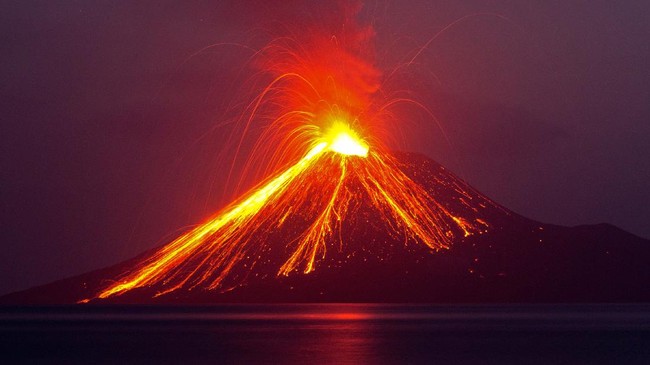
Anak Krakatau remains in a state of eruption and is currently at Alert Level III (Siaga). The volcanic activity was accompanied by loud explosions heard from the Pasauran Monitoring Post on Saturday night (5/9/2026).
Continuous eruptions of Anak Krakatau have been recorded from Friday (4/9/2026) at 23:07 WIB until the report was filed on Sunday (6/9/2026) at 00:31 WIB.
The impact of the Anak Krakatau eruption has expanded, prompting AirNav Indonesia to take action for flight safety. The air navigation authority has officially updated the NOTAM regarding the temporary closure of airspace at three airports simultaneously due to the massive spread of volcanic ash.
The three closed airports are Halim Perdanakutsuma Airport, Radin Inten II Lampung Airport, and Soekarno-Hatta International Airport (WIII).
Anak Krakatau and its Eruptive History
Anak Krakatau is one of the active volcanoes located in the Sunda Strait, Lampung. According to the Geological Agency of the Ministry of Energy and Mineral Resources (ESDM), this Type A volcano is considered young because it grew within the caldera formed after the massive eruption of the Krakatau volcanic complex in 1883.
Eruptive activity of Anak Krakatau began to be recorded in 1927, or nearly a century ago, when the mountain’s body was still underwater. Two years later, in 1929, the mountain began to emerge on the surface and has continued to grow through volcanic activity.
Since its emergence, Anak Krakatau has been in a construction phase, building its volcanic mass. In September 2018, its maximum height was recorded at approximately 338 metres above sea level. Its eruption characteristics generally consist of weak explosive magmatic eruptions (Strombolian) as well as effusive eruptions in the form of lava flows.
Activity was recorded again on 20 June 2016, followed by a Strombolian eruption on 19 February 2017. A year later, Anak Krakatau entered a long period of eruption starting from 29 June 2018, which lasted until the end of the year.
This series of activities shows that Anak Krakatau is still developing and building its structure. Because volcanic activity can increase again after periods of calm, monitoring seismicity, deformation, gas emissions, and surface activity is essential to anticipate potential eruptions.
With a long history of activity since emerging in 1929, Anak Krakatau remains one of the active volcanoes that must be monitored in the Sunda Strait region.
The Dark History of the 1883 Eruption
In August 1883, Mount Krakatau in the Sunda Strait underwent a massive eruption. The catastrophic eruption on 26-27 August 1883 remains one of the most terrifying eruptions in history.
The series of explosions began around 13:00 on 26 August, reaching its peak around 10:00 the following day. The explosion propelled ash up to approximately 80 kilometres into the atmosphere, and the sound was heard as far away as Australia, thousands of kilometres from Krakatau.
The magnitude of the eruption even had a global impact. Volcanic ash caused parts of the world to experience darkness for about two and a half days, while the average global temperature dropped by approximately 1.2°C. Its atmospheric impact even caused abnormal weather patterns to persist for several years.
The 1883 eruption also altered the landscape of the Sunda Strait. From the Krakatau caldera area, Anak Krakatau subsequently emerged, continuing to grow through volcanic activity.
The massive eruption of Mount Krakatau in August 1883 triggered a large tsunami that killed approximately 36,000 people. The tsunami waves were estimated to reach heights of around 30 metres, comparable to the height of a coconut tree.
However, amidst the disaster, some people managed to survive. One such survivor was Ong Leng Yauw.
At that time, Ong and thousands of residents from Banten and Southern Sumatra had actually heard rumbling sounds for about three months. However, they did not know where the sounds were originating from.
“The rumbling sounds from Krakatau had been heard for about three months, but at that time, no one knew where they were coming from,” Ong recalled when sharing his experience with Kwee Tek Hoay in the memoir titled Apa jang saja denger tentang kamandjoerannja klenteng Kwan Im di Bantam (1937).
The following is the history of the Anak Krakatau eruptions, cited from the Smithsonian Institution National Museum of Natural History Global Volcanism Program (GVP), the National Disaster Management Agency (BNPB), and the Geological Agency of the Ministry of Energy and Mineral Resources (ESDM).
Source: jawawa.id (https://jawawa.id/newsitem/a-century-of-anak-krakatau-the-history-of-eruptions-from-1927-to-2026-1788666815)
Originally published by CNBC Indonesia (https://www.cnbcindonesia.com/research/20260906091225-128-765419/seabad-anak-gunung-krakatau-ini-jejak-erupsi-dari-1927-hingga-2026), translated from Indonesian