
A Call for Leadership in the Era of Disruption
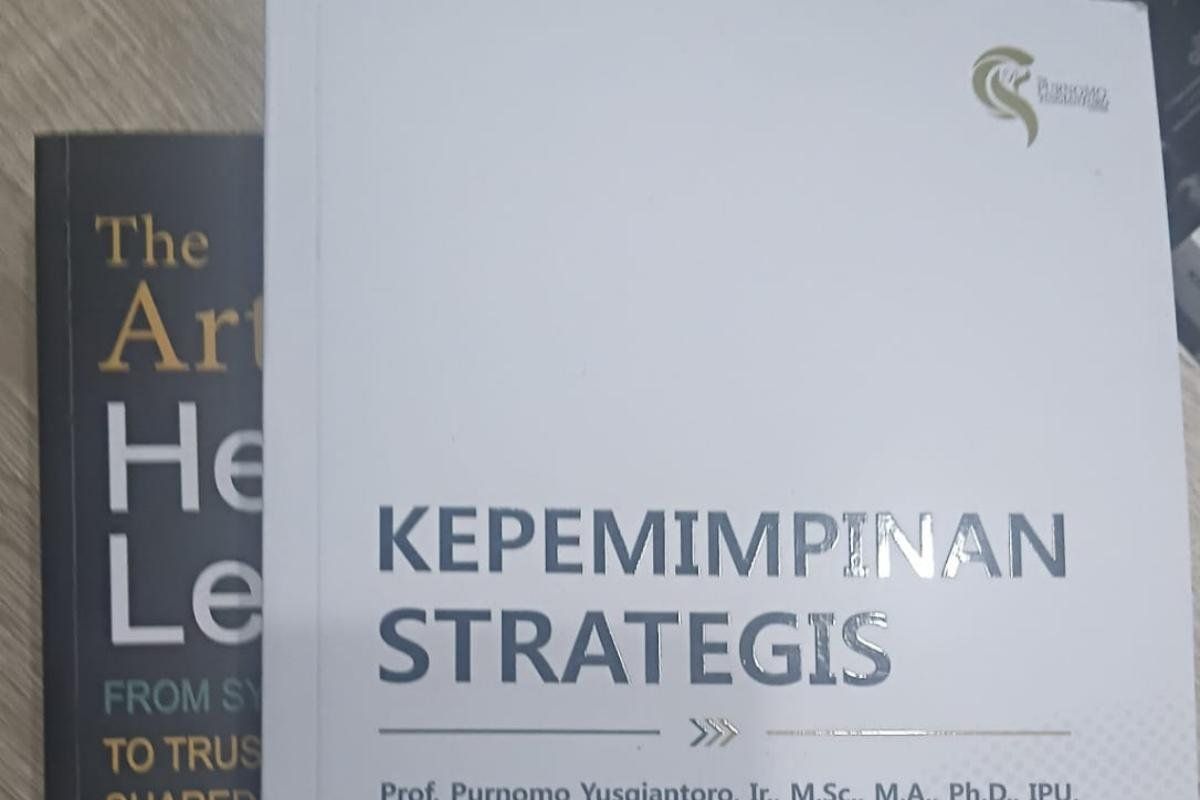
Amidst geopolitical uncertainty, ecological crises, and the acceleration of global digital transformation, leadership can no longer be conducted merely procedurally or by relying on short-term intuition. Indonesia requires a national and sectoral leadership architecture that is adaptive, rooted in national resilience, and capable of transforming the nation’s potential into real strength.
The book ‘Strategic Leadership’ by Prof. Purnomo Yusgiantoro, published in June 2026, serves as a fundamental guide to addressing these challenges. As an academic and practitioner who has led various strategic ministries and national research institutions, Prof. Purnomo presents a comprehensive synthesis of formal leadership theory, national resilience dynamics, and public policy.
To fully understand the scope of these ideas, this review incorporates perspectives from the book ‘The Art of Heroic Leadership’ by Zulfikar M. Rachman and Ahmad Mukhlis Yusuf (September 2026), published by IPB Press.
Core Ideas
In ‘Strategic Leadership’, Prof. Purnomo asserts that a strategic leader must possess three main pillars: visionary skills, institutional execution capability, and a comprehensive understanding of geopolitical and geostrategy dynamics. Leadership is viewed not as an instrument of personal power, but as the capacity to align various national elements—ranging from natural resources and governance to human resource potential—to maintain national sovereignty and sustainability.
Purnomo emphasises the importance of evidence-based decision-making and institutional strengthening. Strategic leaders are required to anticipate future scenarios, manage systemic risks, and coordinate various sectors that often operate in silos.
Perspectives from ‘The Art of Heroic Leadership’
While Prof. Purnomo Yusgiantoro’s work lays the macro foundation regarding what must be built and directed (structure, strategy, and national resilience), the work by Zulfikar M. Rachman and Ahmad Mukhlis Yusuf strengthens this with the depth of how inner capacity and human relationships are formed to support such leadership. There are three theoretical and practical points of convergence that enrich our understanding of Prof. Purnomo’s book.
First, from Systemic Blindness to Systemic Awareness. Prof. Purnomo highlights the danger of failing to read strategic environmental dynamics. In ‘The Art of Heroic Leadership’, this phenomenon is explained as ‘systemic blindness’—a condition where decision-makers only see surface symptoms without realising the interconnected root causes. Effective strategic leaders must be able to transition from systemic blindness to systemic awareness. National leadership requires not only formal data analysis but also the courage to look inward so that decisions truly address the real reality of the community.
Second, heroic leadership interpreted as the synergy of organic leadership and sustainability. Heroic leadership in ‘The Art of Heroic Leadership’ is not interpreted as a solitary, individualistic hero. Instead, leadership is reintroduced as a collective capacity to build trustworthy shared action. This concept enriches Prof. Purnomo’s strategic leadership by suggesting that even the most advanced national strategies will stagnate without trust and the revival of ‘gotong royong’ (mutual cooperation) as collective intelligence.
Third, transformation methodology and the HEROIC rhythm. To execute Prof. Purnomo’s strategic vision, ‘The Art of Heoric Leadership’ offers methodological tools based on awareness-based systems change (such as 3D Mapping and Quantum Mapping) and the HEROIC rhythm (Heartful flow state, Envisioning, Reality check, Options Exploration, Implement strategies, and Commitment to Stewardship). These tools allow both macro and micro leaders to visualise system complexities, listen to unheard voices, and align various sectoral interests into a coherent transformative movement.
Conclusion and Strategic Implications
Prof. Purnomo Yusgiantoro’s ‘Strategic Leadership’ (June 2026) is a monumental work essential for policymakers, academics, and future national leaders. The book provides robust geopolitical and managerial guidance for building national resilience. It covers strategic leadership, change management, and their application in both civil and military contexts, alongside discussions on future challenges in the digital era.
When paired with the perspectives of Rachman & Yusuf (September 2026) in ‘The Art of Heroic Leadership’, we are reminded that the success of strategic leadership ultimately depends on the transformation of the consciousness of its practitioners. True strategic leadership is born from the fusion of sharp geostrategy analysis and the purity of a leader’s inner presence, which triggers trustworthy collective action. The combination of ideas from both books provides a clear and complete compass for Indonesian leaders in pursuing the vision of national sustainability and resilience in the future.