
A 21st-Century Jihad: Santri Shaping the Civilisation of Pasundan
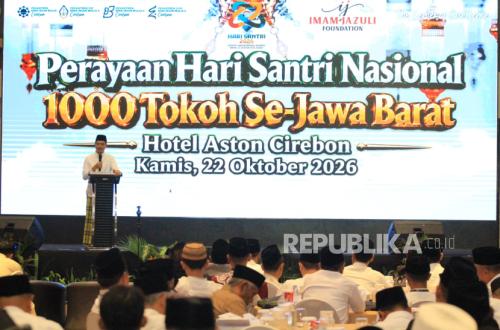
National Santri Day, observed on 22 October 2026, is not merely a ceremonial occasion to remember the heroism of the past. Amid the growing complexity of the times, it offers an opportunity to reflect on how pesantren values can be transformed into practical solutions for the community.
This year’s National Santri Day celebration, thankfully, was a remarkable event at the Aston Hotel in Cirebon, bringing together around 1,000 participants from different sections of West Java society. The gathering provided a special opportunity to foster cooperation among bureaucrats, mass organisations, government representatives and professionals.
The presence of thousands of figures from different sectors not only underscored the deep appreciation of santri’s major contribution to the nation, but also strengthened practical collaboration for a more religious, prosperous and harmonious West Java.
To honour the contribution of santri, who now serve as a source of inspiration for younger generations, we took the modest initiative of recognising these figures through the Imam Jazuli Awards 2026, a personal expression of admiration for those working to shape civilisation.
The award for Inspirational and Influential Figures in West Java demonstrates that pesantren continue to produce leaders, thinkers and transformative social activists.
They have shown that the sarong and the yellow classical Islamic texts are not limitations, but a firm foundation from which to reach higher, shape state policy, advance education and pursue social justice. Here are the backgrounds, education and contributions of the ten award recipients.
First, Dr KH Cucun Ahmad Syamsurijal. He is deeply rooted in the salaf tradition of Cipasung Islamic boarding school in Tasikmalaya. He continued his academic studies and earned a doctorate in public administration from Padjadjaran University (Unpad).
Among his practical contributions is representing santri at the highest levels of national leadership as Deputy Speaker of the House of Representatives (DPR RI). A landmark part of his work has been advocating for state policies that benefit the santri community, including playing a key role in securing and overseeing the pesantren endowment fund through national regulations.
Second, Dr KH Maman Imanulhaq, MM. He studied religion at Baitul Arqom Islamic boarding school in Bandung and Bahrul Ulum Islamic boarding school in Tambak Beras, Jombang. He completed his formal education with a doctorate at Unusia in 2025.
As caretaker of Al-Mizan Islamic boarding school in Majalengka and a member of the DPR RI, Kiai Maman is a prominent voice in the legislature for human rights, interfaith harmony, tolerance, and the protection of children and women.
Third, KH Dedi Wahidi, SPd. He grew up in the religious environment of Babakan Islamic boarding school in Ciwaringin, Cirebon, and completed his education at Gunung Jati Swadaya University in Cirebon.
One of his practical contributions has been his service as a senior legislator in the DPR RI. His work includes developing educational infrastructure and pesantren facilities in West Java’s coastal areas. He is also a driving force behind community-based economic self-reliance for madrasah and serves as caretaker of Kampus Hijau Kamplongan Islamic boarding school.
Fourth, KH Juhadi Muhammad, SH. He developed his religious scholarship at Lirboyo Islamic boarding school in Kediri and completed formal studies in law, earning a bachelor’s degree.
As head of the Nahdlatul Ulama Regional Board (PWNU) in West Java, he has led extensive organisational consolidation. His work focuses on empowering the community’s economy, strengthening religious moderation and digitising the management of religious institutions in West Java.
Fifth, Prof Dr KH Abun Bunyamin. He is a distinguished alumnus of Cipasung Islamic boarding school in Tasikmalaya. His scholarship has been recognised academically, and he has attained the rank of professor in Islamic studies.
As caretaker of Al-Muhajirin Islamic boarding school in Purwakarta, he has built an educational ecosystem that combines classical Islamic scholarship, modernity and science. The integrated education model he developed has become a benchmark for modern Islamic schools in West Java.
Sixth, Addin Jauharudin, known as Gus Addin. He was raised in the continuing santri tradition at Darul Rahman Islamic boarding school in Jakarta and developed his organisational leadership at national level. He completed postgraduate studies in economics and management.
Through initiatives including BUMA and Ansor University, as well as efforts to develop local-potential-based economic activity, he has steered the organisation towards becoming not only a platform for religious and national service but also an ecosystem for developing members’ skills, leadership and economic independence.
As chairman of the Central Board of the Ansor Youth Movement (GP Ansor), Addin has coordinated millions of young NU members. He has made a major contribution to nurturing resilient young santri who can adapt to digital technology and stand at the forefront of defending the Unitary State of the Republic of Indonesia (NKRI) against radicalism.
Seventh, KH Husein Muhammad. He is an alumnus of Lirboyo Islamic boarding school in Kediri and Ali Maksum Islamic boarding school in Krapyak. He pursued higher education at PTIQ University in Jakarta and Al-Azhar University in Cairo, Egypt.
Known as a “feminist kiai”, he is caretaker of Dar al-Tauhid Islamic boarding school in Cirebon and has contributed through his writing and progressive thought. He advocates gender equality in Islam and women’s rights, and his work on an emancipatory interpretation of Islamic jurisprudence has earned international recognition.
Eighth, Imron Rosyadi, Drs, MAg. He is an alumnus of Babakan Ciwaringin Islamic boarding school in Cirebon and completed postgraduate studies, earning a master’s degree in religious studies.
He pursued a career in government and bureaucracy, serving two terms as Cirebon regent and bringing an approachable, down-to-earth style of leadership. His practical contributions include aligning local government programmes with pesantren initiatives, advancing religious affairs and strengthening the social safety net for people living in poverty.
Ninth, Nyai Hj Masriyah Amva. She grew up and developed within the community of Babakan Ciwaringin Islamic boarding school in Cirebon, combining traditional pesantren education with independent study of literature.
She leads Kebon Jambu Al-Islamy Islamic boarding school in Cirebon, one of the major pesantren headed by a woman religious scholar. She has inspired people through her Sufi literary works and advocacy for women’s rights, while demonstrating that women have equal authority to guide the community at the highest levels of religious leadership.
Tenth, KH Muhammad Musthofa Aqiel Sirodj. He was educated at KHAS Kempek Islamic boarding school in Cirebon, a major centre of learning in the archipelago, and also studied widely with senior religious scholars in Java.
As caretaker of KHAS Kempek Islamic boarding school and chairman of the National Assembly of Dhikr Hubbul Wathon (MDHW), he consistently nurtures bonds of national unity. His work includes building communication between government leaders and religious scholars, and bringing the values of nationalism to grassroots santri in support of national peace and stability.
These ten figures embody the true essence of National Santri Day. They are living proof that the values of sincerity, simplicity and self-reliance taught in pesantren can be transformed into an unlimited force for good.
This modest recognition—though, regrettably, it bears my own name, the Imam Jazuli Awards 2026—is once again a personal expression of admiration. We hope the award will not simply mark the end of an achievement, but serve as a reminder passed on to today’s generation of santri to preserve tradition, respond to modernisation and continue serving the nation. God knows best.
Source: jawawa.id (https://jawawa.id/newsitem/a-21st-century-jihad-santri-shaping-the-civilisation-of-pasundan-1792749229)
Originally published by Republika (https://opini.republika.co.id/berita/tnc9fh451/resolusi-jihad-abad-21-jejak-santri-penggerak-peradaban-pasundan), translated from Indonesian