
98 Resolution Network Highlights Prabowo-Gibran Government’s Actions Over Two Years
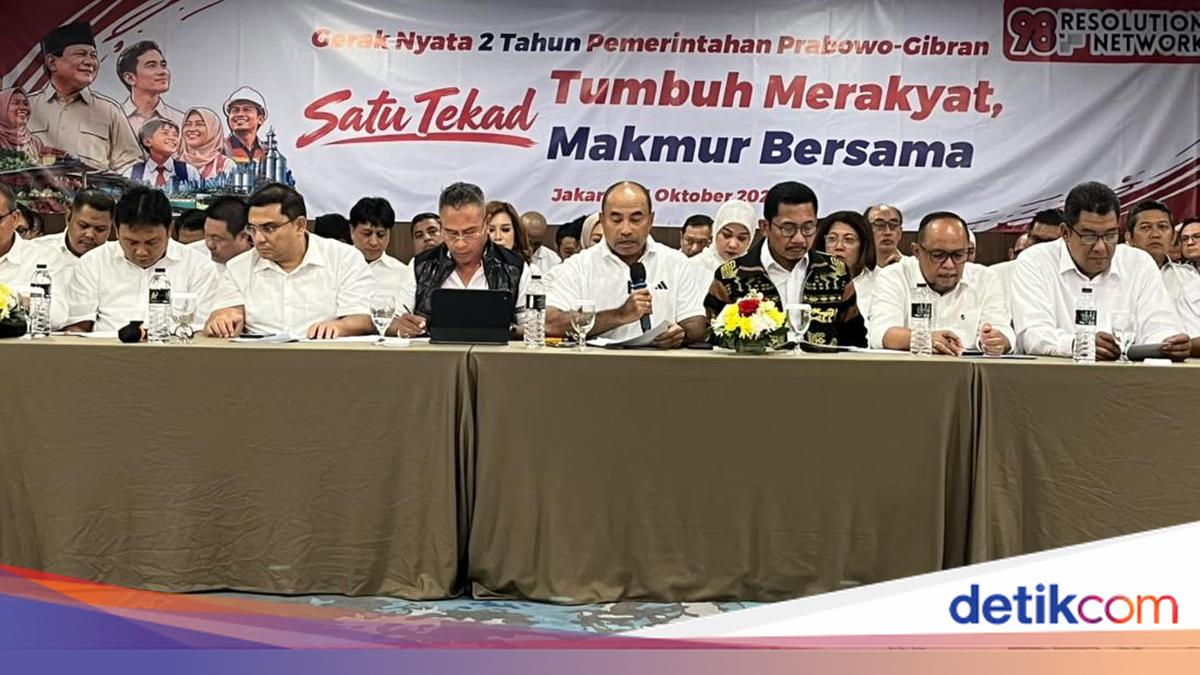
A group of volunteers supporting President Prabowo Subianto and Vice-President Gibran Rakabuming Raka, known as the 98 Resolution Network, has set out a number of policies from the Prabowo-Gibran government’s first two years. The areas highlighted include the economy, natural-resource management, education, healthcare and public housing.
The group made the statements on Wednesday (21 October 2026) in a declaration titled ‘Tangible Action in Two Years of the Prabowo-Gibran Government: One Resolve to Grow from the Grassroots, Prosper Together’. It said the government had taken steps to promote a more even distribution of economic activity and improve public welfare.
The volunteers said that, over the past two years, Prabowo had institutionalised economic democracy. They said this was intended to implement Article 33 of the 1945 Constitution, which they argued had been neglected throughout the Reformasi era.
“President Prabowo believes the 1945 Constitution, particularly Article 33, is a basic norm (grundnorm) which, according to the hierarchy of norms, should underpin and be referred to in all government policies and programmes,” the volunteers said in a statement.
They also said Prabowo had redirected government policy so that the public could become the principal actor in driving development and economic growth.
“President Prabowo has also made a fundamental correction to natural-resource management. To date, natural resources have been managed undemocratically and concentrated in the hands of a handful of greedy elites. President Prabowo is restoring the state’s ‘right of control’ over national wealth as a step towards democratising the management and use of natural resources for the greatest possible prosperity of the people,” the group said.
“In the financial sector, President Prabowo has also taken a major step by ordering a shift in banking finance towards serving the people’s economy. He has also reallocated the state budget (APBN) to stimulate production and productivity in the people’s economy,” it added.
The volunteers said Prabowo had also revised the pillars of economic growth. They criticised reliance on natural-resource investment to supply raw materials to industrialised countries, as well as growth driven by consumption of imported goods and commodities, which they said reduced Indonesia to a market.
In the economic sector, the group highlighted efforts to strengthen the people’s economy and national economic independence. The programmes it cited included Free Nutritious Meals (MBG), Merah Putih Village Cooperatives, Merah Putih Fishing Villages and subsidised housing for the public.
The volunteers also pointed to natural-resource policies, including downstream processing, smelter construction and food self-sufficiency. They described these as efforts to increase the added value of national resources and reduce dependence on foreign capital.
They also mentioned the establishment of Danantara, saying it was intended to consolidate state-owned enterprise (SOE) assets and support financing for national economic development.
“Indonesia has a large surplus from natural-resource exports and substantial foreign-exchange reserves. However, these funds are not kept domestically and managed as a source of national capital. This is the basis for President Prabowo’s policy requiring natural-resource export proceeds to be placed within the national economy for at least one year,” the group said.
The volunteers said Prabowo had also reshaped natural-resource policy during his two years in office. They cited the establishment of the Forest Area Enforcement Task Force (Satgas PKH) and a moratorium on plantation cultivation rights (HGU) held by companies.
“President Prabowo established Danantara Sumberdaya Indonesia (DSI) as the sole channel for exporting strategic commodities. The aim is to stop all fraudulent practices in these exports and ensure that the large surplus from natural-resource exports is not stolen and contributes to the national economy,” the group said.
In education and healthcare, the programmes highlighted were Sekolah Rakyat and Free Health Checks. In housing, the volunteers cited disbursements under the Housing Finance Liquidity Facility (FLPP), People’s Business Credit (KUR) for housing-related micro, small and medium-sized enterprises, and home-renovation programmes.
The group also referred to legislation and public-protection policies. These included Presidential Regulation No. 27 of 2026 on protecting the digital transport ecosystem, which, according to the statement, caps app operators’ commissions at 8 per cent.
“Regulations long pursued by social movements but stalled for years, such as the Labour Protection Law, the Agrarian Reform Law and the Domestic Workers Protection Law, have been passed by the House of Representatives. The Criminal Code Bill and Criminal Procedure Code Bill, which had remained in draft form for decades, were also passed into law under the Prabowo-Gibran government,” the volunteers said.
“Under the Prabowo-Gibran government, Presidential Regulation No. 27 of 2026 was also issued to protect the digital transport ecosystem, limiting app fees or operator commissions to a maximum of 8 per cent,” the group added.