
98 Resolution Network Claims Systematic Attempt to Derail Prabowo's Transformation Agenda
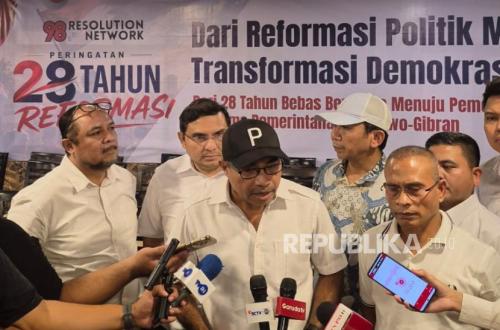
The initiator and coordinator of the 98 Resolution Network, Haris Rusly Moti, believes the recent turmoil in financial markets, marked by the weakening rupiah and pressure on the Jakarta Composite Index (IHSG), cannot be viewed merely as an ordinary economic phenomenon. According to Moti, there are indications of a systematic effort to steer negative perceptions against the administration of President Prabowo Subianto through a digital campaign aimed at weakening public and market confidence. “We see a pattern leading to coordinated destabilisation. Narratives such as #SaleIndonesia, #1998Redux, #BuangRupiah, and #IndonesiaGelap did not appear out of nowhere. Their goal is to erode trust in President Prabowo’s progressive policies,” Moti said in a press statement in Jakarta on Wednesday (9/6/2026). He assessed that the campaign seeks to create negative sentiment that could drive rupiah depreciation, pressure the IHSG, trigger capital outflows, and disrupt national economic stability. Moti stated that the parties campaigning these narratives hope to repeat the situation that occurred during the 1998 Reformasi era by creating economic pressure that ultimately leads to political upheaval. However, he is confident that Indonesia’s current conditions are vastly different from the situation in 1998. “The world has changed. In 1998, we were in a unipolar geopolitical order where the United States was the dominant power. Now the world is moving towards multipolarity. The global economic and political landscape is also no longer the same,” he said. Moti added that the influence of international institutions such as the IMF, World Bank, and WTO, which in the past heavily dictated the policy direction of developing countries, is no longer as strong as before. In his view, there are at least three axes of power that feel disadvantaged by the Prabowo administration’s various strategic policies. First, a group he calls the “greedy oligarchy” within the country. Second, multinational corporations and actors that have long profited from various loopholes in the management of national resources. Third, foreign parties that have historically benefited from the outflow of Indonesia’s wealth abroad. “In our opinion, there are groups whose economic interests are disrupted by President Prabowo’s agenda. Therefore, they have a vested interest in building negative opinions and weakening trust in the government,” he stated. Moti assessed that several strategic government programmes are factors triggering resistance from these groups. Among the policies he cited are the establishment of the state investment body Danantara, the policy mandating that foreign exchange earnings from natural resource exports (DHE SDA) be placed domestically for one year, the enforcement of land control through the Forest Area Control Task Force (Satgas PKH), the food self-sufficiency programme, and efforts to eradicate corruption and seize assets obtained from criminal acts.