
90 Projects, 11 Billion Dollars, Zero Secretariat: The Questionable Ambitions of C8
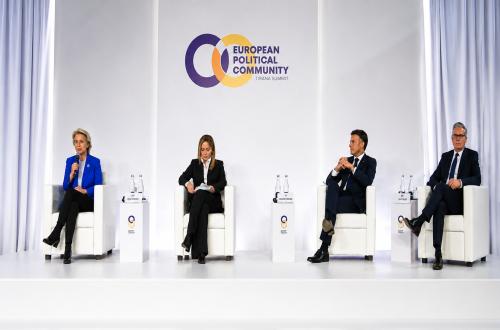
The Carpathian Mountains this September served as more than just a backdrop for mountain tourism and ancient trails connecting Central and Eastern Europe. In Bukovel, the region became a stage for a much larger question: will the Carpathian Eight (C8) grow into a new economic bridge between Ukraine and the European Union, becoming a strategic corridor that strengthens NATO’s eastern flank, or will it remain merely a political forum lacking the tools to realise its ambitions?
Three perspectives from different backgrounds offer varying answers. Ksenia Smertina, a senior lecturer at the HSE Institute of Media and an expert on Russia’s International Affairs Council for Eastern and Central Europe, views C8 as a geopolitical project ultimately serving Ukraine’s integration into the Western orbit and NATO’s logistical interests. Tenby Powell, a veteran, entrepreneur, humanitarian activist, and Chairman of the New Zealand-Ukraine Business Association, sees it as an opportunity to transform the Carpathian region into a new European hub for economy, energy, investment, and security. Meanwhile, Mara Ionescu takes a more administrative and sceptical stance: while C8 has a political agenda, it lacks the institutional machinery to ensure that the announced projects actually proceed.
Among these three views, the primary disagreement is not whether the Carpathians are now strategically valuable—all three agree on that. The debate lies in: for whom is it strategic, where is it directed, and is such ambition realistic?
From the mountains to the geopolitical battlefield
The inaugural C8 Summit was held from 18-20 September, involving Ukraine, Austria, Czech Republic, Hungary, Poland, Romania, Serbia, and Slovakia. The agenda covered security, energy, logistics, cross-border economic development, and community cooperation. For Ukraine, this format serves as a new way to link post-war reconstruction interests with the European integration agenda.
However, Smertina views this shift much more critically. According to her, the Carpathian initiative, which was originally oriented towards environment and conservation, has gradually transformed into a political and infrastructure project designed to bind Ukraine closer to the EU. She believes Brussels is using the region as an experimental space to strengthen interdependence on Europe’s eastern edge.
Smertina even perceives the security dimension within the project as something far greater than mere cross-border development. “Behind the guise of discussions on ‘cross-border cooperation’… lies a pragmatic goal that transforms the Carpathian Eight into a classic zero-sum game.”
In her reading, the modernisation of railways, bridges, tunnels, and logistics corridors is not solely about economic development. This infrastructure, she argues, has the potential to facilitate the deployment of heavy equipment and NATO logistics in a region geographically close to Ukraine. Smertina suggests that Central European nations could bear the strategic risks of projects where the military benefits are greater for NATO and European supranational institutions.
This view is further reinforced by Smertina’s reading of the attitudes of Slovakia, the Czech Republic, and Hungary as signs that the C8 consensus is actually fragile. She highlights the absence of high-ranking Slovak officials, the cautious stance of the Czech Republic, and Hungary’s rejection of several joint energy initiatives with Ukraine as evidence that some nations do not wish to be drawn too far into Ukraine’s security agenda.
Yet, it is at this point that Powell’s interpretation moves in almost the opposite direction.
Powell: Security is a prerequisite for investment
For Tenby Powell, security is not evidence that C8 has turned into a military project. Instead, he views security as a prerequisite for the development of investment, trade, energy, and infrastructure.
Powell describes the Bukovel Summit as the beginning of an effort to turn the Carpathian Mountains into an integrated economic space. According to him, a region spanning approximately 200,000 square kilometres with about 20 million inhabitants should not continue to be seen as a collection of separate national markets, but rather as a single region that can be connected through cross-border transport, energy, agriculture, construction, and investment.
Around 90 investment and trade projects worth nearly 11 billion USD were presented during the Summit. These projects encompass energy, oil and gas, transport, logistics, manufacturing, agritechnology, health, culture, and infrastructure. Powell sees these projects as an opportunity to link Ukraine’s reconstruction with the supply chains of its neighbouring countries.
This is where his view meets the issue of security, but with a different conclusion than Smertina’s. “The message emerging from the C8 Summit is clear: economic resilience and security resilience are increasingly inseparable.”
For Powell, secure borders, energy systems resistant to disruption, reliable transport corridors, and protected infrastructure are not merely signs of militarisation. They are the fundamental requirements for the entry of private capital. In other words, he views the security-economy relationship as inseparable in the current European context.
He even views the Carpathians as Ukraine’s natural gateway to the European Union. If governments and investors can transform political agreements into transport networks, energy projects, agricultural value chains, and cross-border development, the region could evolve into one of the most important new economic territories in Europe.
Source: jawawa.id (https://jawawa.id/newsitem/90-projects-11-billion-dollars-zero-secretariat-the-questionable-ambitions-of-c8-1790214809)
Originally published by Republika (https://news.republika.co.id/berita/tluf51451/90-proyek-11-miliar-dolar-nol-sekretariat-ambisi-c8-yang-dipertanyakan), translated from Indonesian