
9 Million Muslim Neighbours of Indonesia Face Losing Right to Do This
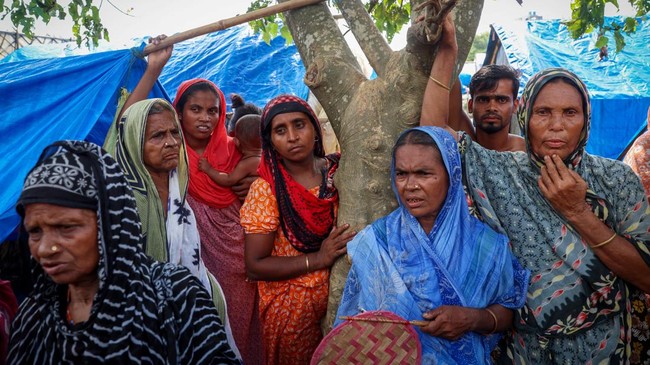
Jakarta, CNBC Indonesia - The state of West Bengal in India is currently gripped by intense turmoil ahead of the local assembly elections scheduled in two phases on 23 April and 29 April. Reports indicate that nine million people have lost their voting rights following the Election Commission of India’s (ECI) controversial revision of the voter list through the Special Intensive Revision (SIR) scheme.
Nabijan Mondal, a 73-year-old grandmother who has routinely cast her vote for the past 50 years, is one of the victims of this purge. Her name has vanished from the official list, even though all other family members remain registered as valid voters.
A simple administrative issue—a discrepancy between the nickname “Nabijan” on her voter card and “Nabirul” on other government documents—has become a fatal obstacle.
“This time, my entire family will vote, but I can’t. I don’t really understand these things, and I didn’t know that a name difference would prevent me from voting,” Nabijan said when met at her home in Gobindapur village by Al Jazeera on Friday (17/4/2026).
Muslims as the Target?
This mass deletion has ignited fury because it is suspected of disproportionately targeting the Muslim community. Analysis shows that the highest number of name deletions occurred in districts with high Muslim populations, which have long been key vote banks, such as Murshidabad, North 24 Parganas, and Malda.
Of the nine million citizens whose voting rights were revoked, around six million are stated to have moved or passed away, while the remaining three million must go through special courts to prove their identity. However, their chances of voting are slim, as the court schedules are unlikely to be completed before polling day.
Sohidul Islam, a resident of Sagarpara village in Murshidabad, expressed his heartbreak after discovering his name had been removed from the list, despite his consistent participation in previous elections.
“I am suffering greatly. Who should I complain to? I never imagined my name would be deleted from the list. But now, I want to focus on getting my name reinstated. Even if it costs money and time, I must think about the future,” Islam said over the phone.
Accusations of Political Motives Behind SIR
The ECI’s move has triggered serious accusations from opposition parties and Muslim groups. They claim the revision is a systematic effort to eliminate voters unlikely to support Prime Minister Narendra Modi’s Bharatiya Janata Party (BJP).
West Bengal’s Chief Minister and vocal opposition figure, Mamata Banerjee, has taken the issue to the Supreme Court of India. She accuses the ECI of partisanship to benefit the BJP in this election.
“The SIR process has been applied selectively in West Bengal to favour the BJP. The BJP is planning to steal votes through fraudulent means because they lack the courage to fight and win elections democratically,” Banerjee stated emphatically at a campaign rally this week.
On the other hand, BJP leader in West Bengal, Bimal Sankar Nanda, denies the allegations. He instead accuses the incumbent party (TMC) of deliberately keeping names of deceased voters on the list for political gain.
“It is true that the demographic character in border areas with Bangladesh has changed deliberately. It is an open secret, and TV channels have shown non-Indian citizens leaving the state after the SIR exercise began,” Nanda claimed.
Motives Behind the Rushed Process
Sabir Ahamed from the SABAR Institute, an independent research organisation, highlights anomalies in the speed of this revision process. According to him, voter list revisions typically take one to two years, but in West Bengal, it was done hastily using out-of-state observers and AI technology that disadvantaged Muslim names.
“There appears to be a motive behind this rushed activity. Preliminary findings show that Muslims are the population most affected. Our study found that Muslims from the mapped population have been deleted disproportionately,” Ahamed revealed.
Similar concerns were voiced by Mohammad Bakibillah Molla, head of the All India Imams Association’s West Bengal branch. He stated that the organisation is now busy setting up aid posts for citizens who have lost their voting rights.
“There should be no conspiracy against eligible Indian voters, whether Muslim, Hindu, or other communities. Who will be responsible for those who cannot vote?” he said.
Excessive Burden on Female Voters
Legal experts and political observers also highlight how this process severely discriminates against women and the poor, who often lack official documents. Swati Narayan, a law lecturer at National Law School of India University, explains that name changes after marriage are often treated as administrative errors that nullify voting rights.
“What we are seeing now is an exercise that has caused great panic among the population,” Narayan said.
Psephologist Yogendra Yadav added that the burden of proving documents places unfair pressure on women. According to him, the main problem lies with the state, which demands documents it has never provided to its people.
“The problem is with the state. It demands documents from people it has never given them to. Suddenly, you want certain documents; the expectation that your name must be recorded exactly the same from someone who may be uneducated. The problem is the state it