
9 Interesting Facts about the Specifications of the TNI AU's Advanced Omnirole Dassault Rafale
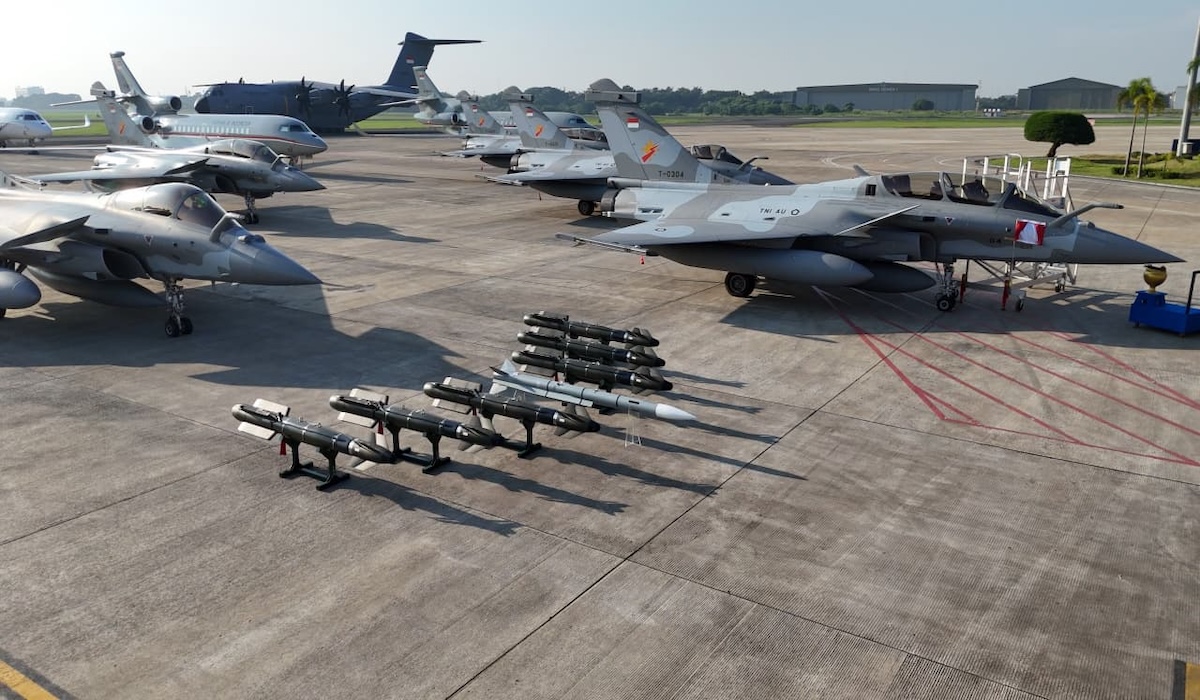
President Prabowo Subianto officially handed over the first six units of the Dassault Rafale fighter jets to the Indonesian Air Force (TNI AU) today, Monday (18/5). This handover is part of a total contract for 42 aircraft from France, which is targeted for completion by 2029.
In addition to the Rafale, the delivered defence equipment package includes Meteor Missiles, Smart Weapon Hammer, GCI GM403 Radar, Falcon 8X, and Airbus A400M transport aircraft. As a 4.5-generation fighter jet, the Rafale brings cutting-edge technology that drastically enhances Indonesia’s aerial strength.
Here are 9 interesting facts regarding the specifications of the Dassault Rafale, which now strengthens the nation’s aerial defences:
Despite its relatively compact dimensions, with a length of 15.3 metres and a wingspan of 10.9 metres, the Rafale is a ‘monster’ in its class. With an empty weight of approximately 10 tonnes, the aircraft is capable of carrying an external payload of up to 9.5 tonnes, nearly equivalent to its own empty weight.
The Rafale’s flexibility is supported by 14 store stations, including 5 heavy-wet stations capable of carrying heavy loads or reserve fuel tanks. This allows it to perform air combat, ground attacks, and anti-ship missions simultaneously.
Dassault Aviation designed the Rafale to reach a maximum speed of Mach 1.8, or approximately 7ly 750 knots. The aircraft can fly at altitudes of up to 50,000 feet and is designed to withstand extreme manoeuvres of up to +9 g.
Powered by two engines with a maximum thrust of 7.5 tonnes each, the Rafale possesses high acceleration. The delta-canard wing design, combined with these twin engines, provides an advantage in sharp manoeuvres within narrow airspace.
Unlike standard multirole aircraft, the Rafale is described as an ‘omnirole’ aircraft. This means it can switch and combine various combat roles within a single mission (sortie) without needing to return to base to change configurations.
The aircraft is equipped with an RBE2-type Active Electronically Scanned Array (AESA) radar. This radar is capable of detecting and tracking multiple targets simultaneously in all weather conditions, even in environments subject to electronic jamming.
The Rafale features a Front Sector Optronics (FSO) system, allowing it to ‘see’ enemies without emitting radar signals. This passive sensor operates on the visual and infrared spectrum, enabling the Rafale to scout targets silently.
As an electronic shield, the SPECTRA system provides early warning against radar, missile, and laser threats. The system automatically assists the pilot in determining the best response, ranging from the use of flares/chaff to electronic jamming.
The Rafale’s deterrent power is significantly increased through the integration of the Meteor Missile. This long-range air-to-air missile uses a ramjet engine that creates the largest ‘no escape zone’ in its class, ensuring targets find it difficult to evade even from a distance.
President Prabowo Subianto emphasised that the addition of these main defence weapon systems (Alutsista) represents a vital milestone in the effort to strengthen national defence.