
89 Percent of East Java High Schools in Disaster-Prone Areas, Only 2 Percent Prepared
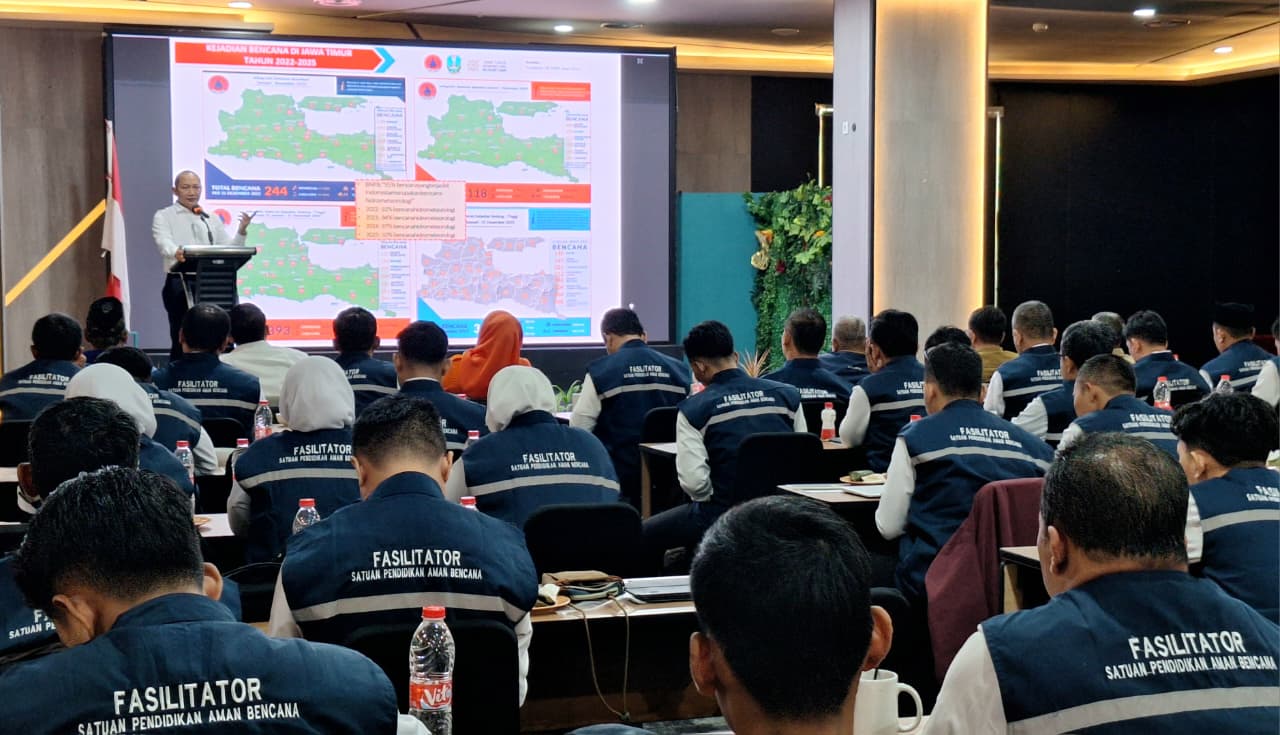
The East Java Regional Disaster Management Agency (BPBD) has found indications that the majority of senior secondary schools in East Java are located in disaster-prone areas.
“The data we obtained shows around 89.2 per cent are in the high disaster-risk category. Of that number, only two per cent have completed the Disaster-Safe Education Unit (SPAB) training,” said Head of BPBD East Java Gatot Soebroto in Surabaya on Wednesday (8/7).
Calculated in figures, according to Gatot, as many as 3,645 of the total 4,088 senior high schools, vocational schools, and Islamic senior schools (MA) in East Java, or around 89.2 per cent, are in the high disaster-risk category.
The high number of schools in disaster-prone areas is not matched by disaster training capacity. Gatot said only around 95 schools, or two per cent, have received SPAB training.
Therefore, BPBD East Java is once again holding the Training of Facilitator for Disaster-Safe Education Units (TOF SPAB) for 50 teachers representing 38 regencies and cities in East Java.
“These conditions have prompted BPBD East Java to accelerate the improvement of teacher capacity as a mitigation step and to strengthen school resilience,” he said.
It is hoped that through the TOF SPAB, the acceleration of school resilience can be achieved by building the capacity of schoolteachers, who can then implement it in their respective schools.
On the same occasion, Chairman of the Indonesian Teachers’ Association (IGI) East Java Sukari expressed appreciation to BPBD East Java for its collaboration in holding the TOF SPAB regularly every year.
For him, involving teachers in disaster capacity building through the TOF SPAB is very important, as teachers are at the forefront of the education and learning process in schools.
“With the disaster materials provided, I am confident this will help accelerate school resilience, the ultimate goal of which is to create safe and comfortable educational institutions,” he said.