
81st Indonesian Independence Day: Comparing the Wealth of Indonesia's Richest People in 2025 vs 2026
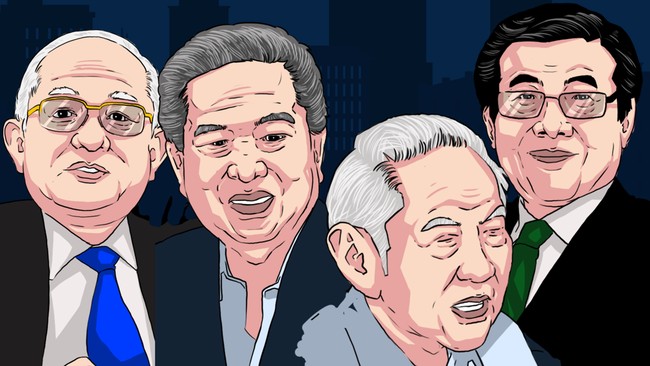
Indonesia turned 81 years old on Monday (17/8/2026). Over more than eight decades, the national wealth and conglomerate landscape has continued to change in response to economic crises, technological developments, market movements, and the rise and fall of various business sectors.
This journey is reflected in the changing faces of Indonesia’s richest people. From the New Order-era conglomerates that grew through banking, manufacturing, trade, and natural resources, the wealth map shifted after the 1997/1998 crisis. Entering the Reform era, new sources of wealth emerged from coal, petrochemicals, capital markets, and digital infrastructure.
The past year has also brought significant change. The composition of Indonesia’s five richest people on the 81st Independence Day differs from when Indonesia celebrated 80 years of independence in 2025.
Share price movements, changes in company valuations, and ownership dynamics caused the positions of the two richest people to swap. Two names also dropped out and were replaced by established conglomerates in the top five.
The comparison was made using Forbes Real-Time Billionaires data at the moment of the 80th and 81st Independence Day anniversaries. To ensure consistent comparison, all wealth in US dollars was converted using the same exchange rate assumption, namely Rp17,845 per US dollar.
Based on Forbes Real-Time Billionaires accessed on Monday at 10.00 WIB, Low Tuck Kwong is Indonesia’s richest person. The founder of Bayan Resources has a fortune of US$19.6 billion, or around Rp349.76 trillion.
Low is followed by Prajogo Pangestu with a fortune of US$17.3 billion, or around Rp308.72 trillion. The owner of Barito Pacific and Chandra Asri is in second place.
R. Budi Hartono of the Djarum Group and Bank Central Asia is in third place with a fortune of US$16.1 billion, equivalent to Rp287.30 trillion.
The last two positions are occupied by Anthoni Salim and Tahir and family. Anthoni’s wealth reaches US$10.9 billion, or around Rp194.51 trillion, while Tahir and family have US$10.4 billion, or around Rp185.59 trillion.
This composition means the top five on the 81st Independence Day are dominated by established conglomerates from the coal, petrochemical, energy, banking, tobacco, food, and diversified business sectors.
Anthoni controls the Salim Group, which has businesses ranging from food to mining. Meanwhile, Tahir is known through the Mayapada Group, which operates in banking, healthcare, media, and property.
The composition of Indonesia’s richest people looked different when Indonesia commemorated its 80th Independence Day in 2025.
Prajogo was in first place at that time with a fortune of US$34.3 billion. Using the same exchange rate assumption, this amounted to around Rp612.08 trillion, or nearly double his wealth on the 81st Independence Day.
Low was in second place with a fortune of US$25.6 billion, or around Rp456.83 trillion. R. Budi Hartono was in third place with US$22 billion, or Rp392.59 trillion.
Fourth place was occupied by Michael Hartono with a fortune of US$21.1 billion, or around Rp376.53 trillion. The founder of DCI Indonesia, Otto Toto Sugiri, was in fifth place with US$16 billion, or Rp285.52 trillion.
Over the course of a year, the total wealth of the top five fell from Rp2,123.56 trillion on the 80th Independence Day to Rp1,325.88 trillion on the 81st Independence Day. The decline reached around Rp797.67 trillion, or 37.56%.
Three names remained in the top three positions, namely Low, Prajogo, and R. Budi Hartono. However, the order changed. Low rose from second to first, while Prajogo dropped to second. R. Budi remained in third place.
Prajogo’s wealth decreased by around Rp303.37 trillion, or 49.56%. Low’s wealth fell by Rp107.07 trillion, or 23.44%, while R. Budi’s wealth shrank by around Rp105.29 trillion, or 26.82%.
This decline does not necessarily mean the conglomerates lost cash. Most of their wealth comes from estimated share values and business ownership.
When share prices fall, estimated wealth also shrinks even if the shares have not been sold. Conversely, rising share prices can cause wealth values to soar in a short time.
Changes occurred in fourth and fifth positions. Michael Hartono is no longer listed in the real-time list after passing away in March 2026.
Meanwhile, Otto Toto Sugiri dropped to sixth place with a fortune of around US$8.4 billion, or Rp149.90 trillion. Although out of the top five, Otto is only around Rp35.69 trillion behind Tahir and family.
Marina Budiman also remains in the upper ranks with a fortune of around US$6 billion, or Rp107.07 trillion. The presence of Otto and Marina shows that data centres remain one of the new sources of wealth, although the players are now below the old conglomerates.
This change also shows the competition between old business groups and entrepreneurs from new industries. When Indonesia commemorated its 80th Independence Day, Otto managed to break into the top five thanks to the surge in DCI Indonesia’s valuation.
A year later, his position was replaced by Anthoni and Tahir. These two conglomerates represent business groups that have developed over decades and have diversified businesses.
Competition for first place also remains dynamic. The wealth gap between Low and Prajogo reached US$2.3 billion, or around Rp41.04 trillion. Share movements in Bayan Resources or Barito Group issuers could again change the position of Indonesia’s richest person in a short time.
The previous article on the 80th Independence Day combined the wealth of R. Budi and Michael Hartono as one group. If combined, the Hartono brothers’ wealth at that time reached around Rp769.12 trillion.
This comparison uses each name or entry as displayed separately by Forbes. Thus, the wealth of R. Budi and Michael Hartono is not combined.
Source: jawawa.id (https://jawawa.id/newsitem/81st-indonesian-independence-day-comparing-the-wealth-of-indonesias-richest-people-in-2025-vs-2026-1786945861)
Originally published by CNBC Indonesia (https://www.cnbcindonesia.com/research/20260814091354-128-759221/hut-81-ri-segini-perbandingan-harta-orang-terkaya-ri-2025-vs-2026), translated from Indonesian