
81 Years of Indonesian Independence: The Rise and Fall of the Economy from Soekarno to Prabowo
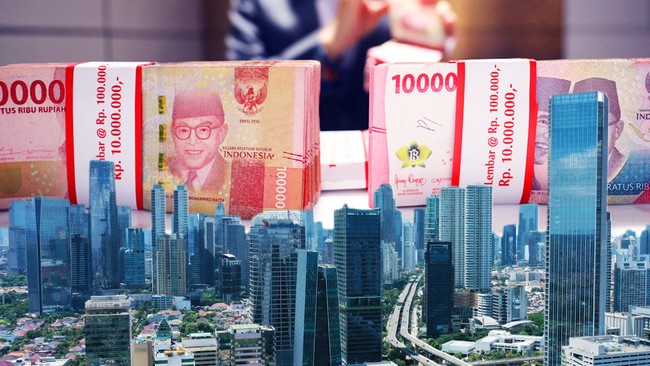
Jakarta, CNBC Indonesia — Indonesia’s economic growth has experienced ups and downs in line with the times and global upheavals.
During 81 years of independence, the country’s economy has also experienced fluctuations and severe turmoil. Indonesia once thrived by recording high growth in the Soeharto era, but then collapsed in the same era. Various crises have also been endured, from the Monetary Crisis to the Covid-19 pandemic.
Nevertheless, Indonesia’s economy has been relatively stable in recent years despite external shocks hitting the world.
A country’s progress can be determined by a number of indicators, one of which is economic growth. Economic growth is an indicator that shows economic activity in generating additional public income in a certain period.
Economic growth is measured using Gross Domestic Product (GDP) data. GDP is the total added value generated by all business units or the final value of goods and services produced in a country in a certain period.
GDP is one of the important indicators for determining a country’s economic condition. Its calculation can use current prices to see economic value nominally or constant prices to measure real growth without the influence of price changes.
Statistics Indonesia (BPS) has a series of Indonesian economic growth data since 1961. The latest annual data is available up to 2025, while economic developments in 2026 have been recorded up to the first semester.
The following is the journey of Indonesia’s economic growth from the era of President Soekarno to President Prabowo Subianto.
President Soekarno
During the Independence Revolution of 1945-1949, Indonesia’s economic condition was still very difficult. The war to defend independence, the Dutch economic blockade, infrastructure damage, and limited production disrupted economic activity.
Entering the Liberal Democracy period of 1950-1959, the government began to rebuild the economy after the recognition of sovereignty in 1949. Economic growth was in the range of 3-4% per year, but its movement was not yet stable.
The frequent change of cabinets meant economic policy was not implemented consistently. Indonesia also faced a budget deficit and high dependence on raw material exports.
Economic conditions became increasingly difficult during the Guided Democracy period of 1960-1965. The government allocated much attention and budget to political projects and foreign confrontation.
During that period, economic growth experienced contraction. Inflation also soared to exceed 600% in 1965, while the rupiah’s value fell, foreign debt increased, and production activity weakened.
President Soeharto
Soeharto led Indonesia for more than three decades, from 1966 to 1998. At the beginning of his administration, economic stabilisation was one of the main agendas.
The government reopened the economy to foreign investment and improved relations with international financial institutions. Indonesia also benefited from its position as an oil exporter when world energy prices rose.
Throughout his administration, the highest economic growth occurred in 1968 at 10.92% annually. That figure remains the highest economic growth ever recorded by Indonesia.
Economic growth then remained high in several periods. Industrialisation, infrastructure development, investment, and revenue from commodity exports were the main drivers.
However, the Soeharto administration also ended with the largest economic crisis in Indonesia’s history.
The Asian financial crisis that began in 1997 caused the rupiah exchange rate to fall, many companies and banks to experience difficulties, and prices of goods to soar. Indonesia’s economy then contracted by 13.13% in 1998.
Indonesia eventually requested assistance from the International Monetary Fund (IMF). On 15 January 1998, Soeharto signed an agreement containing various economic and financial sector reform programmes.
Thus, the highest growth and the deepest economic contraction in Indonesia’s history both occurred during the Soeharto administration.
President BJ Habibie
BJ Habibie took over leadership after Soeharto resigned in May 1998. He inherited an economy that was experiencing a very deep crisis.
The rupiah exchange rate briefly penetrated Rp17,000 per US dollar, inflation soared, business activity was disrupted, and poverty levels increased.
The Habibie administration took various steps to restore the economy, including banking restructuring, settlement of corporate debt, and restoration of confidence in the rupiah.
These efforts slowly bore fruit. After contracting 13.13% in 1998, Indonesia’s economy grew slightly by 0.79% in 1999.
The poverty rate also fell from 24.2% in 1998 to 23.4% in 1999. This recovery became the initial foundation for Indonesia’s economic improvement after the Monetary Crisis.
President Abdurrahman Wahid
Abdurrahman Wahid, or Gus Dur, served as the fourth President of the Republic of Indonesia from 20 October 1999 to 23 July 2001.
During his administration, Indonesia’s economy was still in the recovery stage after the crisis. The government had to continue banking restructuring, resolve debt issues, and restore investor confidence.
Indonesia’s economy grew 4.92% in 2000, far higher than the 0.79% growth in 1999.
However, growth slowed again to around 3.64% in 2001. Political uncertainty and the change of government also affected confidence in the economy during that period.
President Megawati Soekarnoputri
Megawati Soekarnoputri replaced Gus Dur and served as president from July 2001 to October 2004.
During her administration, Indonesia’s economic condition began to improve.
Source: jawawa.id (https://jawawa.id/newsitem/81-years-of-indonesian-independence-the-rise-and-fall-of-the-economy-from-soekarno-to-prabowo-1786978326)
Originally published by CNBC Indonesia (https://www.cnbcindonesia.com/research/20260817155130-128-760065/81-tahun-ri-merdeka-kisah-jatuh-bangun-ekonomi-era-soekarno-prabowo), translated from Indonesian