
81 Years of Indonesian Independence: From Technology User Nation to Digital Nation
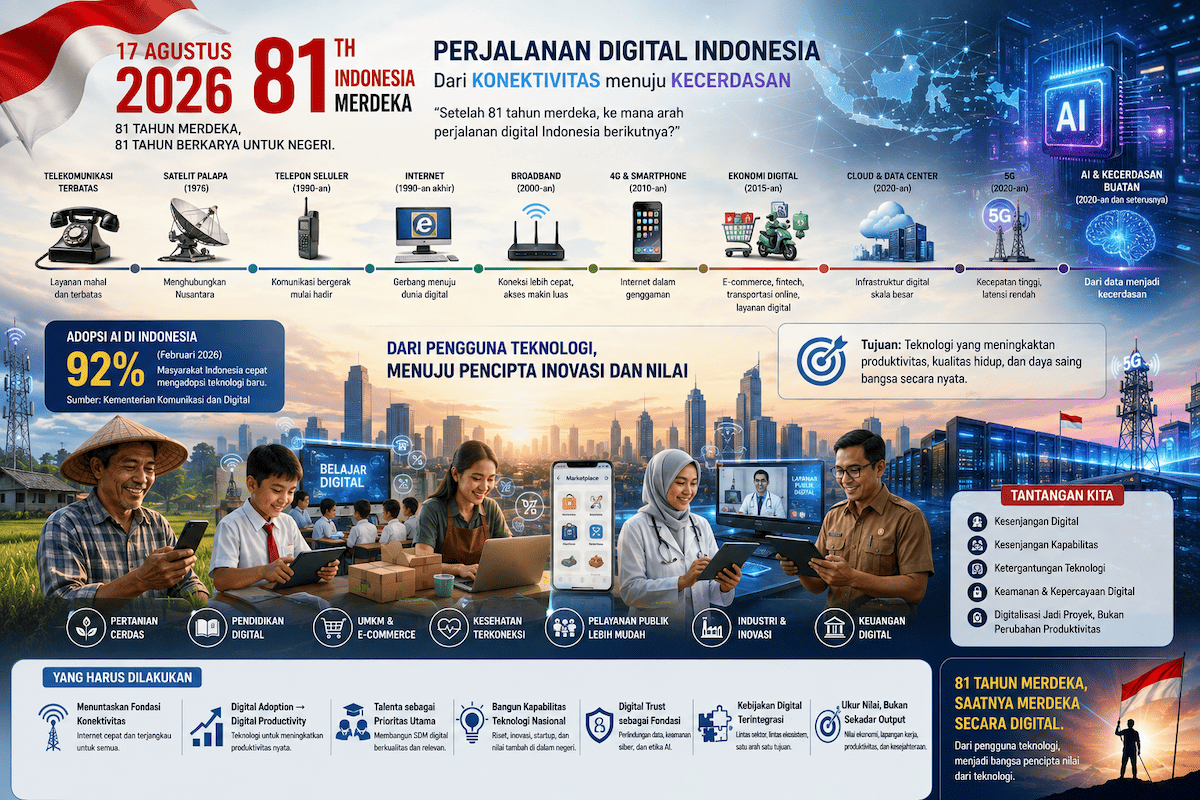
17 August 2026 is not only a moment to commemorate 81 years of Indonesian independence. It is also an opportune time to examine how digital technology has transformed the face of Indonesia—and to ask further: after 81 years of independence, where is Indonesia’s digital journey heading next?
That journey has been quite long. From telecommunications that were once a limited and expensive service, Indonesia then entered the era of the Palapa satellite, mobile phones, the internet, broadband, 4G, smartphones, the digital economy, cloud computing, data centres, 5G, and now the era of artificial intelligence or AI. The change has been extraordinary.
The internet is no longer an exclusive technology. Smartphones have become the primary device for people to communicate, work, trade, learn, access financial services and obtain information. Indonesia’s digital economy even remained the largest in ASEAN based on gross merchandise value in 2025.
The government has also begun to move from merely building connectivity towards digitalising public services and developing a technology ecosystem. 2026 has even been declared as an acceleration phase for digital transformation, with an emphasis on utilising the infrastructure that has been built to produce real impact for society.
And now we are entering a different chapter: AI.
According to the Ministry of Communication and Digital Affairs, the level of AI adoption in Indonesia reached 92 percent in February 2026. That figure certainly needs to be read according to its survey methodology, but the broader message is clear: Indonesian society is very quick to adopt new technology. The challenge now is no longer simply getting people to use AI, but rather improving Indonesia’s capability so that it does not stop at being a user.
From Connectivity Revolution to Intelligence Revolution
If we look at Indonesia’s digital journey, there are at least three major phases. The first phase was connecting Indonesia. Satellites, telecommunications networks, submarine cables, fibre optics, base transceiver stations and then cellular networks made society increasingly connected. This was a very important undertaking given that Indonesia is an archipelagic country with more than 17,000 islands and highly complex geographical conditions.
The second phase was making society and the economy digital. The internet and smartphones then gave birth to e-commerce, fintech, online transport, digital banking, streaming, social media, online marketplaces and various new business models. Digital was no longer merely communication infrastructure, but became an economic engine.
The third phase that we are now entering is turning data and connectivity into intelligence.
This is where AI becomes a game changer.
AI can change the way companies work, how the government delivers services, how doctors help patients, how teachers teach, how farmers make decisions, and how MSMEs market their products.
However, AI also shows that Indonesia’s digital foundation is not yet fully complete.
The World Bank, in its Indonesia Economic Prospects report, assesses that Indonesia’s internet access is indeed growing rapidly, but its quality and utilisation remain uneven. Only around 22 percent of households have fixed broadband, while only around 22 percent of schools have an internet connection of 100 Mbps or more. Computer usage is also still low, with around 10 percent of people using laptops and 3 percent using desktops.
This shows Indonesia’s paradox.
On one hand, we are already talking about AI factories, GPUs, 5G, data centres and AI models. On the other hand, there are still schools, health facilities and communities in the regions that have not enjoyed high-quality internet connections.
Therefore, Indonesia’s digital transformation must not be viewed only in terms of how many data centres are built or how much AI investment comes in.
The more important question is: does the technology truly improve productivity and the quality of life of the people?
Our Challenge: Do Not Let Infrastructure Advance While Added Value Leaves
Indonesia now has far greater opportunities than two decades ago.
Its market is large. Digital talent is growing. Infrastructure continues to develop. Investment in data centres and AI is increasing. The government has begun to build an AI policy framework, including discussions on the National Artificial Intelligence Roadmap 2026–2029.
But great opportunities always come with great risks.
The first risk is the digital divide. Indonesia must not have two faces: big cities enjoying AI, cloud, 5G and advanced digital services, while parts of the frontier, outermost and least developed regions are still struggling to obtain stable and affordable internet.
The second risk is the capability gap. People who use AI are not necessarily able to create AI. The government itself acknowledges that adoption alone is not enough; Indonesia must improve its capability so that it can move from being a user to a creator of innovation.
The third risk is technological dependence.
We could have many data centres and thousands of GPUs, but if the core technology, chips, models, cloud, platforms and intellectual property are still largely controlled by other parties, Indonesia’s position in the global value chain will remain on the user side.
Therefore, the development of AI factories must produce more than just computing capacity. There must be research, start-ups, talent, applications, industry, knowledge transfer and economic value that remain in Indonesia.
The fourth risk is digital security and trust.
The more people’s activities move into the digital space, the greater the consequences of data leaks, digital fraud, cyberattacks, information manipulation and AI misuse. The government itself has warned that the very rapid development of AI has not been fully matched by readiness in governance and risk mitigation.
And the fifth risk is perhaps the most fundamental: digitalisation becoming a…
Source: jawawa.id (https://jawawa.id/newsitem/81-years-of-indonesian-independence-from-technology-user-nation-to-digital-nation-1786949416)
Originally published by majalahict.com (https://www.majalahict.com/81-tahun-indonesia-merdeka-dari-negara-pengguna-teknologi-menjadi-bangsa-digital/), translated from Indonesian