
80 Hoses Serve as the Lifeline for Kalidadap Residents in Bantul
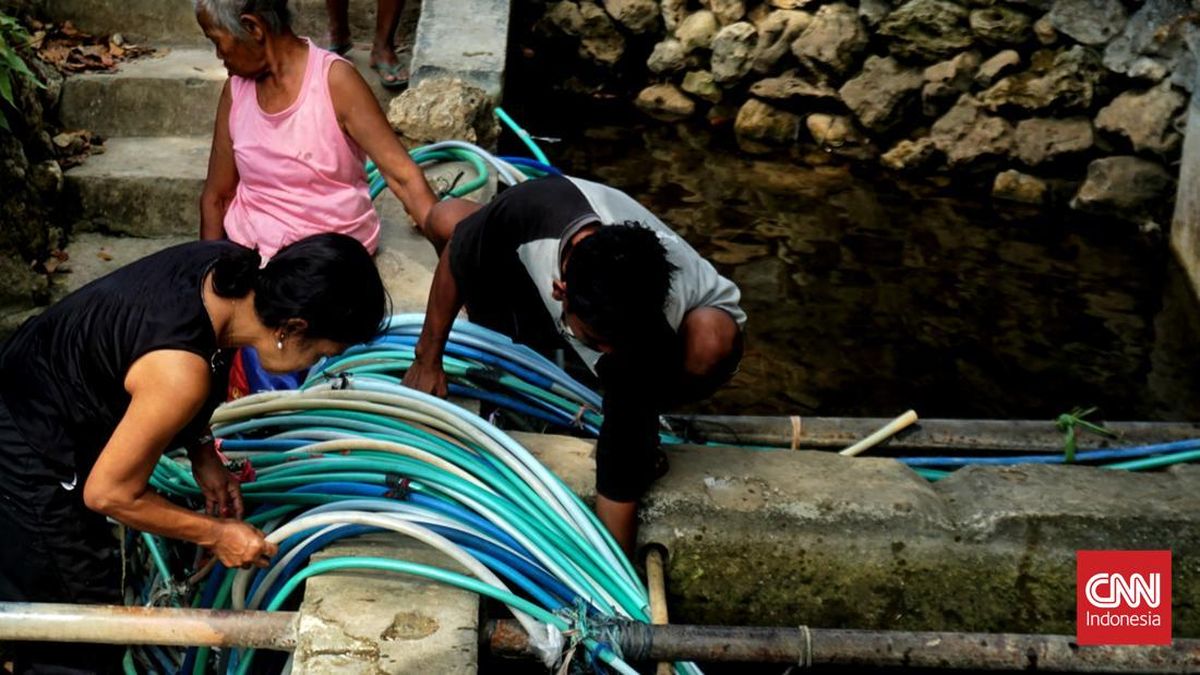
Dozens of people, ranging from youths to the elderly, stood patiently under the shade of trees on Friday (31/7), waiting for the sound of trickling water from the ‘Sendang Wonosari’ natural spring in Kalidadap I, Selopamioro, Imogiri, Bantul. This spring is where their daily lives almost always begin and end.
While chatting casually, residents occasionally untangle hoses extending from the edge of the spring. There is no rush; the residents of Kalidadlagap I and II take their respective hoses, preparing to channel water to houses scattered across the limestone hillsides. The water flows without the aid of machines or pumps. Residents simply use their mouths to create suction at the end of the hose until water is pushed into the plastic pipes, after which gravity takes over. The elevation difference between the spring and the houses allows the water to flow downwards through hoses that can reach hundreds of metres in length.
This simple method has been part of the residents’ daily routine for decades. In an area not yet reached by the regional water utility (PDAM), the spring is a primary pillar for meeting life’s needs, including drinking, cooking, bathing, and livestock requirements. During the dry season, the water volume decreases, forcing residents to wait longer for their turn as the flow diminishes. However, these limitations have never led to conflict or competition among the community.
There are at least approximately 80 hoses connecting the spring to the residents’ homes, each of varying lengths depending on the distance from the source. One of the longest belongs to Teguh, 27, a resident of Kalidadap I. “Mine consists of 12 rolls of hose, with each roll being 50 metres,” Teguh said. He claims his hose is the longest because his house is the furthest away, reaching a total length of about 600 metres as it follows the contours of the road.
The routine of gathering around the spring occurs daily at 06:00, 08:00, and 14:00 WIB. These times are chosen before most of the water volume is diverted to irrigate agricultural land on the lower slopes. “We gather here at these specific times. We wait for the water to fill up, and then we suction it together,” he explained.
While the process appears simple, transporting water via hoses requires patience and precision. The water will not flow smoothly if the hose connections are left attached from the start. Therefore, residents must disconnect each joint first to allow air to escape the hose so the water can move faster. “Every hose connection needs to be disconnected first. If not, the water won’t reach or will flow too slowly. Once it is flowing, we reconnect them,” said Teguh.
That afternoon, several residents were seen walking along their hose paths. Some returned to connection points because the water had not yet reached their homes. Fortunately, each hose is marked so owners can easily identify theirs among the dozens of intersecting lines. For Teguh, the routine can sometimes be both troublesome and amusing. He recalled a time when his water storage tank was completely empty just when he needed to use the toilet, leaving him no choice but to trek back up to the spring to restart the suction process. “Yes, it is quite a hassle when that happens,” he said with a chuckle.