
80 Hectares of Rice Fields in Badung Threatened by Drought
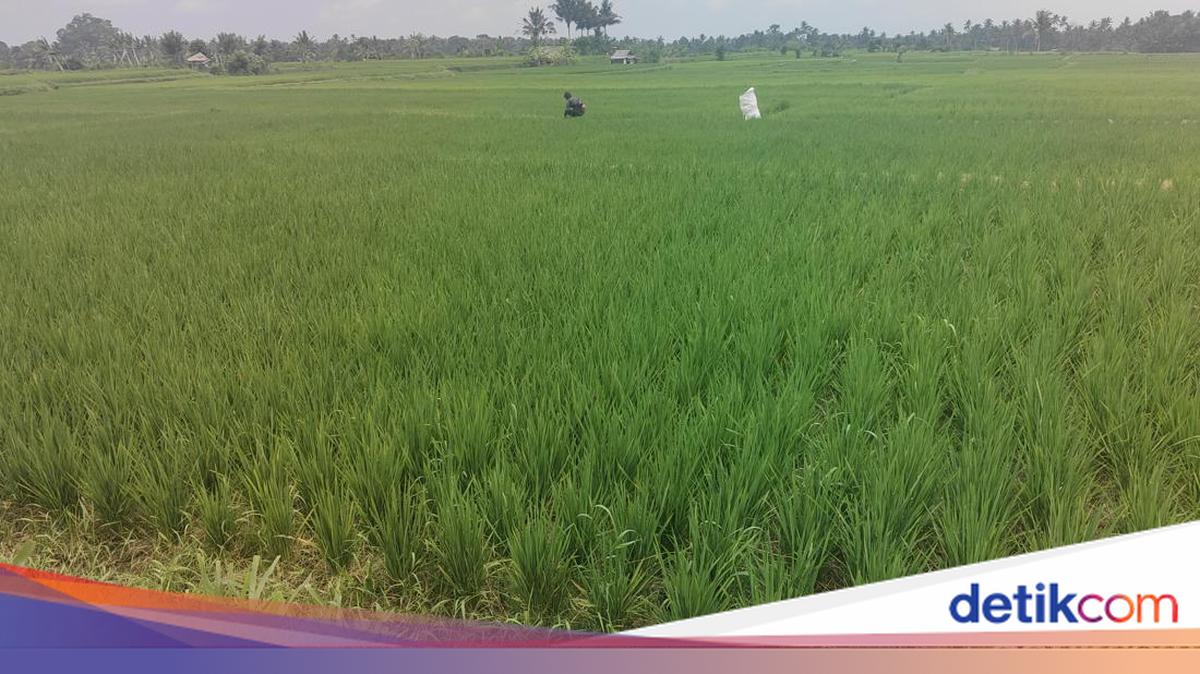
An extreme dry season is triggering drought threats to active agricultural land in Badung Regency, Bali. Drought impact maps indicate that at least 80 hectares of rice fields, spread across the Petang and Abiansemal districts, are currently affected.
Decreasing river water levels have forced local farmers to implement strict water supply rotation systems to save their crops. This challenge is being felt directly by farmers in Subak Bregiding, Pangsan Village, Petang District, who must prepare to irrigate their fields in the early hours of the morning.
“The water flow from upstream is very low, so we farmers must take turns receiving water. I receive my schedule once every two days, and starting at 2 am, the irrigation channels are diverted to the rice plots,” said local farmer Wayan Karya, 39.
He noted that this situation has persisted since last month. In addition to natural factors, the deterioration of aged water tunnels in the area is currently undergoing repairs. According to Wayan, the disrupted water flow is impacting southern areas, such as the Geriana subak in Abiansemal.
The Head of the Badung Agriculture and Food Office, Anak Agung Ngurah Raka Sukadana, confirmed that the situation is impacting rice productivity across a total of 80 hectares of rice fields in the Petang district and several points in Abiansemal.
“The subak affected by the drought covers approximately 80 hectares in Petang. There is also impact in Gerana, Abiansemal District, due to tunnel damage that affects areas further downstream,” said Ngiment Ngurah Raka Sukadana on Thursday (1/10/2026).
The primary drivers of this agricultural drought include not only reduced water discharge but also the delayed rainy season and inadequate irrigation infrastructure. Furthermore, water allocation is increasingly disrupted because a three-kilometre stretch of traditional irrigation channel in one agricultural area has not yet been concreted, causing much of the water to be absorbed into the ground.
“Water levels have indeed decreased significantly due to the extreme climate, but the key lies in water management and channel repairs. In Subak Buangga, for example, much of the water is absorbed by the soil because the irrigation channels have not been concreted,” said Raka Sukadana.
As an emergency measure, the Badung Regency Agriculture and Food Office is encouraging stricter crop rotation patterns by switching to secondary crops (palawija). Adjusting planting schedules is considered the most rational solution given that extreme weather predictions suggest the arrival of the rainy season continues to shift.
“Our farmers actually understand the weather, but recently many were daring to plant rice in hopes of rain. However, if managed with secondary crop patterns and good irrigation, extreme weather would not have such a significant impact,” Raka Sukadana explained.
The Badung Regency Government has coordinated with the Bali-Penida River Basin Organisation (BWS) to repair damaged upstream tunnels and clogged water channels. Additionally, physical infrastructure repairs and the re-profiling of farmers and irrigation systems are set to be realised through the supplementary budget.
“The repair of the damaged tunnel is currently underway manually because the terrain is steep and difficult for heavy machinery to access. We have also budgeted for irrigation and farmer condition data collection in the supplementary budget so that physical repairs can be accelerated,” concluded Raka Sukadana.
Source: jawawa.id (https://jawawa.id/newsitem/80-hectares-of-rice-fields-in-badung-threatened-by-drought-1790848415)
Originally published by detikBali (https://www.detik.com/bali/berita/d-8687999/80-hektare-sawah-di-badung-terancam-kekeringan), translated from Indonesian