
8 Key Points from Prabowo's Speech: 121 Policies, Food Self-Sufficiency, to 6 Percent Economic Growth
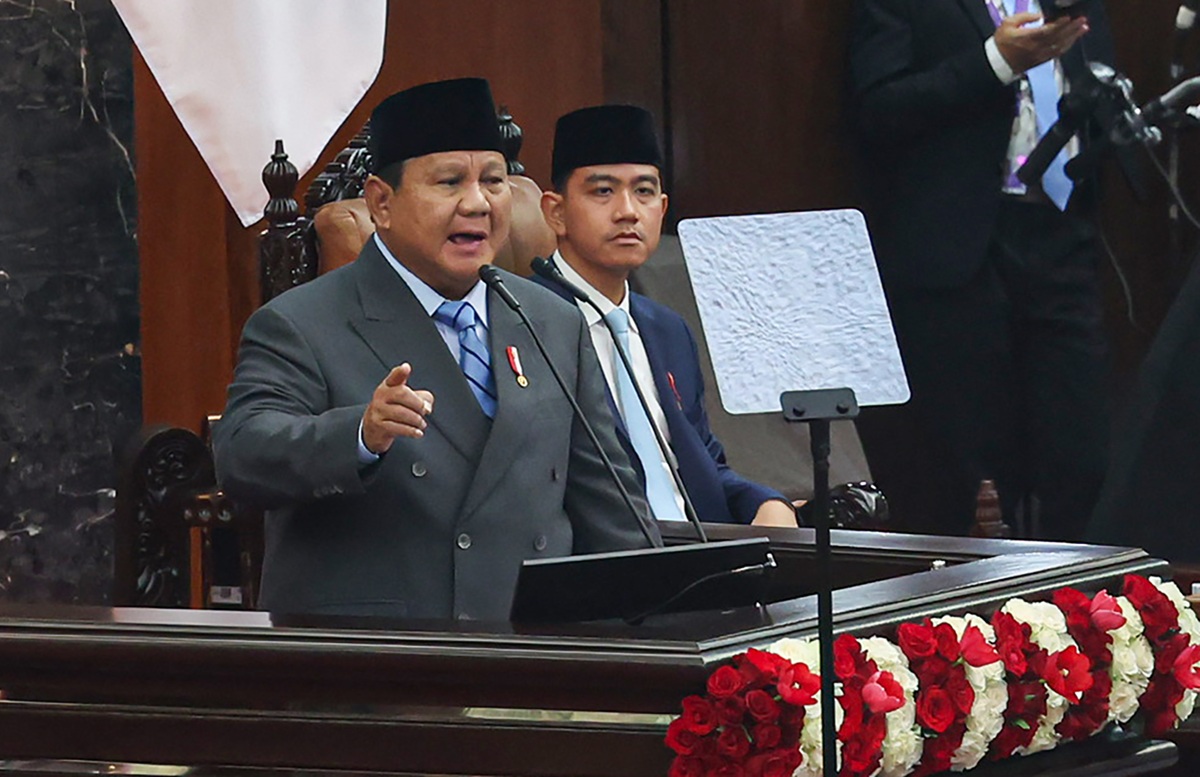
President Prabowo Subianto delivered a series of major government agendas in his state address at the Annual Session of the MPR RI and the Joint Session of the DPR and DPD RI on Friday (14/8). In the speech, which was followed by the delivery of the Government’s Statement on the Draft Law on the 2027 State Budget (RUU APBN) and its Financial Note, Prabowo emphasised his administration’s direction towards strengthening national self-reliance, economic growth, budget efficiency, human resource development, and the management of natural wealth for the people’s benefit.
One of Prabowo’s main messages was that economic growth must not stop at statistical figures. According to him, the measure of development success must be seen from how much that growth improves public welfare. In his speech, Prabowo mentioned that the Indonesian economy grew by 5.61 percent in the first quarter of 2026 and 5.45 percent in the first half of 2026. He is optimistic that economic growth can reach 6 percent by the end of this year if the government implements the right policies. “With the right, rational, and common-sense policies, I am confident our economic growth can reach 6 percent,” said Prabowo.
Prabowo stressed that economic growth and investment are not the government’s ultimate goals. Investment must have a direct impact in the form of job creation and improving the quality of life of the people. He said investment realisation in 2025 reached Rp1,931 trillion and created more than 2.7 million jobs. Meanwhile, investment in the first half of 2026 reached Rp1,010 trillion and was said to have generated more than 1.4 million jobs. “For me, growth and investment are not the end goal. Our goal is the welfare of the people,” said Prabowo.
Within the framework of the 2027 Draft State Budget (RAPBN), the government has set an economic growth target of 6 percent. State spending is designed at Rp4,097.2 trillion with state revenue of Rp3,426 trillion. The budget deficit is set at 2.4 percent of gross domestic product (GDP), lower than the projected 2026 deficit of 2.85 percent and still below the maximum limit of 3 percent as stipulated by law. Meanwhile, the macro assumptions of the 2027 RAPBN include inflation of 2.5 percent, an average rupiah exchange rate of Rp17,500 per US dollar, and a 10-year government bond yield of 6.9 percent.
Prabowo also said the design of the 2027 RAPBN remains expansionary, but is directed in a more measured manner to encourage growth while accelerating welfare improvement. “The architecture of the 2027 State Budget is designed to remain expansionary, collaboratively, directed, and measured,” said Prabowo. Furthermore, eight main agendas are the focus of budget policy, including food and energy self-sufficiency, strengthening national industry, and improving the quality of education.
Amidst large spending needs, Prabowo paid attention to fiscal discipline. He stressed that budget control must not only be carried out when the state budget is drafted and approved, but must be applied through to the implementation stage. “Fiscal discipline does not stop when the budget is approved,” said Prabowo. The government is targeting spending efficiency through the consolidation of government procurement of goods and services. Prabowo assessed that many ministries, agencies, and regional governments have been buying the same goods separately, resulting in varying prices and weakening the government’s bargaining power.
He cited the example of procurement of interactive smart screens or Interactive Flat Panels (IFP). Previously, regional governments were said to have purchased these devices separately at a price of around Rp150 million per unit. After procurement was consolidated through the Ministry of Primary and Secondary Education, the price was reduced to around Rp26 million per unit, including delivery and installation to underdeveloped, frontier, and outermost regions. Based on LKPP data presented by Prabowo, consolidation of regional government procurement produced efficiency of 20.86 percent in 2025 and is projected to reach 25.43 percent in 2026. The government estimates this efficiency could reach around Rp360 trillion in a year. “We can do a great deal with Rp360 trillion, and this is in our hands,” said Prabowo.
To strengthen this policy, the government plans to upgrade the institutional status of LKPP to become a government procurement agency. The needs of ministries, agencies, and regional governments will be consolidated, goods specifications standardised, and procurement volumes aggregated so that the government has greater bargaining power. The procurement system is also directed to be digitally based to strengthen transparency and accountability. Prabowo assessed that budget savings must be returned to the public through more productive spending. The fiscal space obtained from efficiency will be directed, among other things, to repairing schools, renovating community health centres, strengthening hospitals, and providing health equipment.
Another major agenda is transforming Indonesia’s natural wealth into national economic strength. Prabowo said the government does not want Indonesia to be merely a country rich in natural resources but not obtaining optimal added value from that wealth. “All the policies we undertake have one goal: to transform Indonesia’s wealth into Indonesia’s strength,” he stressed. Therefore, the government is encouraging the strengthening of strategic commodity exchanges, optimisation of state-owned enterprise assets, development of the Indonesia International Financial Centre (IIFC), and the establishment of the Danantara Development Management Fund (DDMF) to finance long-term projects. The government is also encouraging the creation of a market for domestic products through electric vehicle subsidies.
Prabowo also specifically announced plans to establish a Strategic Mineral and Commodity Exchange. The exchange is targeted to begin operations on 1 January 2027. The policy is intended so that Indonesia is not only a producer of various strategic commodities.
Source: jawawa.id (https://jawawa.id/newsitem/8-key-points-from-prabowos-speech-121-policies-food-self-sufficiency-to-6-percent-economic-growth-1786765834)
Originally published by Media Indonesia (https://mediaindonesia.com/ekonomi/922091/8-poin-penting-pidato-prabowo-121-kebijakan-swasembada-pangan-hingga-ekonomi-6-persen), translated from Indonesian