
8 Hours to Break Through Domei and the Non-Simultaneous News of Independence
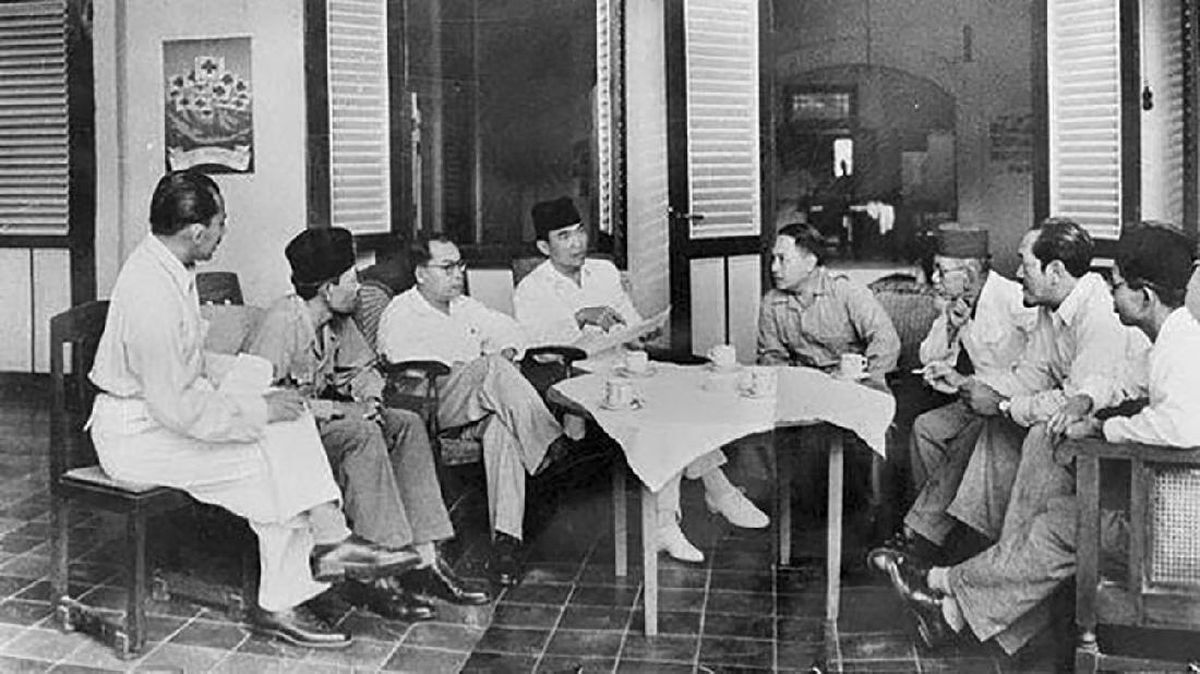
That night Sukarno and Mohammad Hatta gathered at the residence of Rear Admiral Tadashi Maeda, Head of the Japanese Navy Liaison Office. Sukarno asked Hatta to draft the text of Indonesia’s proclamation of independence.
“I invite Bung Hatta to draft that concise text because I consider his language to be the best,” Sukarno said to Hatta on the night of 16 August 1945.
That moment is recorded in Hatta’s autobiography entitled Menuju Gerbang Kemerdekaan.
At 03.00 WIB, the drafting of the proclamation text was completed and it was planned to be read by Sukarno together with Hatta at 10.00 WIB in Pegangsaan Timur, Jakarta.
Hatta did not go straight home. He advised the young people present, including members of the press: “You have all worked hard all day, but you must continue vigorously with the new task, namely reproducing the proclamation text and spreading it throughout Indonesia as far as possible. Those of you who work at the Domei office should wire the news of the proclamation as far as possible to the whole world that can be reached.”
Hatta’s words became a signal for the young generation to immediately inform all regions that Indonesia was independent.
A number of young people took on the heavy task of becoming “couriers” to spread the news of the proclamation. At that time, a courier was not merely a carrier of a piece of proclamation message, but rather a ‘human network’.
While Sukarno and Hatta rested to prepare themselves to read the proclamation, the student groups, Sukarni, and the kaigun (known as the three youth groups) remained awake until morning.
They prepared plans to organise the dissemination of the news of the proclamation of independence. In the book Sejarah Berita Proklamasi, it is written that one of their central gathering points was at Def van den Bosch 56.
There, they devised tactical strategies while also rapidly printing thousands of leaflets with the help of the people and workers of the Domei news agency, now known as Antara News Agency.
Alongside the reading of the proclamation of independence, columns from various groups also began spreading the news of this historic event.
They spread the news in the places where they were assigned while being shadowed by Japanese troops. Quickly the news of independence spread throughout Jakarta and its surrounding areas.
Spreading beyond Jakarta
The dissemination of this news was also carried out to areas outside Jakarta using trains, cars, telephones, and telegraph wires. It took about 8 hours for the event of Indonesia’s proclamation of independence to be broadcast for the first time via radio.
Sukarni initially tried to force his way into the broadcast studio belonging to Domei, but failed. At 13.00 WIB, a similar attempt was made by a group of student fighters. They failed because they were arrested by the Japanese after a pistol fell while climbing the stairs.
A senior journalist from the Domei news agency, Sjachrudin, tried to enter and succeeded. Sjachrudin managed to enter the studio after climbing the back wall from Tanah Abang. He carried two sheets of paper consisting of a letter from Adam Malik and the complete text of the proclamation of independence.
The news of Indonesia’s proclamation of independence was then broadcast for the first time via radio at 19.00 WIB. The success of broadcasting the proclamation news via radio was inseparable from efforts to deceive the Japanese troops.
When the proclamation of independence was first broadcast, the loudspeaker directed into the studio room played official news bulletins, whereas the actual news being broadcast was the proclamation of Indonesian independence.
However, in the end, the deception was discovered. This led to Jusuf Ronodipuro, the reader of the proclamation news, and Bachtiar Lubis, the news editor, being arrested by the Kempetai.
They were tortured until finally released when Tomobachi, the general manager of Japanese Radio, came and freed them on the condition that they stop all radio broadcasts.
However, Ronodipuro together with his comrades in arms, led by Abdulrachman Saleh, established clandestine transmitters under the name Radio Indonesia Merdeka.
For direct overseas broadcasts, the radio used the identifier ‘This is the voice of free Indonesia’ located in Gondangdia (now the BNI 46 building) and at the medical school on Salemba Raya.
Dissemination of the proclamation news in the regions
The news of Indonesia’s proclamation of independence was received at different times in various regions of Indonesia. Professor of History at the University of Indonesia (UI), Susanto Zuhdi, explained that there were three main channels in the dissemination of the proclamation news to the regions.
Zuhdi said that the efforts to spread the news of the proclamation of independence were mainly carried out by young people who had been involved in the Indonesian independence movement.
However, he stressed that what the young people did was not merely spreading the news of the proclamation of independence, but they also actively participated in building regional governments after the proclamation of independence was made.
“So, there are three categories (of dissemination of the proclamation news). Through the press such as radio because the Domei news agency had been taken over by the youth and so on, then through print media such as brochures or leaflets that were printed, and through the youth and students in Jakarta who were then assigned to return to their respective regions,” Zuhdi told CNNIndonesia.com by telephone on Sunday (9/8).
“These are the ones who truly returned to their regions and then did not merely convey that we were independent, but also formed regional governments,” he continued.
Similarly, historian from the National University, Andi Achdian, also explained that the youth, students, and figures who returned to their respective regions to convey the information about the proclamation of independence were not merely couriers.
Andi said their presence was to give confidence to the public that Indonesia was independent, with a more complete explanation. Moreover, he said, at that time information tended to be difficult to believe because there were still many fascist Japanese troops in Indonesia.
“So, even though people had heard via radio, they still needed to be convinced because this is a matter of whether it is true that we are independent, which indeed needed to be assured,” Andi told CNNIndonesia.com on Saturday (8/8).
Furthermore, Andi explained that the youth or figures who returned to the regions immediately built government structures as a follow-up to an independent state.
Therefore, Andi stressed that the majority of these returning figures were not merely couriers, but educated people who had long been involved in the process of Indonesia’s independence struggle.
“Their main task was to institutionalise the independence of the Republic. So, when they arrived, they arranged and built the Regional Indonesian National Committee (KNID) organisation, and in that process the information related to independence also became more systematically conveyed,” Andi revealed.
The non-simultaneous news of independence
Regarding the disbelief of people in the regions when receiving information about the proclamation of independence, this is also written in the book Sejarah Berita Proklamasi Kemerdekaan.
In Sumatra, for example, there were residents who immediately believed and there were also residents who doubted.
Several factors caused this: Japanese troops strictly controlled political activities in the regions, differences in residents’ opportunities to access information, differences in the public’s psychological response to decisions with major impacts, and the attitude of community groups that had special relationships with the colonisers.
Inequality or differences in receiving the news of the proclamation of independence in Sumatra were also apparent.
The city of Bukittinggi received the news on the same day, namely on the evening of 17 August 1945. This important information was received by Ahmad Basya, a post, telegraph, and telephone (PTT) employee at the Domei news agency.
At that time, Ahmad Basya and his colleague named Asri Aidid Sutan Rajo Nan Sati immediately typed the proclamation text in 10 copies which were then posted in various locations in Bukittinggi.
Unlike Bukittinggi, which received the information about independence on the same day, the city of Pekanbaru only learned of the information in the final days of August.
The information was first learned by Saari and Azwar Apin, who were also PTT employees at the Domei news agency.
At that time, they also only received information verbally rather than in text form, which caused residents to doubt the news of Indonesia’s independence.
Residents’ belief in the information about independence began to grow on 30 August, triggered by the arrival of the written proclamation text brought from Bukittinggi.
Kalimantan also experienced delays in receiving information about the proclamation of independence, as did Sumatra. Some areas even only received news of Indonesia’s independence several months later.
Apart from being caused by communication facilities and infrastructure that were difficult to reach remote areas, the delay in information was also caused by repressive actions by fascist Japanese troops.
Pontianak received the news of independence more quickly, namely on the evening of 18 August. At that time, a young man named M. Sukandar heard the news of the proclamation from his radio which was hidden from Japanese troops.
Through that radio, he heard that Sukarno had proclaimed Indonesia’s independence on 17 August 1945, which he then passed on secretly by word of mouth until it spread from mouth to mouth.
In contrast to Pontianak, Pemangkat and Singkawang only received news of Indonesia’s proclamation of independence in October.
Information about the proclamation of independence was only received by the people of Singkawang through a member of the Youth Broadcasters of the Republic of Indonesia (PPRI) named Ya’ Ahmad Dundik on 2 October.
Meanwhile, the people of Pemangkat only received news of Indonesia’s independence through M. Akir in mid-October. Akir was a young man from Semparuk Village who returned after migrating from Semarang.
Source: jawawa.id (https://jawawa.id/newsitem/8-hours-to-break-through-domei-and-the-non-simultaneous-news-of-independence-1786924254)
Originally published by CNN Indonesia (https://www.cnnindonesia.com/nasional/20260813201153-20-1392023/8-jam-menembus-domei-dan-berita-kemerdekaan-yang-tak-serentak), translated from Indonesian