
8,177 UGM Students Deployed to 32 Provinces for Community Service Programme
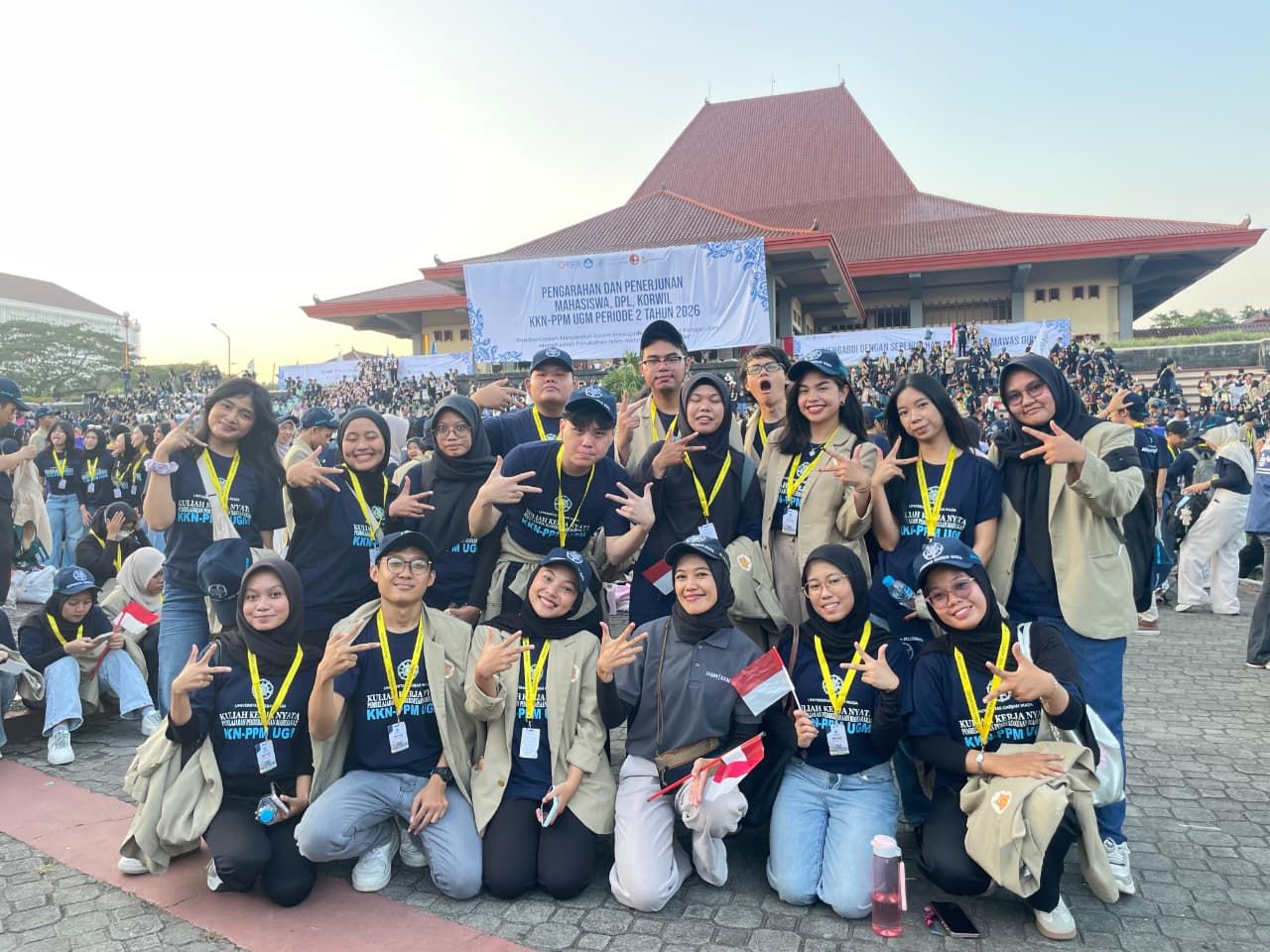
Deputy Minister of Industry (Wamenperin) expressed high appreciation and entrusted an important mission to more than 8,000 Universitas Gadjah Mada (UGM) students deployed in the UGM Community Empowerment Learning Programme (KKN-PPM) Period II of 2026. “I want us to jointly cheer for our proud campus, Universitas Gadjah Mada, by shouting long live UGM. Long live UGM! Long live UGM! Long live students!” exclaimed the Deputy Minister during the briefing and deployment event for students, field supervisors, and regional coordinators on Friday afternoon. In his remarks, the Deputy Minister conveyed pride in UGM’s decades-long consistency in maintaining close ties between academia, society, and the regions. He described KKN as a tangible form of intellectual service to directly experience community conditions while helping to find swift solutions to problems on the ground. Recognising that students will face diverse cultures, customs, and ways of thinking at their placement sites, the Deputy Minister remained optimistic that these challenges can be overcome. “We are confident that with our spirit of national unity, your service will proceed smoothly and you will return to our beloved campus to complete your education,” he said. The Deputy Minister stressed that the vast natural potential, resources, and networks in villages would be wasted if not woven into industrial strength. For the Ministry of Industry, village industrialisation is the solution to economic problems the nation has faced for decades. He specifically requested direct assistance from the thousands of UGM KKN students to engage with the Small and Medium Industry (IKM) sector. Currently, there are more than 14,000 IKM centres spread across various regencies throughout Indonesia. “These small and medium industry centres are what we hope will become the motor of village industrialisation. I want your help to provide many ideas, initiatives, and direct assistance so we can empower these IKM centres. Those that are dormant we can revive, those halfway we can push forward, and those already strong we can help with networks and connections,” he explained. The Ministry challenged the students to bring back feedback after the KKN period ends, in the form of concrete input on strategic steps needed to strengthen IKM centres in the future. The younger generation, particularly UGM students, is expected to become a strong bridge between campus knowledge and development practice in society. “The future of industrialisation is truly determined not only by the government, but by the ability of the young generation to deliver real solutions for the people. Congratulations on your service, congratulations on helping the people. Make KKN a space for learning as well as a space for contributing to build an Indonesia that is more advanced, inclusive, and competitive,” he stated. UGM Rector Prof Ova Emilia said the total number of KKN-PPM participants this time is 8,177 students, spread across 32 provinces. The implementation of SHE (Safety, Health, and Environment) is a fundamental evaluation focus to strengthen security and risk mitigation. Each team now has a special SHE coordinator who works together with KAGAMA (UGM Alumni Family) and the task force. UGM has also prepared life jackets for locations with water-based activities. Director of the UGM Directorate of Community Service, Dr. dr. Rustamaji, M.Kes., added that the overarching theme of this KKN is food security. This theme was chosen due to Indonesia’s scattered geographical conditions and data from the National Food Agency (BAPANAS) showing that several KKN locations, such as Papua, are in a food security red zone because they are heavily dependent on external supplies. The programme is directed at encouraging self-sufficiency and improving the supply chain. The programme output focuses on economic resilience, which includes identifying and developing new tourism areas, strengthening MSMEs, and enhancing financial and digital literacy to prevent fraud in communities that are still unfamiliar with such risks. “All students will be withdrawn on 8 August 2026,” he concluded.