
73rd Anniversary of IKAHI Viewed as Reflection on Criminal Justice Reform
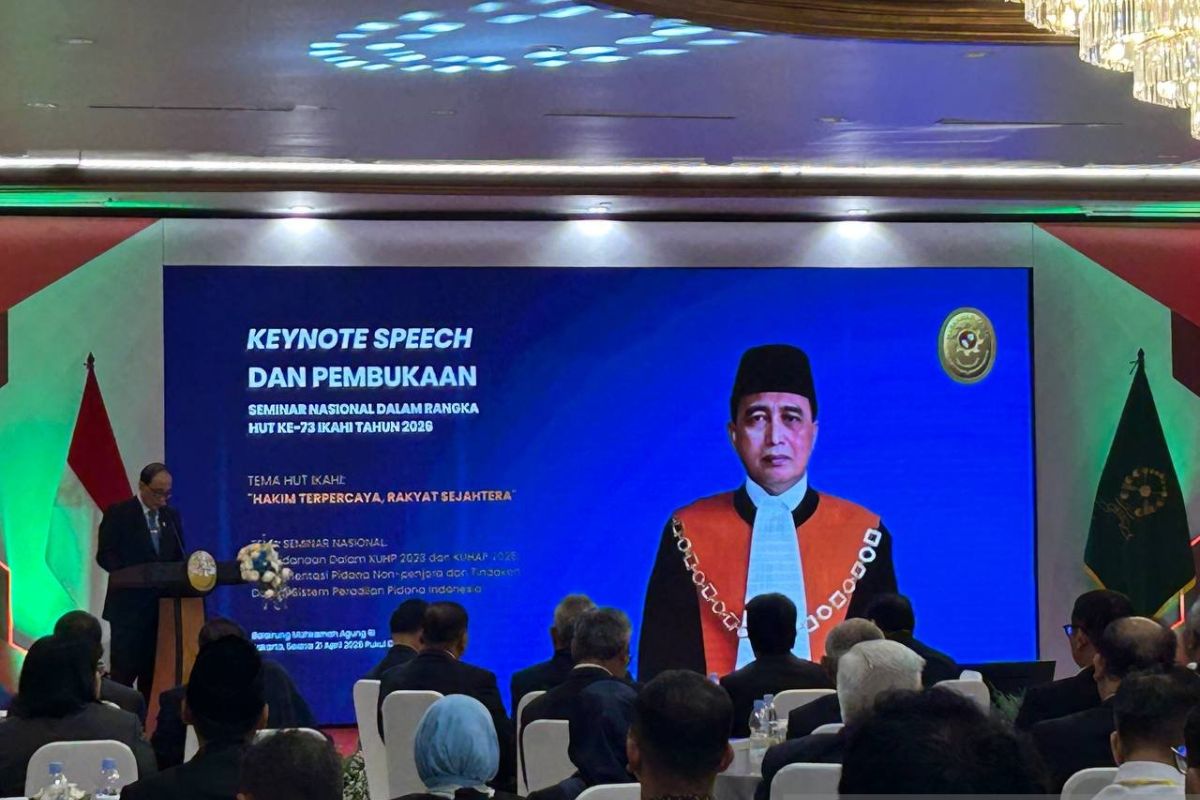
Jakarta (ANTARA) - Supreme Court Chief Justice Prof. Sunarto views the commemoration of the 73rd anniversary of the Indonesian Judges Association (IKAHI) not merely as a ceremonial event, but as a space for collective reflection to bolster commitment to criminal justice reform that is adaptive, humane, and oriented towards substantive justice.
“This is not just a ceremonial event, but a space for collective reflection to strengthen commitment to adaptive, humane criminal justice reform oriented towards substantive justice,” said Sunarto at the National Seminar marking the 73rd IKAHI Anniversary in Jakarta on Tuesday.
He stated that a good criminal justice system is not only measured by its ability to enforce legal norms formally, but also by its capacity to realise civilised justice, namely justice sensitive to humanitarian values, upholding professionalism, and oriented towards social utility.
In line with that, he said, the success of implementing the new sentencing paradigm, including strengthening non-custodial penalties and actions, is greatly determined by the integrity, consistency, and synergy of all elements in the criminal justice system.
The national seminar carried the theme “Sentencing in the 2023 Criminal Code and 2025 Criminal Procedure Code: Implementation of Non-Custodial Penalties and Actions in the Indonesian Criminal Justice System”.
Speakers included Chairman of Commission III of the House of Representatives (DPR RI) Habiburokhman, Deputy Minister of Law Prof. Edward Omar Sharif Hiariej, and Deputy Attorney General for General Criminal Affairs (Jampidum) Prof. Asep Nana Mulayana.
IKAHI Chairman Prof. Yanto conveyed that the seminar held on Tuesday is not merely a ceremonial academic activity, but a strategic and highly urgent forum in the context of national criminal law dynamics.
“At present, we are part of a major paradigm shift, from a sentencing system oriented towards imprisonment to a more humane, restorative, rehabilitative, and corrective system,” he said.
According to Yanto, there needs to be a common perception at the implementation level of these new laws because the new laws still have articles that conflict with others.
“Therefore, to ensure a common perception among law enforcement officials, both investigators, prosecutors, and judges, this is why we initiated this seminar,” he said.