
70% of Indonesian Farmers Are Over 45: The Government’s Plan
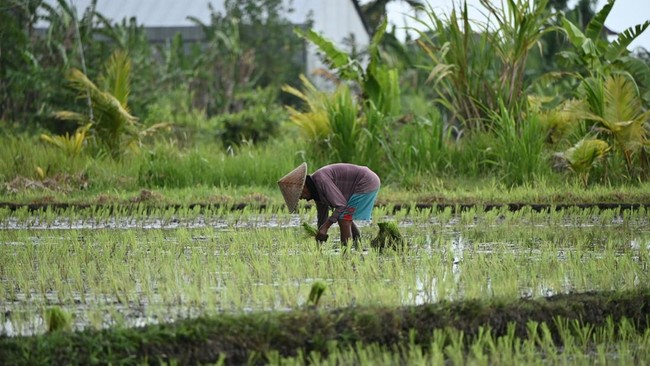
Jakarta, CNBC Indonesia — The government is seeking to transform Indonesia’s agricultural sector to make it more attractive to younger generations. Data show that around 70% of Indonesian farmers are now aged over 45, making farmer succession an urgent challenge.
Widiastuti, Deputy for Food and Agricultural Business Coordination at the Coordinating Ministry for Food Affairs, said the government needed to make agriculture more appealing to young people—not merely as a traditional occupation, but as a promising business opportunity.
“Currently, 70% of our farmers—Indonesian farmers—are aged 45 or over,” Widiastuti said at CNBC Indonesia’s World Food Day event on Friday (30 October 2026).
She said three main areas needed to be addressed to encourage young people to enter the sector: the use of modern technology, attractive economic returns, and the prestige or pride associated with being a farmer.
One challenge in attracting young people, she said, was the image of farming as physically demanding work in rice fields, involving direct contact with mud and soil.
“In my view, there are three things that need to be overcome. The first is modern technology, because young people today have grown up with technology,” she said.
The government also needs to ensure that agriculture can offer attractive economic returns. This would help young people see farming as a business with prospects, rather than simply an inherited occupation passed down by their parents.
“Second, there must be promising returns. These cannot just be something imagined; young people who choose to farm need to be able to calculate the actual and attractive economic gains,” she said.
The third factor is prestige. According to Widiastuti, farming must also inspire appeal and pride so that young people no longer view it as an occupation with poor prospects.
“The third is clearly prestige for today’s young people. We need to make a breakthrough so that the sector becomes attractive and all three pillars are achieved,” she said.
To achieve this, the government is promoting the digital transformation of agriculture. By using technology, young people are expected to manage farming businesses through digital devices such as mobile phones and tablets.
This technology can help farmers plan production according to the conditions and size of their land, including determining the appropriate amount of fertiliser and managing water use.
“With a mobile phone or tablet, it is possible to plan farming based on the conditions of the land. For example, on one hectare, you can work out how much fertiliser is appropriate and how much water is needed, without necessarily having to get wet,” Widiastuti said.
Alongside digitalisation, the government also wants to encourage entrepreneurship among younger generations. Young people are expected not only to work in agriculture, but also to develop innovations and creative ways to manage farmland, including land owned by their families.
“Young people must be able to develop their innovation and creativity to bring their own land, or their father’s land, into productive agricultural use,” she said.
The government also considers easier access to land and financing, as well as certainty of markets, important to helping young people develop agricultural businesses.
Widiastuti said digitalisation could also open up wider markets, allowing agricultural products to reach beyond domestic buyers.
“This is an interesting breakthrough, because it can open up access to a much more global market,” she said.
Education, training and the presence of agricultural extension officers are also considered important to supporting the next generation of farmers.
Widiastuti said the government was seeking to strengthen the role of extension officers so that support and development in the agricultural sector could be better directed.
She referred to Presidential Instruction No. 3 of 2025 on agricultural extension officers, which provides for their transfer to the central government to support progress in the sector.
“Food Affairs Coordinating Minister Zulkifli Hasan said in 2025 that, under Presidential Instruction No. 3 of 2025 on extension officers, their role—following the initiative of the technical ministry—is to be brought under the central government. This is to ensure a unified focus on agricultural progress,” she said.
Source: jawawa.id (https://jawawa.id/newsitem/70-of-indonesian-farmers-are-over-45-the-governments-plan-1793353859)
Originally published by CNBC Indonesia (https://www.cnbcindonesia.com/news/20261030133303-4-780916/70-petani-di-ri-berumur-di-atas-45-tahun-ini-rencana-pemerintah), translated from Indonesian