
70 Million Indonesians Banned from Social Media, Yet Many Remain Defiant
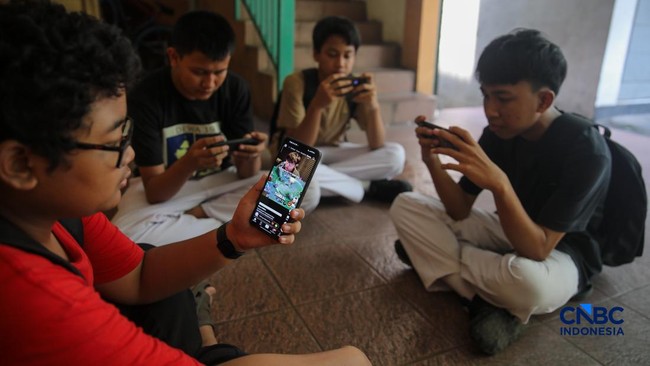
Jakarta, CNBC Indonesia – The government has set a ban on children under 16 accessing social media from 28 March 2026. The policy refers to Government Regulation Number 17 of 2025 (PP Tunas), subsequently reinforced by Ministerial Regulation of the Ministry of Communication and Digital Number 9 of 2026.
The Minister of Communication and Digital (Menkomdigi), Meutya Hafid, revealed recently that this step forms part of a national movement to protect the younger generation from the harmful effects of digital-space algorithms.
According to government data, there are approximately 70 million children in Indonesia aged 16 and under. This means that as of 28 March, those 70 million Indonesian citizens will certainly lose their right of access, or be legally banned from using social media platforms.
Nevertheless, the implementation of this rule has encountered challenges in practice. This was disclosed by the Deputy Minister of Communication and Digital, Nezar Patria, in an official statement on the Komdigi website at the start of the week.
“There is one survey showing that out of five children, three have definitely falsified their age in order to access social media. This is already commonplace,” said Nezar.
This practice of data manipulation poses a serious challenge to regulatory enforcement, as the gatekeeping verification mechanism rests entirely under the control of each digital platform’s own system.
Pushing for Stronger Technology Whilst Safeguarding Personal Data
In response to this loophole, Komdigi has affirmed that it has asked all global digital platform operators to urgently strengthen their age identification and verification technology. Whilst urging platforms to tighten their systems, the government has also cautioned that such measures must not come at the expense of users’ sensitive data security.
“We have already conveyed this to the platforms, because it is the platforms that can regulate this with the technological solutions they possess. However, age identification must also continue to comply with the principles of personal data protection,” Nezar explained.
To date, a number of major platforms are reported to have begun responding by implementing far more aggressive algorithmic systems. This technology is designed to detect and recognise activity patterns of users suspected to be underage, including tracking the type of content they access.
Nezar added that this systemic intervention is slowly beginning to bear fruit, with a number of children’s accounts proven to have falsified their identity now being progressively blocked and no longer able to access the services.
The Key Lies in Parents’ Hands
Beyond the sophistication of technology and the strictness of regulatory sanctions, Komdigi emphasises that the most crucial line of defence for children’s cyber safety lies in the smallest environment, namely the family.
The government continues to encourage the use of parental guidance features and active parental involvement in regularly monitoring children’s digital footprints.
“As parents, we must indeed be more intensive in accompanying our children. The family approach remains an important part of protecting children in the digital space,” he concluded.