
7 Facts About the Tramadol Factory Producing Millions of Pills Dismantled by Jakarta Police
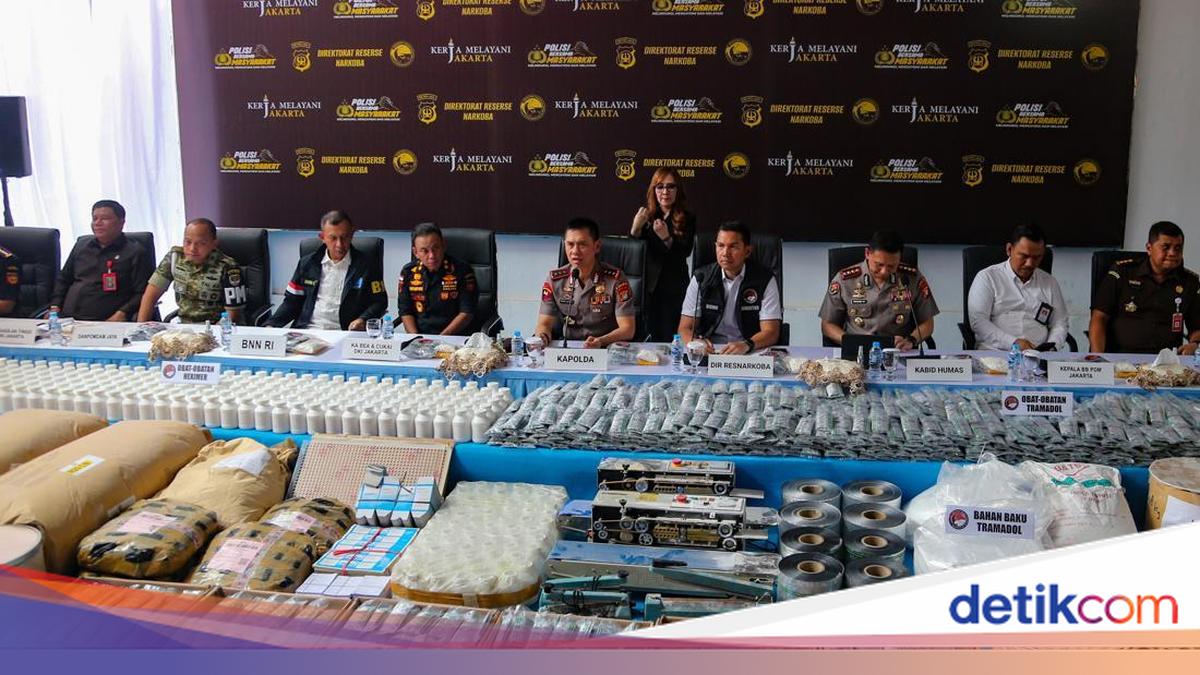
The circulation of tramadol in Jakarta and surrounding areas has caused concern among the public. Disguised as grocery shops, herbal medicine stores and other businesses, some distributors have been operating with increasing impunity.
Recently, Jakarta Metropolitan Police uncovered a shipment of 20 packages of tramadol at the Kereta Api warehouse in Kampung Bandan, Tanjung Priok, North Jakarta. The investigation led police to dismantle factories producing millions of tramadol tablets in Gatak and Kartasura sub-districts, Sukoharjo regency, Central Java.
Alongside millions of tramadol and trihexyphenidyl tablets, police seized 16 suspects. Two alleged owners of the factories remain at large.
Jakarta Metropolitan Police Chief Commissioner General Dadang Hartanto said the case was uncovered through cooperation between the force’s narcotics investigation directorate and the Jakarta Regional Office of the Directorate General of Customs and Excise. He said the operation reflected the National Police’s commitment to tackling narcotics and dangerous prescription medicines, and was in line with National Police Chief General Suyudi Ario Seto’s priority programme.
“This is an effort to protect the public from being influenced to use and misuse medicines. It is in line with the National Police Chief’s priority programme, ‘Police with the Community’. One of the eight quick-win programmes focuses on narcotics,” Dadang said at a press conference at Jakarta Metropolitan Police headquarters on Wednesday, 21 October.
Here are the key facts about the tramadol factories in Sukoharjo.
1. Sixteen suspects arrested and their roles
The Jakarta Metropolitan Police Narcotics Investigation Directorate dismantled illegal tramadol factories in Kartasura and Gatak, Sukoharjo, on 15 October 2026. Police arrested 16 suspects at the two sites.
“Based on these findings, further investigations were carried out, resulting in 16 people being detained,” Dadang said.
He said 11 suspects were arrested at the Kartasura factory and five at the Gatak factory.
At the Kartasura factory, suspects identified by the initials ML and ATM were responsible for or operated the factory, and had also sent the 20 packages found in Kampung Bandan. JPI and CS operated the ingredient-mixing equipment; R and AA operated the tablet-pressing machine; PAP, KS and RLS operated the automatic strip-packing machine; and TBW coordinated packing the medicine strips into boxes.
At the Gatak factory, DO was responsible for or operated the factory. MFS and W operated the ingredient-mixing equipment, while MK and IS operated the tablet-pressing machine.
2. Seizure of 7.8 million tablets and 29 tonnes of raw materials
At the two factories, police seized millions of tramadol and trihexyphenidyl tablets, as well as printing machinery, other equipment and large quantities of raw materials.
“We seized 7,862,500 finished tablets of tramadol and trihexyphenidyl,” said Jakarta Metropolitan Police Narcotics Investigation Director Commissioner Bismo Teguh Prakoso at a press conference on Wednesday, 21 October.
At the Kartasura factory, the seizure included 1,485,000 white tramadol tablets ready for packing and 2,372,500 tramadol tablets ready for distribution.
“We also secured 13 types of raw materials, weighing 29 tonnes in total. There were also 270 litres of liquid materials, as well as solid materials,” Bismo said.
Police also found Rp9 billion in cash at the first factory. The source of the money is under investigation.
3. Tramadol sales turnover reached Rp3 billion a day
Bismo said the factories in Sukoharjo had been operating in 2025 and 2026, with turnover reaching billions of rupiah a day.
“The first factory in Kartasura produced one tonne of white powder ready for pressing, enough to make 7,535,715 tablets; 1,485,000 white tramadol tablets ready for packing; and 2,372,500 tablets ready for distribution. The first factory’s daily turnover was Rp2 billion to Rp3 billion. It could produce 55 packages a day, or a total of 1.7 million tablets a day,” Bismo said.
4. Millions of tramadol tablets produced daily
The two factories produced millions of tramadol tablets each day using high-capacity machinery.
“We seized raw materials and large-capacity production machinery, including mixers, presses and tablet-making machines. What you can see here is just a sample from the sites in Central Java, where the two factories were located,” Bismo said at a press conference on Wednesday, 21 October 2026.
In total, police found 13 types of raw materials weighing 29 tonnes, as well as 270 litres of liquid materials at the Kartasura and Gatak factories.
“The machinery comprised nine mixers, two tablet-pressing machines, three strip-printing machines and two plastic-sealing presses,” he added.
At the Kartasura factory, police seized one tonne of white powder ready for pressing. According to Bismo, that amount could produce 7,535,715 tramadol tablets.
5. Police searching for alleged factory owners
Jakarta police are continuing their investigation and are pursuing two other suspects believed to be the owners of the factories.
“We are also looking for two people suspected of owning the factories and helping to control their operations,” Dadang said at a press conference at Jakarta Metropolitan Police headquarters on Wednesday, 21 October 2026.
The 16 suspects face charges under Articles 435 and/or 436 of Law No. 17 of 2023 on Health, which carry a maximum sentence of 12 years in prison and/or a fine of Rp5 billion.
Jakarta Metropolitan Police Public Relations Chief Commissioner Budi Hermanto said the operation demonstrated the force’s commitment to disrupting the illegal drug supply chain. He said it also showed strong cooperation between the police and government agencies to combat illegal prescription medicines and protect the public, particularly young people, from the dangers of drug misuse.
“This activity is part of the Indonesian President’s Asta Cita agenda to combat narcotics, as well as the National Police Chief’s ‘Police with the Community’ priority programme, particularly Quick Win 2 on restoring drug-affected areas through cooperation between agencies and the community,” Budi said.
6. Workers paid up to Rp10 million a month
Jakarta police said operators at the tramadol factories in Sukoharjo were paid as much as Rp10 million a month. However, they were not allowed to leave the premises.
“Employees working at the factory were paid between Rp5 million and Rp10 million a month and were not allowed to leave. They stayed inside, where there were dormitories,” Bismo said.
The operators were generally high-school graduates, most of whom had no pharmaceutical training or expertise. Many had previously worked at herbal medicine factories.
7. Factories had no BPOM distribution permits
Bismo said the medicines were not produced to standards set by the National Agency of Drug and Food Control (BPOM). The factories also had no clear legal corporate status.
“The packaging had no company name, BPOM registration or Health Office details, meaning consumers would have no clear party to complain to if they suffered adverse effects. This shows that the medicines were illegal,” he added.
Source: jawawa.id (https://jawawa.id/newsitem/7-facts-about-the-tramadol-factory-producing-millions-of-pills-dismantled-by-jakarta-police-1792633970)
Originally published by detikcom (https://news.detik.com/berita/d-8718332/7-fakta-pabrik-jutaan-tramadol-dibongkar-polda-metro-jaya), translated from Indonesian