
67% of Indonesian Unemployed are Youth, Vocational Training Identified as Solution
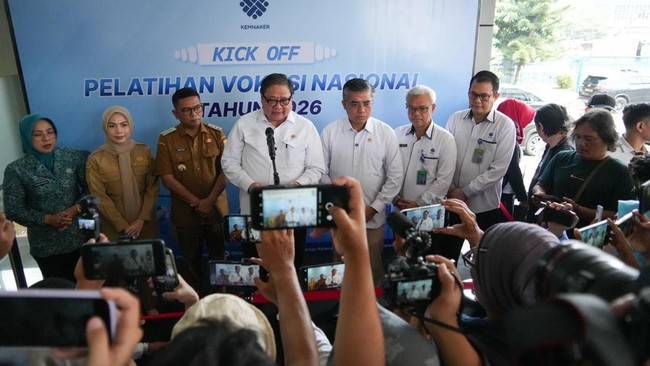
The government is accelerating the national vocational training programme as part of the economic stimulus for the second half of 2026. This move is intended to address the challenge of high youth unemployment, which continues to dominate the Indonesian labour market.
Coordinating Minister for Economic Affairs Airlangga Hartarto revealed that approximately 67% of the total national unemployment currently comes from the youth generation, equivalent to 4.8 million people. Consequently, vocational training programmes are considered a vital instrument to bridge the gap between labour skills and industrial requirements.
“This programme is a directive from the President and is part of the stimulus for the second semester of 2026, which needs to be implemented effectively, precisely, and with an impact on society,” said Airlangga during the opening of the 2026 National Vocational Training Programme Batch IV in Serang, Banten, on Wednesday (2/9/2026).
Airlangga explained that strengthening vocational training is becoming increasingly important alongside the heavy influx of investment into Indonesia. As of the first semester of 2026, realised investment reached Rp1,010.6 trillion, growing by 7.2% year-on-year, representing 49.5% of the annual target.
This investment has created approximately 1.4 million new jobs. However, the government believes that job creation must be balanced with a workforce prepared with competencies that meet industrial needs.
On the other hand, the national open unemployment rate has indeed fallen to 4.65%. Nevertheless, the dominance of unemployment among the youth group indicates a persistent mismatch between industrial needs and the skills of job seekers.
Beyond the manufacturing and service sectors, new labour demands are also emerging from the digital economic transformation and the transition towards a green economy.
According to Airlangga, the development of the renewable energy industry will create various new professions requiring specialised skills, ranging from solar panel technicians and turbine technicians to workers proficient in modern agricultural technology or smart farming.
The government is currently pushing for the development of solar power plants (PLTS) up to 100 gigawatts (GW). This figure is even larger than the current national electricity capacity, which stands at approximately 88 GW.
Meanwhile, domestic solar panel production capacity has approached 11 GW. This situation is expected to open significant opportunities for workers possessing competencies in the new and renewable energy sector.
To support these needs, the 2026 National Vocational Training Programme targets a total of 340,000 participants. This figure consists of 70,000 participants funded through regular state budget (APBN) allocations and an additional 270,000 participants through the 2026 second-semester economic stimulus.
As of August 2026, 89,337 participants have taken part in the training programme. Meanwhile, for Batch IV, which is being conducted simultaneously, the number of participants reached 12,128 people.
Airlangga emphasised that this target can only be achieved if all training facilities are utilised optimally, including through the involvement of local governments and the business world.
“The President wants this to be on a large scale, including vocational training; therefore, moving forward, we must utilise all available facilities, not only from the Central Government and Local Governments but also from the industrial sector,” he stated.
Spokesperson for the Coordinating Ministry for Economic Affairs, Haryo Limanseto, added that vocational programmes must be designed to be more adaptive to keep pace with the rapidly changing needs of the working world due to technological advancements.
According to him, collaboration between the government and the industrial sector is key to ensuring that upskilling and reskilling programmes not only enhance labour skills but also ensure that training graduates can be absorbed into the labour market.
“Vocational training needs to be designed adaptively so that the competencies provided are truly relevant to industrial needs and the evolution of job types,” said Haryo.
With a target of hundreds of thousands of participants and a focus on future sectors, the government hopes that vocational programmes can serve as a primary instrument to reduce youth unemployment while meeting labour demands amidst heavy investment and national economic transformation.
Source: jawawa.id (https://jawawa.id/newsitem/67-of-indonesian-unemployed-are-youth-vocational-training-identified-as-solution-1788328605)
Originally published by CNBC Indonesia (https://www.cnbcindonesia.com/news/20260902112158-4-764285/67-pengangguran-ri-ternyata-anak-muda-vokasi-jadi-solusi), translated from Indonesian