
635 Drones Shot Down, Yet Russian Refineries Still Burn: The Paradox
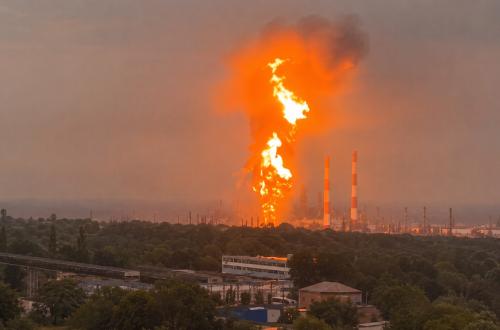
Russia claims its air defences shot down 635 Ukrainian drones in an overnight attack lasting into Sunday (2/8/2026). Yet, the Russian sky was not completely sealed. Fires still broke out in the Ufa industrial zone and at a logistics warehouse in Samara, while two people were killed after a residential building in Engels, Saratov region, was hit.
The Russian Ministry of Defence did not disclose the total number of drones launched by Ukraine in the wave. The figure of 635 therefore only indicates the number claimed to have been destroyed, not the success rate of Russia’s air defences. Moscow’s claim also cannot be independently verified.
Samara Governor Vyacheslav Fedorishchev said a facility belonging to Wildberries, Russia’s largest online trading company, caught fire after being hit. The location is approximately 800 kilometres from the forward positions of Ukrainian forces. In Bashkortostan, Governor Radiy Khabirov acknowledged a drone was shot down over the Ufa industrial zone and a fire subsequently occurred at the site.
In the Saratov region, Governor Roman Busargin said an attack on a residential building killed two people in Engels. The city is home to a strategic Russian military airbase, while the city of Saratov across the Volga River hosts one of the country’s major oil refineries.
However, a crucial distinction must be made. The claim of shooting down 635 drones refers to the wave of attacks from Saturday night into Sunday. Reports of three oil refineries in the Republic of Bashkortostan being attacked stem from the previous night’s wave, from Friday into Saturday.
Ukrainian President Volodymyr Zelenskyy said on Saturday that Ukrainian drones attacked three refineries in Bashkortostan that process millions of tonnes of oil annually. These facilities are nearly 1,600 kilometres from Ukraine. At least one fire was reported at the Ufa refinery complex, although the scale of the damage and the claim that all three refineries were hit could not be independently verified.
The two waves of attacks illustrate a paradox of Russian defence. Moscow can destroy hundreds of drones and still fail to prevent a small fraction from reaching their targets. In drone warfare, the attacker does not need all of its vehicles to get through. A few drones striking the most sensitive parts of a refinery can already cause major disruption.
Mathematically, the claim of downing 635 drones cannot be assessed without knowing the total number launched. If Ukraine sent more than that figure, a number of drones could still have penetrated. If some drones were shot down directly over an industrial zone, their debris could still cause fires or damage.
Russia possesses one of the most layered air defence networks in the world, ranging from long-range S-300 and S-400 systems to point-defence systems like Pantsir. However, the country must also protect the largest landmass on earth, a front line stretching over 1,000 kilometres, government centres, nuclear bases, airfields, military facilities, arms industries, ports, power plants, and dozens of oil refineries.