
610 Thousand Barrel Lifting Target Full of Challenges, Academics Assess Minister Bahlil's Strategy as Appropriate
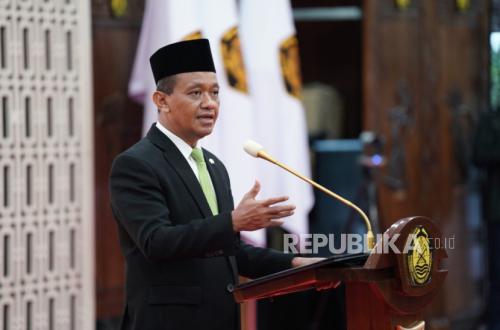
Academics from various universities view the President’s statement targeting oil lifting of 610 thousand barrels per day (bpd) in 2027 as a challenge amid the natural decline in national oil field production. However, the steps taken by Minister of Energy and Mineral Resources (ESDM) Bahlil Lahadalia through accelerating exploration, optimising existing fields, and improving the investment climate are considered to be on the right track to maintain production while strengthening national energy security.
Public policy expert from the Faculty of Social and Political Sciences (Fisip) at Padjadjaran University (Unpad) Bonti Wiradinata assessed that the 610 thousand bpd lifting target cannot be seen merely as a production figure. According to him, the target has a strategic position in maintaining Indonesia’s energy security amid geopolitical uncertainty and global energy market volatility.
“The target of 610,000 barrels per day in the 2027 RAPBN functions as a defensive baseline to maintain Indonesia’s bargaining power amid global market volatility,” said Bonti on Tuesday (18/8/2026).
According to Bonti, the policy direction of the Ministry of Energy and Mineral Resources in accelerating greenfield exploration, optimising existing fields with Enhanced Oil Recovery (EOR) technology, and improving the investment climate is an appropriate policy combination to address the problem of declining national oil production.
“From a public policy perspective, the combination of these three strategies is considered on target because it adopts a trinity approach of policy intervention: short-term intervention, long-term intervention, and the provision of fiscal facilities, to resolve the root causes of declining upstream oil and gas production,” said Bonti.
He explained that optimising existing fields is an important step because the majority of Indonesia’s oil fields are mature fields experiencing natural production decline. Optimisation through EOR can be a short- and medium-term measure, while exploration of new areas is needed to maintain the sustainability of reserves and production in the long term.
In addition, Bonti assessed that improving the investment climate is an important instrument given that upstream oil and gas exploration requires large capital and carries high risk. According to him, fiscal incentives, flexibility in contract schemes, and licensing cuts can increase the attractiveness of Indonesia’s upstream oil and gas investment.
Bonti also assessed Minister Bahlil’s emphasis on increasing lifting and exploration to reduce import dependence as being in line with the broader energy security agenda. Increasing domestic production is not only important for maintaining supply but can also reduce import pressure amid global oil price uncertainty.
“State revenue from oil and gas can be used to maintain Indonesia’s macroeconomic stability while funding renewable energy infrastructure. And if managed well, this will be very promising and prospective,” he said.
According to Bonti, if the government is able to halt or even reverse the years-long decline in oil production, this could be an indicator that upstream oil and gas sector reform is beginning to yield results.
“The ability to halt or reverse the years-long decline in oil production is valid evidence that structural reform is working. This indicates increased investor confidence (capital inflow) and the functioning of coordination between SKK Migas and relevant ministries,” said Bonti.
Meanwhile, energy economics expert from Gadjah Mada University (UGM) Fahmy Radhi assessed that the 610 thousand bpd lifting target faces challenges, particularly from the condition of national oil reserves and fields that have entered mature age. Based on historical trends, according to him, Indonesia’s oil production is in the range of 600 thousand bpd and tends to decline.
Fahmy said this condition means that efforts to maintain oil production require extra work. Nevertheless, he acknowledged that various efforts made so far have been able to increase production, including through the use of technology, optimisation of old wells, and development of people’s wells.
“Over the past year, various efforts have indeed been made desperately. For example, the use of technology in exploration, then utilising old wells, and also encouraging people’s wells,” said Fahmy.
According to Fahmy, the sustainability of these various measures is important so that the production achieved can be maintained. Therefore, production optimisation efforts need to be carried out consistently amid the challenges of natural decline in oil fields.
“If the efforts that have been made are not continued, I think it will be difficult to achieve an increase or even maintain production of around 608 thousand barrels per day,” he said.
On the other hand, Fahmy sees that Indonesia still has great energy potential from the oil and gas sector. One of these is through the development of the Masela Block in Maluku. He assessed that accelerating the project could become an important source of national oil and gas production in the future.
“For gas, the potential is still large and spread across various regions, including Masela,” said Fahmy.
Fahmy even encouraged Pertamina’s involvement in the development of Masela to accelerate the project. According to him, the state-owned company has options to seek funding both through internal sources and external funding without having to depend on the state budget.
“If Pertamina enters Masela, this will accelerate production from Masela. Then it will produce gas that can become revenue for the state,” he said.
Previously, President Prabowo Subianto targeted Indonesia’s economic growth in 2027 to reach 6%. This target is higher than the economic growth target in the 2026 state budget of 5.4%. In the energy sector, he targeted oil lifting in 2027 to reach 610 thousand barrels.