
608,000 US Companies and Citizens Face Bankruptcy: Victims of Trump?
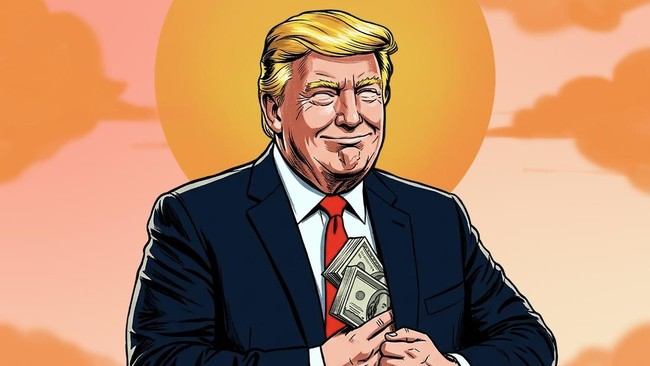
A wave of bankruptcy is sweeping across the United States, from households and small businesses to large corporations. The situation comes as businesses continue to face expensive borrowing costs, rising operational expenses, and pressured consumer purchasing power.
The situation has raised questions about President Donald Trump’s America First agenda. Tariff policies designed to protect domestic industry risk adding costs for US companies that still depend on imported goods and raw materials.
US Bankruptcies Continue to Climb
Federal court data shows US bankruptcy filings reached 608,511 cases in the twelve months ending June 2026.
The figure represents a 12.2% increase compared with the previous period. It has also surged nearly 60% from the 2022 level of 380,634 cases.
Of the 608,511 bankruptcy filings in the United States up to June 2026, some 26,941 cases came from the business or corporate sector, up 16.9% from the same period a year earlier.
Meanwhile, the remaining 581,570 cases came from individuals and households, reflecting financial pressure on consumers amid high living costs and interest rates.
The rise continues a trend that began after US bankruptancies hit their post-pandemic low in 2022.
Although filings continue to rise, the total remains well below the record of nearly 1.6 million cases in 2010. This means the US has not returned to the conditions of the global financial crisis, but pressure on the ability of households and companies to service debt is increasingly visible.
Business Bankruptcies Double
The pressure on the business world has been even greater. Business bankruptcy filings rose 16.9% to 26,941 cases in the same period.
Compared with 2022, the figure has more than doubled.
Chapter 11 filings, commonly used by companies to restructure debt whilst maintaining operations, jumped almost 23% to 10,320 cases.
Data from the American Bankruptcy Institute also shows commercial Chapter 11 filings rose 28% throughout the first half of 2026.
High borrowing costs, increased spending, and geopolitical volatility are said to be pushing more companies to use the bankruptcy route to restructure their obligations.
Industry the Biggest Victim
Pressure is also visible among large corporations.
S&P Global reports that large-company bankruptcy filings in the United States this year up to June reached 372 cases.
This is a marginal increase from 371 cases in the same period last year. The figure keeps the corporate bankruptcy rate at its highest level since 2010, or in the last 16 years.
The industrial sector recorded the most filings with 50 companies, followed by the non-essential consumer goods sector with 35 companies and healthcare with 26.
The dominance of the industrial sector has drawn attention because Trump has made a manufacturing revival one of the main aims of his tariff policy.
However, many US producers still depend on steel, aluminium, machinery, electronic components, and raw materials sourced from abroad. Tariffs on these goods can raise production costs for domestic companies.
Non-essential consumer goods businesses face a different problem. Companies in this sector struggle to raise prices too sharply because consumers facing higher living costs will cut back on non-essential purchases first.
Is There a ‘Trump Effect’?
The rise in bankruptcies cannot be attributed entirely to Trump. The filing trend has been under way since 2022, whilst high interest rates, pandemic-era debt, changing consumption patterns, and companies’ internal problems have also played a part.
However, Trump’s tariff policies risk becoming an additional layer of pressure, particularly for companies with thin margins and heavy reliance on imported goods.
Tariffs are paid upfront by US companies that import goods. These companies must then choose between passing the costs on to consumers or absorbing them through shrinking profit margins.
A Federal Reserve survey illustrates this dilemma in concrete terms.
Some 84% of small businesses using foreign inputs reported higher costs. Around 76% passed on at least part of the increase, whilst 60% also absorbed some of the costs internally.
Both responses can occur simultaneously. Companies can raise prices but still be unable to pass on the entire cost increase to consumers.
Small businesses are the most vulnerable because they generally lack the power to negotiate prices with suppliers or raise prices without risking the loss of customers.
Squeezed by Tariffs and High Rates
Tariffs also risk prolonging inflation problems. When higher import costs are passed on to selling prices, the Federal Reserve has less room to cut interest rates.
This creates layered pressure on the business world. Raw material costs rise, consumer purchasing power weakens, yet refinancing and new borrowing costs remain expensive.
Companies that previously survived by rolling over their debt are ultimately forced to restructure when maturities arrive and new financing becomes too expensive.
The Irony of America First
This is where the irony of Trump’s policy emerges. Tariffs are intended to protect US industry from foreign competition, but in the short term they also raise costs for domestic producers still dependent on global supply chains.
Large companies may be able to switch suppliers, relocate production, or pass costs on to consumers. Small businesses and companies already mired in debt do not have that luxury.
Trump is not the sole cause of the bankruptcy wave. However, his tariffs and policy uncertainty are aggravating factors for companies that were already fragile.
If interest rates remain high and import costs continue to rise, the America First agenda risks producing a paradox: a policy claimed to protect American businesses may instead help determine which companies survive — and which ultimately fall.
Source: jawawa.id (https://jawawa.id/newsitem/608-000-us-companies-and-citizens-face-bankruptcy-victims-of-trump-1785851572)
Originally published by CNBC Indonesia (https://www.cnbcindonesia.com/research/20260804122926-128-756377/608000-perusahaan-warga-amerika-terancam-bangkrut-korban-trump), translated from Indonesian