
6 Key Issues to be Discussed at Trump-Xi Summit in the US Today
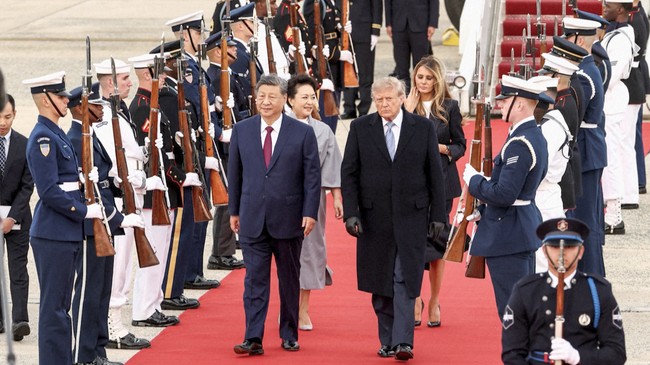
US President Donald Trump welcomed Chinese leader Xi Jinping to Washington on Wednesday local time. Xi Jinping is commencing a three-day state visit, with a summit scheduled for Thursday (24/9/2026).
This Trump-Xi summit marks their second meeting this year, following their previous encounter in China in May. Both leaders are seeking to establish stability in bilateral relations, which are currently under significant pressure due to various ongoing issues.
Xi has overseen a surge in China’s global trade in recent years, amidst sluggish domestic spending and a property crisis. Meanwhile, Trump is facing the complexities of the conflict with Iran and its subsequent impact on public approval ratings ahead of the US mid-term elections for the House and Senate, which could potentially strip his party of Congressional leadership.
Here are the primary issues to be discussed during their meeting at the White House:
- Trade Truce or Return to Trade War?
According to Reuters, markets will be closely watching for signs of an extension to the tariff truce announced following the Trump-Xi summit in South Korea last October. That agreement is scheduled to expire on 10 November.
The deal previously halted the trade war, during which the world’s two largest economies threatened each other with tariffs exceeding 100%, posing risks to global supply chains.
“Both countries will make several announcements regarding agriculture and non-tariff barriers,” stated US Trade Representative Jamieson Greer earlier this month.
Market participants are also monitoring developments regarding a joint tariff reduction agreement covering trade worth US$30 billion. One of the most straightforward steps for China would be to reduce tariffs on US agricultural products.
- Boeing Aircraft and Agricultural Products
Trump will seek to announce positive trade outcomes ahead of the US mid-term elections in November. This includes potential large-scale purchases of Boeing aircraft and US agricultural products by China.
Greer noted on Monday that China has made progress regarding commitments to purchase 200 Boeing aircraft. However, he did not indicate whether additional large orders would be announced imminently.
Trump previously stated in May that China could potentially increase Boeing orders to 750 aircraft. However, Boeing CEO Kelly Ortberg recently lowered the expectations of some industry analysts regarding new orders during the Trump-Xi meeting.
“I believe there will be additional orders in the future,” Ortberg said during an investor conference, emphasising that announcements would be made by individual airlines at their own discretion.
Industry sources suggest larger deals have been stalled for years after Trump threatened to cut off China’s access to essential engine parts. Following the May summit, the White House stated that China had committed to purchasing at least US$17 billion of US agricultural products annually for 2026, 2027, and 2028.
Meanwhile, US Republican Senator Pete Ricketts stated last week that Trump should urge Xi to fulfil these commitments, including the promise to open the Chinese market to more US beef products.
- China’s Grip on Rare Earths
Beijing is urging the US to postpone regulations that would prohibit thousands of Chinese companies from receiving advanced US technology. Conversely, Washington wants Beijing to ease the export of rare earths and critical minerals, which are vital to various high-tech industries, ranging from automotive to aerospace and defence manufacturing.
Experts suggest Trump is adopting a softer approach than usual ahead of his meeting with Xi, partly due to China’s increasing leverage through its control of critical minerals.
According to consultant AlixPartners, China controls up to 70% of global rare earth mining. The nation also dominates 85% of refining capacity and approximately 90% of the production of rare earth alloys and magnets.
The Trump administration has so far refrained from threatening high tariffs on Chinese imports or banning US technology exports, a departure from the more aggressive stance seen before previous summits.
Notably, last year, in retaliation for Trump’s tariffs, China restricted rare earth exports, which caused significant global market volatility.
- Taiwan
US allies in Asia are increasingly concerned that, for economic gain, Trump might be tempted to relax Washington’s support for Taiwan. The island is claimed by China but maintains a democratic government.
Taiwan rejects China’s sovereignty claims. While the US, like most nations, does not have formal diplomatic relations with Taiwan, Washington remains its most important international supporter and arms supplier.
Trump stated that Xi pressured him regarding US arms sales to Taiwan during their May visit. Subsequently, Trump described a pending arms package worth up to US$14 billion as a “negotiating tool.”
Beyond weaponry, sources close to China’s efforts told Reuters that Beijing hopes Trump will explicitly state that the US opposes Taiwanese independence, rather than merely maintaining the long-standing US policy of not supporting independence.
Source: jawawa.id (https://jawawa.id/newsitem/6-key-issues-to-be-discussed-at-trump-xi-summit-in-the-us-today-1790222084)
Originally published by CNBC Indonesia (https://www.cnbcindonesia.com/news/20260924091539-4-770456/6-isu-yang-dibahas-ktt-trump-xi-jinping-di-as-hari-ini), translated from Indonesian