
6.9 Million Passengers Use Rail and LRT Services to Access Airports Across Indonesia
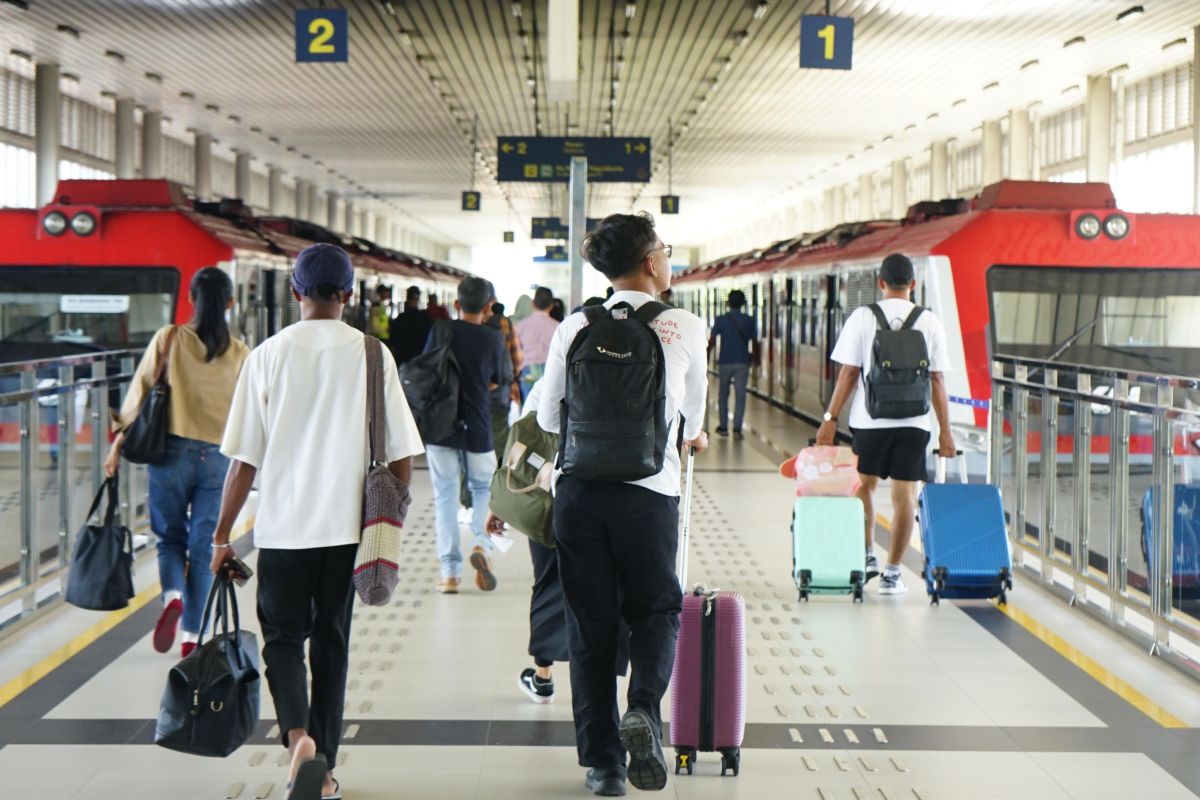
Jakarta (ANTARA) - Airports serve as gateways for air travel, and trains and LRT systems are present as land connectors that help the public reach these gateways more easily, on schedule, and in an integrated manner.
PT Kereta Api Indonesia (Persero), through the KAI Group, is strengthening connectivity between rail services, LRT, and airports in Java and Sumatra. Throughout January to May 2026, KAI Group served 6,201,016 passengers on rail and LRT services connected to airports.
This figure comprises passengers on the Soekarno-Hatta Airport Commuter Line, Yogyakarta International Airport (YIA) Train, Adi Soemarmo International Airport Train (KA BIAS), Srilelawangsa Train in North Sumatra, South Sumatra LRT, and Minangkabau Express Train in West Sumatra. Of the total, services in Java served 2,518,233 passengers, while services in Sumatra served 3,682,783 passengers.
Vice President of Corporate Communication at KAI, Anne Purba, stated that rail and LRT services connected to airports play a vital role in strengthening connectivity from city centres, residential areas, buffer zones, economic hubs, tourist destinations, to air transport nodes. “When stations are connected to airports, the public’s journeys become easier to plan. Trains provide time certainty, broaden access, and help passengers reach their flights more comfortably,” Anne said.
In the Greater Jakarta area, the Soekarno-Hatta Airport Commuter Line served 1,013,574 passengers during January to May 2026. This figure represents a 14.78 percent increase compared to the same period in 2025, which recorded 883,065 passengers. The service strengthens access for the public from the Greater Jakarta urban area to Soekarno-Hatta International Airport. For passengers travelling for business, tourism, education, healthcare, or family visits, the Airport Commuter Line has become a more scheduled mobility option amidst urban traffic congestion.
In the Special Region of Yogyakarta, the YIA Airport Train served 1,129,627 passengers during January to May 2026. This total consisted of 763,216 passengers on the regular YIA Train and 366,411 passengers on the YIA Xpress Train. Compared to the January–May 2025 period, which saw 1,117,749 passengers, YIA Airport Train ridership increased by 1.06 percent. The YIA Airport Train serves as a vital link between activity centres in Yogyakarta and Yogyakarta International Airport in Kulon Progo, supporting the mobility of tourists, students, workers, creative economy players, MSMEs, and the public using flights to and from Yogyakarta.
In Central and East Java, KA BIAS served 375,032 passengers during January–May 2026, a 24.90 percent increase from 300,271 passengers in the same period of 2025. KA BIAS is a train service connecting Adi Soemarmo International Airport in Solo with surrounding areas. With the extension of the service to Caruban Station in Madiun Regency, KA BIAS broadens access for communities from Solo Raya, Madiun, and surrounding areas to the air transport hub and activity centres in Central and East Java.
In North Sumatra, KA Srilelawangsa served 1,775,765 passengers during January–May 2026. This total comprised 664,833 passengers on the Medan–Kualanamu route and 1,110,932 passengers on the Medan–Kuala Bingai route. Compared to the January–May 2025 period, which recorded 1,736,958 passengers, KA Srilelawangsa ridership increased by 2.23 percent. KA Srilelawangsa strengthens connectivity between Medan, Kualanamu, Binjai, and surrounding areas. The Medan–Kualanamu route provides rail access to Kualanamu International Airport, while the Medan–Kuala Bingai route extends the reach of communities from buffer zones to Medan city centre and onward connections.
In South Sumatra, KAI Group provides access to the Sultan Mahmud Badaruddin II Airport area via the South Sumatra LRT. Throughout January–May 2026, the South Sumatra LRT served 1,815,017 passengers. The LRT connects the airport area with the city centre, educational zones, public service centres, sports complexes, and activity points in Palembang, strengthening the integration of urban transport with the aviation hub in South Sumatra.
Meanwhile, in West Sumatra, the Minangkabau Express Train served 92,001 passengers during January–May 2026. This service connects the Padang area with Minangkabau International Airport and serves as a mobility option for the public, tourists, and air travellers. The Minangkabau Express supports West Sumatra’s connectivity, particularly for those needing access from the city centre to the airport, and also supports tourism, education, trade, and family travel activities in the Padang area and its surroundings.
Anne added that the integration of trains, LRT, and airports is an important part of the public transport ecosystem. With interconnected services, passengers can continue their journey from home, the city centre, or buffer zones to the airport more easily. “Airports and stations are two important nodes in public journeys. When they are connected, access to work, education, healthcare, and tourism becomes more open. KAI Group strengthens the role of trains and LRT as safe, comfortable, and integrated mobility connectors,” Anne concluded.