
6,500 Workers at Two Indonesian Firms Face Mass Layoff Threat
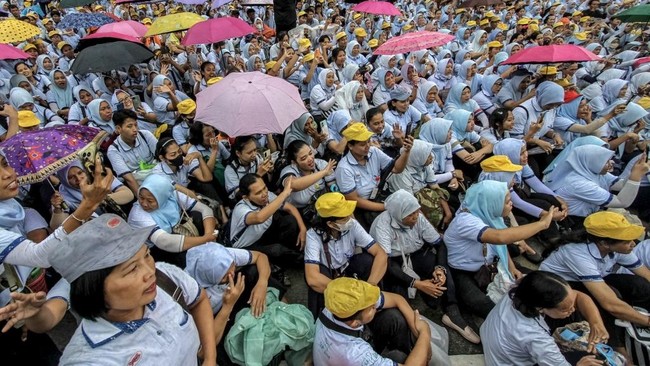
President of the Confederation of Indonesian Trade Unions (KSPI) and Special Adviser to the President on Employment and Labour Welfare, Said Iqbal, stated that the government and labour unions are taking mitigation steps to prevent a wave of terminations of employment (PHK) amid threats of global economic uncertainty caused by the war involving the United States, Israel, and Iran. Said Iqbal revealed that field visits to East Java, West Java, and Jakarta showed real impacts from the prolonged conflict. “The findings are true. The economic uncertainty caused by the Iran war against America and Israel is greatly affecting export-oriented companies and those whose raw materials come from imports. Demand for goods from abroad has decreased, so company production has also decreased,” he explained.
One of the companies visited was PT Pakerin in Mojokerto, East Java. Said Iqbal arrived at the location accompanied by the Federation of Indonesian Metal Workers Unions (FSPMI), the East Java Provincial Manpower Office, the Mojokerto Regency Manpower Office, and the Mojokerto Regional Secretary. “We came to the factory, which has stopped operating, and met with the workers. We found a potential threat of layoffs for 2,500 workers,” he said. He explained that the main problem stemmed from the company’s working capital funds, which were stored in a bank that has been liquidated by the Indonesia Deposit Insurance Corporation (LPS). “PT Pakerin’s funds, around Rp800 billion to Rp1 trillion, are under the supervision of the Financial Services Authority (OJK). As a result, production has stopped because the LPS has not yet released the funds,” he stated. He also noted the wider economic impact on the surrounding community. “I visited the market near PT Pakerin and many stalls were closed. This proves that when a company stops operating, not only are the workers affected, but also the local economy,” said Said Iqbal.
Several mitigation steps have been taken for this case. “First, coordinating with the Director General of Industrial Relations and Social Security at the Ministry of Manpower and the East Java Provincial Government to ensure that if layoffs occur, all workers’ rights and ongoing wages are paid through a special escrow account so they do not enter the company’s account, which is feared might be used for other purposes. Second, I reported this issue to the President and copied the report to the Minister of State Secretary and the leadership of the House of Representatives (DPR RI) so that the LPS can be summoned to save the workers’ rights,” he continued.
Furthermore, in West Java, Said Iqbal found a potential threat of mass layoffs for around 4,000 workers at PT Fengtai in Bandung Regency. “Initial information we received from labour unions and journalist colleagues stated that around 4,000 workers could be affected. They are currently furloughed, not yet laid off,” he explained. Based on initial findings, there are two main causes. First, the Nike shoe order at PT Fengtai has been completed and there is no certainty about the next order. Second, there is a delay in raw material supply due to the war situation, which has caused distribution to be diverted to other suppliers. Said Iqbal stated he would visit PT Fengtai in Banjaran, Soreang, Bandung Regency directly.
Several mitigation steps to be taken include: the government helping to resolve the problems faced by the company, including utilising the code of conduct mechanism owned by multinational companies such as Nike, Adidas, and Uniqlo; the government and labour unions requesting the company, including writing to Nike, to extend and add orders at PT Fengtai; and reporting to the President regarding the possibility of providing tax relief to the company so that production activities can continue and thousands of workers can return to work. During the mitigation process, all workers’ rights must still be fulfilled. “Four thousand workers must not lose their rights. Wages must still be paid in full because there is information that furloughed workers are only being paid 50 percent,” Said Iqbal stressed. He added that the efforts being made are not to find fault with the company. “We are not correcting the company’s mistakes, but we want to help the company and ensure workers’ rights are obtained. The goal is no layoffs,” he concluded.