
5G Becomes Indonesia's New Economic Engine, Projected to Contribute Rp 710 Trillion in Five Years
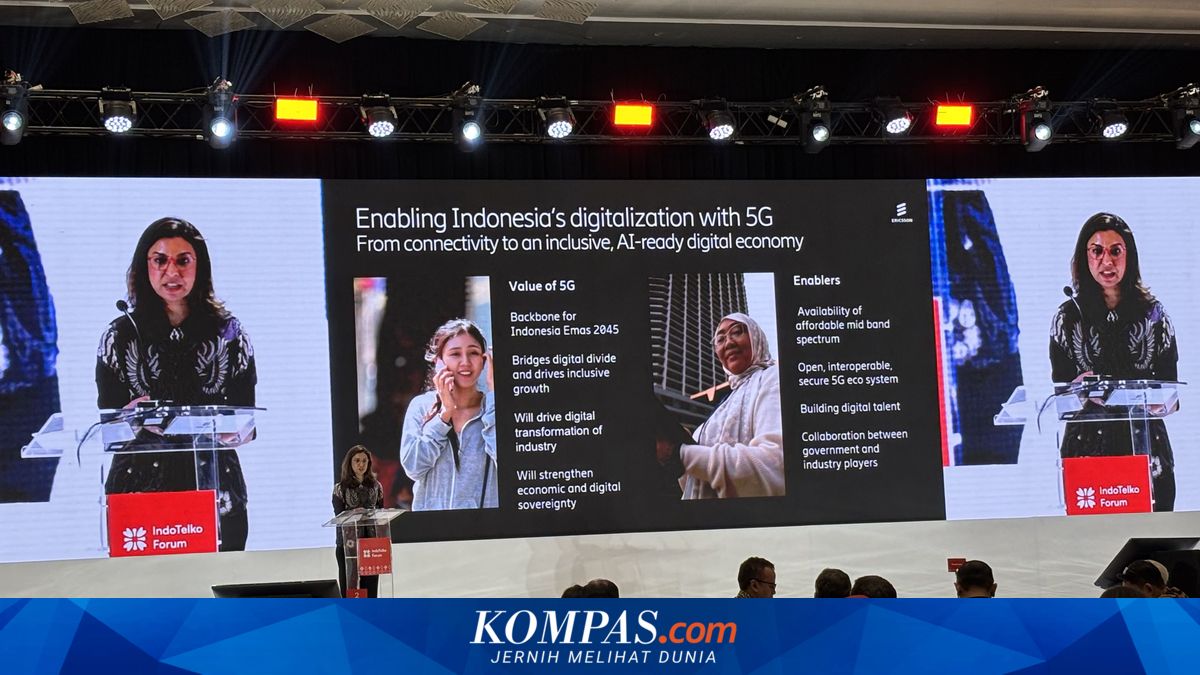
JAKARTA, KOMPAS.com - Fifth-generation (5G) network technology is projected to become a new engine for Indonesia’s economic growth, alongside the development and entry of renewable technologies in the country.
President Director of Ericsson Indonesia, Nora Wahby, revealed that the development of 5G in the country has the potential to contribute around US$41 billion, equivalent to Rp 710.3 trillion (exchange rate of Rp 17,270 per US dollar), to the domestic product (GDP) throughout 2026-2030.
“5G in Indonesia can add 41 billion dollars (US) to GDP between this year and 2030,” Nora stated during her presentation at the opening of the IndoTelko Forum seminar in Jakarta on Wednesday (29/4/2026).
She noted that Indonesia, as an archipelagic nation with more than 17,000 islands, has an urgent need for equitable connectivity.
According to her, 5G will serve as a catalyst for accelerating digital services, from payment tools and health services (e-health) to education, government portals, and banking services.
The presence of this high-speed network will enable people in various regions to access public services more equitably and efficiently.
“5G will develop inclusive growth, develop high-quality broadband, digital payments, and essential e-services such as e-health, education, government portals, banking, beyond major cities, more towards remote areas,” she explained.
Furthermore, she elaborated that 5G will also have a direct impact on national priority sectors.
The utilisation of private 5G networks in industrial areas such as factories, ports, and the logistics sector is believed to be able to enhance operational efficiency, productivity, and the global competitiveness of Indonesian industry.
“5G directly strengthens priority sectors. Private 5G in factories, ports, logistics, can increase productivity and enhance competitiveness,” she said.
In urban areas, 5G opens opportunities for developing smart city ecosystems through the integration of connected transportation, more efficient utility management, and improved public security systems.
This will ultimately enhance the quality of life for the community while creating safer and more sustainable cities.
Not only that, the integration of 5G with cloud and edge computing technologies is said to be the main foundation in the development of artificial intelligence (AI) in Indonesia.
Sectors such as health services, education, smart cities, and the creative industry are expected to experience accelerated innovation along with improved connectivity quality.
Source: jawawa.id (https://jawawa.id/newsitem/5g-becomes-indonesias-new-economic-engine-projected-to-contribute-rp-710-trillion-in-five-years-1777449218)
Originally published by Kompas (https://money.kompas.com/read/2026/04/29/134100526/5g-jadi-mesin-baru-ekonomi-ri-diproyeksi-sumbang-rp-710-triliun-dalam-5-tahun-?utm_source=ABC&utm_medium=rss), translated from Indonesian