
583 Hectares of Peatland Burned in Riau Corporate Concessions
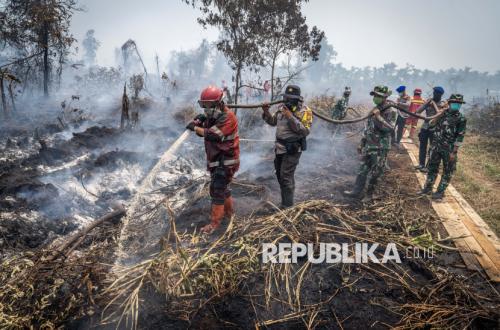
The Riau Forest Rescue Network (Jikalahari) has found approximately 583 hectares of burned areas in five corporate concessions in Riau Province. The findings are seen as evidence of weak protection of peatland ecosystems and inadequate oversight of business permits in areas vulnerable to forest and land fires (karhutla).
Based on analysis of hotspots, Sentinel satellite imagery, and field verification conducted from 15 to 24 August 2026, Jikalahari identified burned areas totalling approximately 583 hectares. The fire locations are spread across two Forest Utilisation Business Permit (PBPH) concessions for industrial timber plantations (HTI) and three oil palm plantation concessions located on deep peatland.
Jikalahari Deputy Coordinator Arpiyan Sargita said the organisation has reported the findings to the National Police Criminal Investigation Agency (Bareskrim). The move was taken because a report of suspected forest and land fires submitted by Jikalahari to the Riau Regional Police in 2025 has not yet been resolved.
“We chose to report these findings to Bareskrim because our report last year to the Riau Regional Police has still not been completed. This step was taken so that Bareskrim can process this new case firmly, while also giving the Riau Regional Police room to focus on resolving the 2025 forest and land fire reports,” said Arpiyan, as quoted in a Jikalahari statement on Sunday (29/8/2026).
Jikalahari urged law enforcement officials to follow up on the field findings and ensure accountability if violations are found. Law enforcement, according to the group, is necessary to prevent recurring fires in peatland areas.
Meanwhile, Head of the Forestry and Biodiversity Division at the Indonesian Center for Environmental Law (ICEL) Adam Putra Firdaus said forest and land fires are not solely related to climate phenomena such as El Niño. According to him, the fires also reflect fundamental problems in forestry governance and law enforcement.
According to Adam, the problem of forest and land fires begins upstream, particularly with the granting of large-scale utilisation permits in areas with high ecological vulnerability. He assessed that several aspects of forestry regulation remain inadequate, including supervision, administrative sanctions, strict liability, and environmental restoration.
“Corporations whose concession areas have burned must be punished, affected communities must be protected, and damaged forest ecosystems must be restored,” said Adam.
He also encouraged the government to strengthen the foundation of forest protection through forestry regulatory reform. In addition, the government is asked to conduct a comprehensive evaluation of permits, particularly those located in areas with high ecological vulnerability.
Jikalahari Coordinator Okto Yugo Setiyo assessed that the forest and land fire situation in 2026 cannot be separated from the regression of peatland protection policies at both central and regional levels. According to him, the dissolution of the Peatland and Mangrove Restoration Agency (BRGM) has weakened coordination of peatland restoration nationally.
Okto said protection of peatland in Riau remains far from adequate. Of the approximately 4.9 million hectares of peatland ecosystems in the province, only 5.72 percent has protected function status in spatial planning.
In fact, based on Government Regulation Number 71 of 2014, amended through Government Regulation Number 57 of 2016 on the Protection and Management of Peatland Ecosystems, at least 30 percent, or approximately 1.8 million hectares, of peatland ecosystems in Riau should be designated as protected function areas.
“This must be changed immediately,” said Okto.
Meanwhile, Greenpeace Indonesia assessed that the government needs to change its perspective on forest and land fires. Greenpeace Indonesia Forestry Campaigner Refki Saputra said El Niño can indeed increase fire risk, but it is not the only cause.
According to Refki, damage to peatland ecosystems, human activity, industrial expansion, weak mitigation, and limited handling capacity also increase the risk of forest and land fires. Therefore, the government should not use natural factors as an excuse to ignore corporate accountability.
“The government is mistaken in interpreting the meaning of forest and land fire disasters as being solely due to natural factors (El Niño), and therefore does not pursue corporate accountability,” said Refki.
He added that the increase in pulp industry capacity in Sumatra has the potential to increase demand for wood raw materials. This condition, according to Greenpeace, could drive industrial expansion and increase pressure on peatland areas.
The civil society coalition then urged Bareskrim to immediately follow up on the fire evidence found by Jikalahari. They also asked authorities to apply the principle of strict liability to corporations proven responsible.
In addition to law enforcement, the government is urged to conduct a comprehensive evaluation of business permits located on peatland, especially deep peatland with high vulnerability to fire. Ecosystem protection and restoration of affected areas are considered essential components of forest and land fire management so that disasters and smoke pollution do not continue to recur.
Source: jawawa.id (https://jawawa.id/newsitem/583-hectares-of-peatland-burned-in-riau-corporate-concessions-1788047463)
Originally published by Republika (https://esgnow.republika.co.id/berita/tkjyls393/583-hektare-gambut-terbakar-di-konsesi-korporasi-riau), translated from Indonesian