
57,413 People in 14 Central Java Regions Affected by Drought
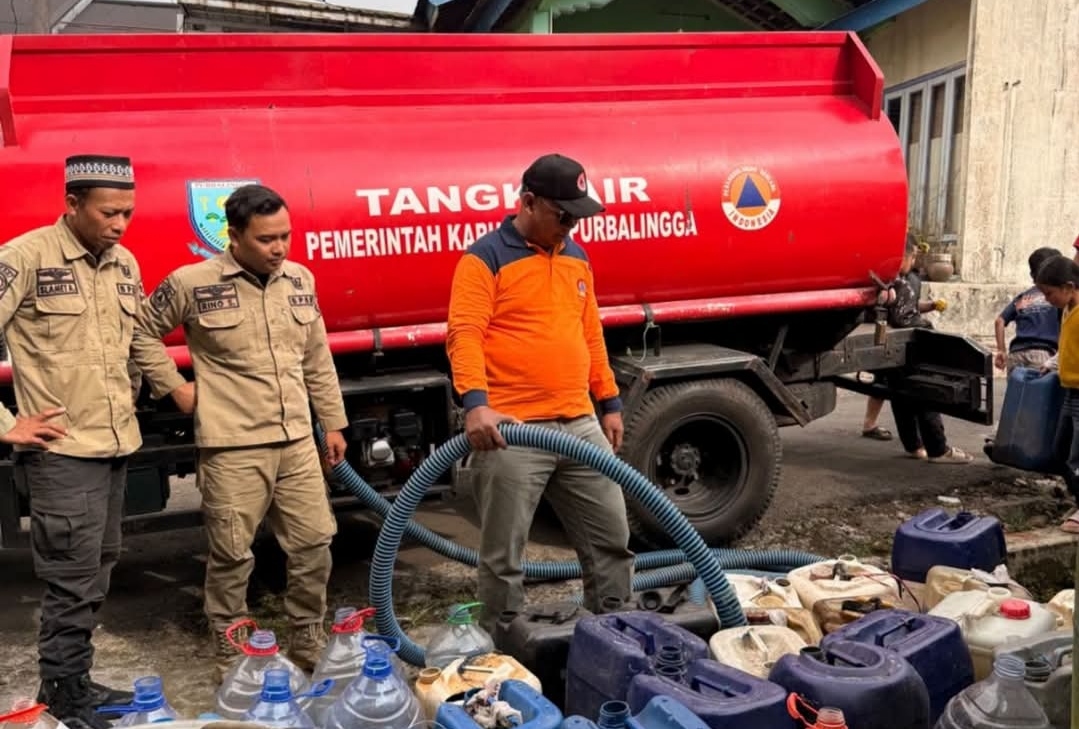
Some 20,393 families, or 57,413 people, spread across 60 villages in 40 districts in 14 regencies of Central Java have begun to be affected by drought. To meet residents’ consumption needs, clean water assistance continues to be distributed, and so far has reached 2,251,000 litres.
Based on monitoring on Tuesday (14 July), hundreds of water tankers move daily towards villages experiencing a water crisis caused by the dry season that began last June. The aid is focused on 14 affected regions: Cilacap, Banyumas, Purbalingga, Banjarnegara, Purworejo, Boyolali, Klaten, Sukoharjo, Sragen, Grobogan, Jepara, Demak, Semarang City and Pemalang.
The Head of the Central Java Regional Disaster Management Agency (BPBD), Bergas Catursari Penanggungan, revealed that five regions are suffering the most severe drought. “There are five regions that have experienced the worst drought, namely Klaten, Banjarnegara, Pemalang, Cilacap and Purbalingga,” he said.
BPBD data shows the total assistance distributed has reached 2,251,000 litres, equivalent to 453 tankers. Klaten has received the largest supply, namely 1,045,000 litres (209 tankers) for 23,366 people, followed by Pemalang with 402,000 litres (83 tankers) for 6,516 people. Other regions such as Banjarnegara received 171,000 litres, Grobogan 135,000 litres and Cilacap 125,000 litres.
The peak of the dry season is expected to occur only in August and September. To anticipate an expansion of drought-affected areas, BPBD has increased its clean water reserves. “We continue to add to our clean water reserves, with 129 million litres available, up from the previous 123 million litres,” Bergas added.
Despite the dry season, Agus Triyono, a forecaster at the BMKG Ahmad Yani Meteorological Station in Semarang, said there is still a chance of light rain in mountainous and highland areas. On Tuesday (14 July), light rain was likely to fall in Purbalingga, Wonosobo and Slawi.
For Wednesday (15 July), nine regions were predicted to experience similar conditions: Banjarnegara, Banyumas, Brebes, Magelang, Pemalang, Purbalingga, Tegal, Temanggung and Wonosobo. “These conditions slightly ease the hot weather during the day,” said Agus.
Beyond the water crisis, the BMKG has also highlighted extreme weather conditions in the form of hot temperatures during the day and very cold temperatures at night. In the Dieng Plateau, cold temperatures have triggered the phenomenon of frost, known locally as embun upas. Generally, air temperatures in Central Java range between 14 and 32 degrees Celsius, with humidity levels of 45 to 95 per cent.
The Ministry of Forestry has strengthened forest and land fire mitigation measures following an increase in hotspots in 2026 amid the threat of El Nino. An emergency alert status has been declared until 30 September 2026, as the long dry season is expected to be even drier.
The El Nino phenomenon has caused severe drought in Pidie Regency, Aceh. Dozens of rice paddies in the villages of Labui and Dayah Teubeng are at risk of harvest failure due to the water crisis.
This year’s dry season has also struck Makassar City in South Sulawesi.
According to an evaluation by the Central Java Regional Police for the period 1 to 11 July 2026, 16 land fire incidents were recorded across various regions of Central Java.
The East Java Provincial Government has put more than 2,000 borewells into operation over the past two years, with an additional 1,800 units this year, to anticipate the prolonged dry season of 2026.
Cianjur Regency in West Java is bracing for potential drought, particularly ensuring readiness in the agricultural sector, which is predicted to be affected.
The prolonged dry season continues to blanket Aceh Province.