
50 UNHAS PKM proposals secure funding from the Ministry of Education, Science and Technology (Kemdiktisaintek) for 2026
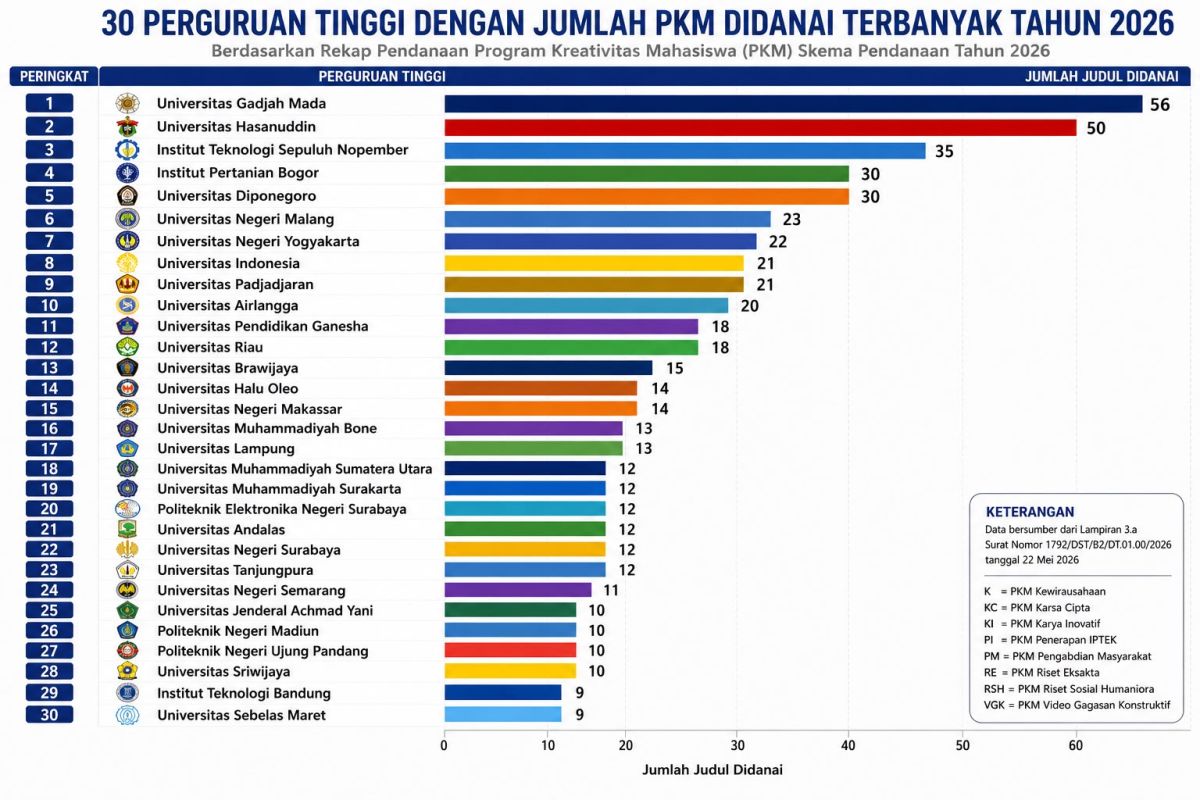
Makassar (ANTARA) – A total of 50 proposals for the Student Creativity Programme (PKM) at Hasanuddin University (Unhas) secured funding from the Ministry of Education, Science and Technology (Kemdiktisaintek) for 2026.
The Director of Student Affairs at Unhas, Abdullah Sanusi PhD, in Makassar on Saturday, said this achievement also positions Unhas as the second-ranked university nationally, behind Universitas Gadjah Mada (UGM), with 56 proposals.
He explained that the success is not merely about ranking, but reflects the growth of a culture of creativity, innovation, and scientific competition within the Unhas student community.
“For us, this achievement is not simply about numbers or positions, but about the quality of the student development process. Last year, Unhas made history by achieving national first place in PKM funding,” he said.
“Therefore, although this year we find ourselves in the second national position, we still see it as a very proud achievement and a sign of Unhas’s consistency in being among the country’s top universities in the field of student creativity and innovation,” Abdullah Sanusi said.
In 2026, Unhas submitted 190 PKM proposals nationally, of which 50 proposals (or 26 percent) secured funding.
This achievement is very high, given that the quality of proposals from various universities in Indonesia is increasingly improving. In addition, the funding quota is limited.
The success, he continued, is inseparable from the intensive, disciplined, and timeline-based mentoring strategy.
The mentoring process began at the socialisation stage to increase student participation, then continued with technical guidance for proposal writing up to the stage of periodic reviews.
“The most decisive factor is the mentoring system conducted intensively, disciplinely, and sustainably. Students are not only guided in drafting proposals but are also accompanied through periodic review processes to continually improve proposal quality,” he said.
Not only involving supervising lecturers and internal reviewers, the mentoring process is also strengthened by the involvement of students who have experience passing PKM or the National Student Scientific Week (PIMNAS).
According to him, this collaborative pattern is considered effective in building an inter-student learning ecosystem and at the same time increasing the readiness of the team to face the national selection.
Abdullah Sanusi confirms mentoring does not stop at the funding stage. All teams that pass will continue to receive support in programme implementation, monitoring and evaluation of activities, report preparation, and preparation for the PKP2 and PIMNAS stages.