
50,000 East Java Workers at Risk of Lay-offs, with Manufacturing Most Vulnerable
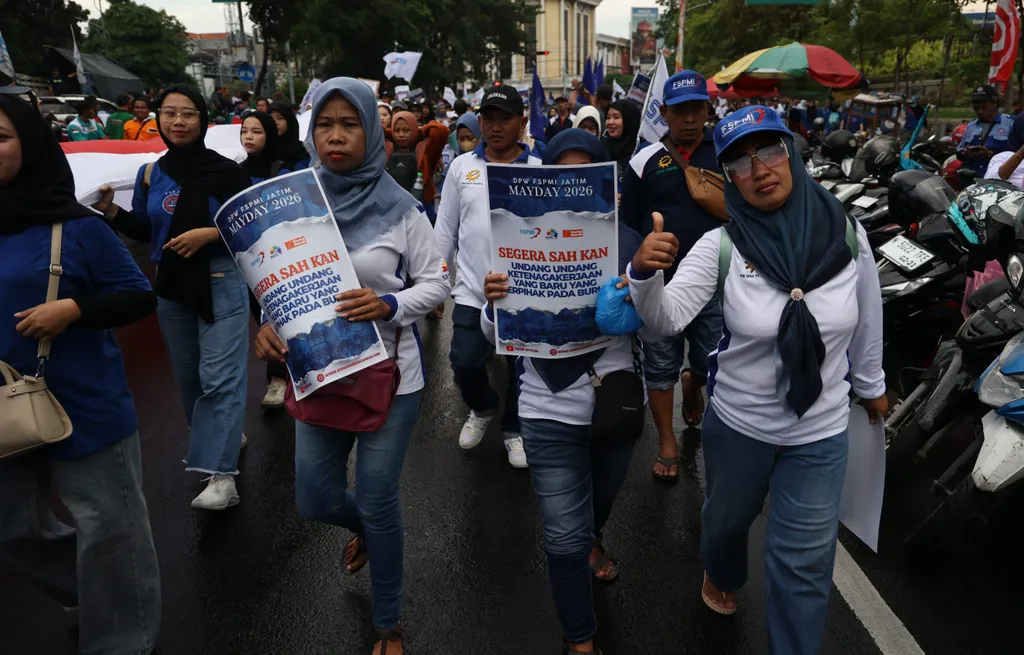
The threat of lay-offs is looming over workers in East Java, particularly those in manufacturing. Trade unions say up to 50,000 people could be at risk of losing their jobs in 2026.
Some workers in East Java feel that the threat of termination is becoming increasingly imminent. Dismissal can come at any time, even while they are busy at work. The situation is linked to the impact of national and global economic turbulence.
Data compiled by several trade unions in East Java indicate that around 50,000 formal-sector workers could be laid off during 2026. That is more than ten times the figure compiled by the Ministry of Manpower.
Jazuli, chairman of the East Java branch of the Indonesian Metal Workers Federation (FSPMI), said the province could become one of the areas with the highest number of lay-off cases nationally. Manufacturing workers, particularly those in labour-intensive sectors, are most vulnerable to losing their jobs.
“Those industries include textiles, garments, footwear, paper, electronics, wood and furniture. They are the most vulnerable to national and global economic turbulence,” Jazuli said on Sunday (11 October 2026).
Jazuli cited local textile, garment and footwear products, which previously dominated the domestic market but now face intense competition from imports from China. He said the situation was linked to what he considered increasingly permissive import policies.
According to Jazuli, Chinese imports are flooding the market with lower prices and designs considered more modern, although their quality is not necessarily better than that of domestic products. The situation has been compounded by declining consumer purchasing power, which is encouraging buyers to opt for cheaper goods.
He said many footwear factories in Sidoarjo had closed and laid off workers. Many small and medium-sized footwear businesses, including those in Wedoro and Mojokerto, had also gone out of business. Some factories that remain open have moved part of their production overseas, reducing their workforce as a result.
Jazuli added that the manufacturing sector’s difficulties had also been driven by higher industrial gas prices and rising costs for key raw and ancillary materials. Some of these inputs still rely on imports, leaving them heavily exposed to rupiah fluctuations against the US dollar and global geopolitical conditions.
The employment situation has also been worsened by growing numbers of workers losing their jobs when contracts expire and are not renewed. Some companies have also converted permanent positions into outsourced jobs.
According to Jazuli, the end of employment for contract or part-time workers is often not recorded as a lay-off in government data. This accounts for the significant gap between trade union and government estimates of the number of people who have lost their jobs.
As of 1 August 2026, the Ministry of Manpower recorded 4,800 workers laid off in East Java.
Jazuli said the figure did not fully reflect conditions on the ground. He said it was based largely on claims for Job Loss Insurance (JKP), while many people who had lost their jobs could not access the scheme because they did not meet its requirements or did not know how to apply.
The uncertainty in the labour market is an anomaly amid East Java’s strong economic performance, which has outpaced national growth.
Statistics Indonesia (BPS) data show that East Java is the second-largest contributor to the economy of Java, accounting for 25.4 per cent. It is also Indonesia’s second-largest provincial contributor, with a 14.34 per cent share.
East Java’s gross regional domestic product (GRDP) reached around Rp930 trillion in the second quarter of 2026.
The three leading sectors by business activity are industry, contributing 31.11 per cent; trade, 18.22 per cent; and agriculture, 11.20 per cent. Fourteen other business sectors account for a combined 39.47 per cent.
Industry is the dominant driver of the economy in East Java, known as the Land of Majapahit. Manufacturing dominates the province’s industrial sector and employs around 3.58 million people.
The scale of manufacturing, together with East Java’s population of around 42 million, has helped drive the development of trade. The sector is also a major source of jobs, employing around 4.56 million people.
At the same time, East Java is one of the country’s food-producing centres. Although agriculture contributes just 11.2 per cent of GRDP, well below industry and trade, it provides the most jobs, employing around 7.7 million people.
However, most agricultural jobs are informal, while formal employment remains heavily supported by manufacturing.
In response to the threat of a wave of lay-offs, trade unions have urged the East Java provincial government to strengthen its mitigation efforts. One proposal is to facilitate communication between workers, businesses and the central government to find solutions that would prevent companies from laying off staff.
The unions are also urging the regional government to maintain a conducive business climate so industry can grow. Measures proposed include simplifying licensing, cracking down on illegal levies and guaranteeing business security so investors do not move their investments out of East Java.
As East Java marks its 81st anniversary on 12 October 2026, workers hope provincial policies will do more to support their welfare. They are calling, among other things, for provincial and district or municipal minimum wages to be set closer to the decent living standard (KHL).
Jazuli said East Java’s 2026 provincial minimum wage of around Rp2.4 million a month remained well below the unions’ estimated minimum KHL of around Rp3.5 million a month. Minimum wages are intended as a benchmark for workers with a certain length of service, he said, whereas many workers have families and face greater living costs.
East Java Deputy Governor Emil Elestianto Dardak has said on several occasions that, despite economic turbulence, a number of indicators show the province’s economy remains on a positive trajectory.
He cited the large volume of People’s Business Credit (KUR) disbursed in East Java, with a non-performing loan (NPL) ratio of around 1.9 per cent.
“That means KUR borrowers in East Java, particularly micro, small and medium-sized enterprises, are resilient customers,” Emil said at the opening of the 2026 East Java Festival and East Java Investment Forum (EJIF) on Friday (2 October 2026).
Other indicators include regional economic growth and GRDP. Much of East Java’s GRDP is underpinned by manufacturing. But, Emil said, supporting industry was not straightforward, particularly if a region relied solely on natural resources or low-wage labour.
“East Java must focus on building strengths in its economic ecosystem, particularly in manufacturing,” Emil said.
He added that a conducive business ecosystem, along with skilled and educated workers, and infrastructure were essential to support trade and manufacturing.
Consumer purchasing power also needed to be maintained to create a strong market for manufactured goods and stimulate trade. Emil said manufacturing was one of the main pillars of East Java’s economy.
“If we want to create more jobs, we have to develop industry,” he said.
Asked which industries East Java could develop, Emil said the possibilities were broad. The provincial government hoped, however, to steer industrial development towards processing agricultural products, in line with efforts to increase value added for farmers.
Examples include bioethanol production using sugar cane and the production of rosin and turpentine from pine resin. The East Java government is seeking to attract investment to establish these and other new industries.
One initiative was the 2026 East Java Festival and EJIF, held on 1–2 October 2026. The event, organised jointly by the provincial and local governments and Bank Indonesia’s East Java representative office, brought together businesses, prospective investors, project owners, regional governments and financial institutions.
Domestic and international investors attended, including representatives from the United Kingdom, the Netherlands, Australia, China, Japan, South Korea, Saudi Arabia, Singapore and Malaysia.
EJIF 2026 presented 28 Investment Project Ready to Offer (IPRO) projects worth around Rp73.7 trillion in total, covering manufacturing, tourism, infrastructure and agro-industry. It also offered seven industrial estates and special economic zones, 80 potential regional government assets, and various potential banking projects. “Our strong foundations in manufacturing and agriculture are the basis of East Java’s investment appeal,” Emil said.
Ibrahim, head of Bank Indonesia’s East Java representative office, said the event had generated investment agreements worth Rp2.4 trillion through 12 commitments in the province.
He said investment not only supported economic growth but also helped create jobs and lift people out of poverty.
“Good investment conditions, combined with fiscal sustainability, financial system stability and a sound payments system, will be key to driving sustainable economic growth,” Ibrahim said.