
5 KNKT Findings Behind Fatal Collision Between Anggrek Train and KRL
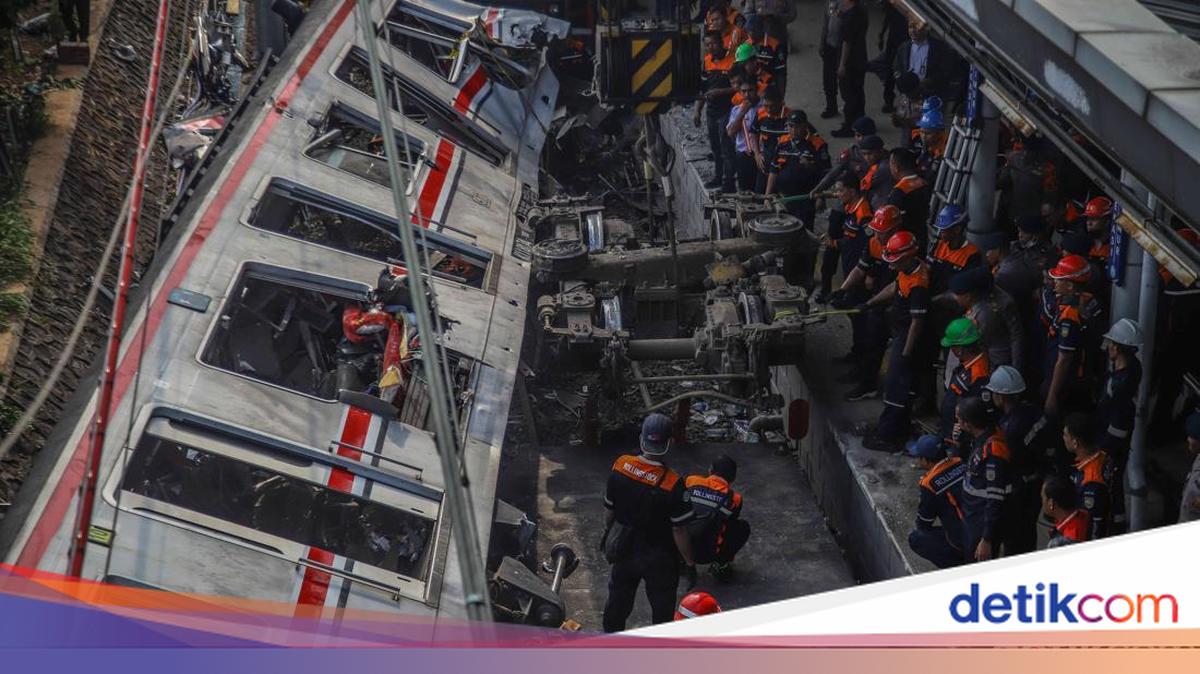
The National Transportation Safety Committee (KNKT) has released the results of its investigation into the fatal collision between the KA Anggrek (formerly Argo Bromo Anggrek) and the KRL Commuter Line at Bekasi Timur Station. In its report, the KNKT outlines the chronology, analysis of communication obstacles, and the factors contributing to the accident.
The KNKT also concluded its findings with several recommendations directed at the government through the Directorate General of Railways of the Ministry of Transportation, PT KAI, and PT KCI.
Here are the five key findings from the KNKT investigation report, summarised by detikcom:
- Chronology
The report details the chronology of the collision between KA 4B Argo Bromo Anggrek (KA 4B) and KA 5568A Commuter Line on Track 1 of Bekasi Timur Station on 27 April 2026, at 20:52 WIB.
The brief chronology outlined by the KNKT is as follows:
27 April 2026
20:48:24 WIB: A collision occurred between KA 5181B Commuter Line (travelling from Tambun Station to Bekasi Timur Station) and a Battery-Based Electric Vehicle (Taxi) at JPL 86 Ampera Road (downstream track).
20:48:55 WIB: KA 5568A (KRL) stopped at Track I (upstream) of Bekasi Timur Station for passenger boarding and alighting.
20:49:19 WIB: KA 5568A (KRL) moved approximately 1.69 metres towards Tambun Station.
20:49:24 WIB: KA 5568A stopped again as the driver observed a crowd of people on the upstream track towards Tambun Station.
20:50:43 WIB: KA 4B (KA Anggrek) proceeded directly on Track III of Bekasi Station.
20:52:12 WIB: A collision occurred between KA 4B and KA 5568A on Track I (upstream) of Bekasi Timur Station.
The KNKT stated there were 123 victims in the accident, with 107 people injured and 16 fatalities.
- Six Contributing Factors
The KNKT outlined six factors that contributed to the accident. However, the KNKT clarified that these contributing factors are not intended to establish fault or responsibility in administrative, civil, or criminal terms.
“The identification of contributing factors is not intended to establish fault or responsibility in administrative, civil, or criminal terms. The contributing factors are arranged chronologically and do not indicate the level of contribution to the occurrence of the accident,” wrote the KNKT.
The six contributing factors are:
Failure to identify hazard conditions in the signalling relationship between Bekasi Station and Bekasi Timur Station.
Communication issues during emergency conditions.
Communication failure of KA 5568A.
Lack of an information delivery mechanism between PPKP Selatan and PPKP Timur.
Failure to identify aspects of the UB104 Auxiliary Signal.
Absence of emergency braking procedures for high speeds on curved tracks.
Details of KA Anggrek Braking Traces
The KNKT investigation report explains the braking traces of the KA Anggrek driver during the service brake and emergency brake phases. The service brake phase lasted 37 seconds, starting at 20:51:16, when the train was 1,341 metres (Km 28+600) from the post-collision stopping point (Km 28+941), or 1,315 metres from the collision point with the KRL KA 5568A (Km 28+915).
Briefly, between 20:51:43 and 20:51:55, at positions 611 metres (Km 28+078) to 322 metres (Km 28+619), the driver maintained braking at full service.
Subsequently, the emergency brake phase lasted 25 seconds, from 20:51:56 to 20:52:21. The emergency brake was activated at Km 28+588, approximately 275 metres before KA 4B (KA Anggrek) struck the KRL KA 5568A at Km 28+915.
“After the collision, KA 4B continued to move for 26 m and finally stopped at Km 22+941. The emergency brake was activated when the speed of the train had dropped to 78 km/h. This action was taken by the driver as a last resort to stop the train after seeing the rear formation of KRL KA 5568A,” stated the KNKT.
Within a 4-second window, the KNKT noted that the BP pressure dropped drastically from 43 psi to 0 psi, while the BC pressure rose sharply from 0 psi to 70 psi.
“During the same period, the throttle position decreased gradually from T4 to T1 and then to the idle position. The activation of the emergency brake on the train set is indicated by the pneumatic control switch (PCS) changing to the ‘Open’ position. This condition automatically cut off the electrical current to the traction motors, forcing the throttle to the idle position and causing the traction motor current to drop drastically from 104 A to 0 A,” wrote the KNKT.
During this period, the train’s speed decreased from 78 km/h to 70 km/h. While the emergency braking was still in progress, at 20:52:03 or at a distance of 163 metres, the throttle was at idle, BP pressure was 0 psi, BC pressure was 70 psi, and the locomotive traction motor current load was 0 A, with a speed of 65 km/h. The KNKT stated that the driver of KA 4B activated the independent brake, a braking system that directs compressed air directly from the reservoir to the pressure piston inside the locomotive’s BC, working separately from the train formation brakes.
“The use of this independent brake was known from the independent brake system (IBS) indicator in the KA 4B locomotive logger, which showed an ‘Appl’ or applied indication, whereas it previously showed a ‘Rel’ or release indication. In this condition, the emergency brake had already been applied, where the air pressure in the locomotive’s BC had reached 70 psi, which is the maximum air pressure in the BC, so the braking force in the locomotive’s brake blocks to press the locomotive wheels had reached its maximum. The activation of the independent brake on the locomotive did not provide additional braking force,” wrote the KNKT.
The KNKT stated that the service brake was applied after the driver received information from PPKP Timur regarding an accident at a level crossing between the KRL from the direction of Tambun Station and an electric taxi. The KNKT noted that the driver of KA Anggrek increased braking to full service after seeing signal block B104.
Source: jawawa.id (https://jawawa.id/newsitem/5-knkt-findings-behind-fatal-collision-between-anggrek-train-and-krl-1790729763)
Originally published by detikcom (https://news.detik.com/berita/d-8685254/5-temuan-knkt-di-balik-tabrakan-maut-ka-anggrek-dengan-krl), translated from Indonesian