
5,000 MSEs Receive Halal Certificates, BPJPH Chief: It's an Economic Instrument
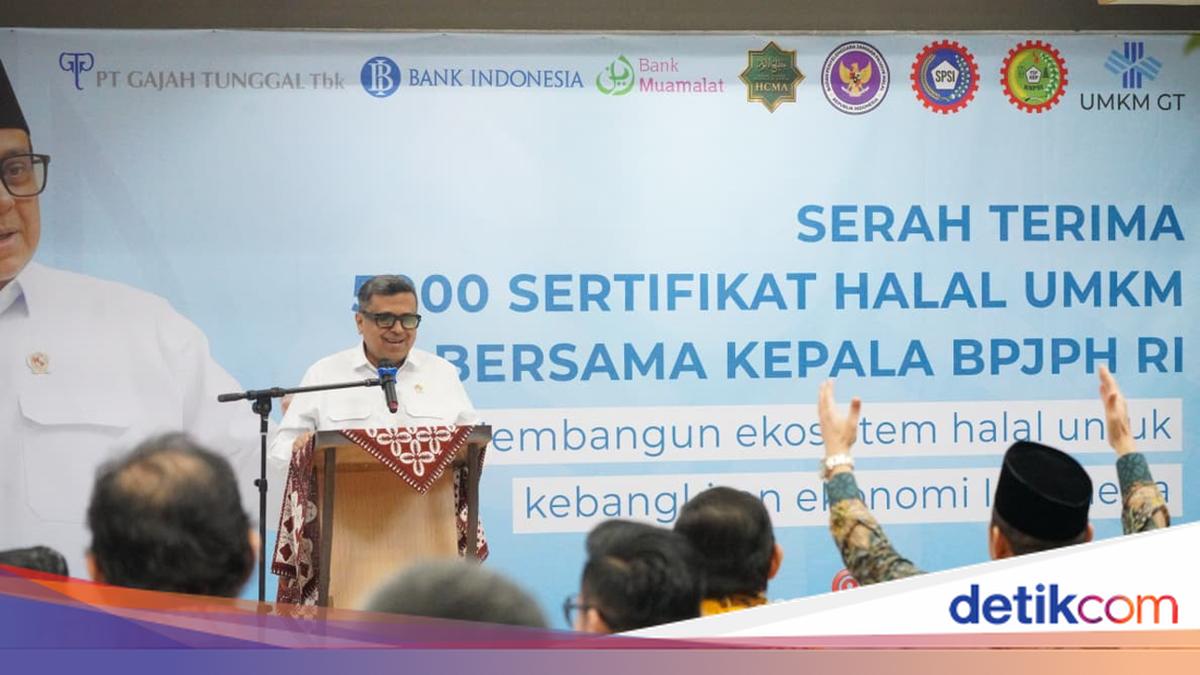
The Head of the Halal Product Assurance Agency (BPJPH), Ahmad Haikal Hasan, has stated that halal certification has developed into more than just consumer protection. According to him, it is now an important instrument for providing economic added value while increasing market confidence in products. “Halal has now become an important economic instrument. The halal value chain is proven to have a very large economic contribution, reaching 27 per cent of the National GDP. That figure is equivalent to around Rp4,900 trillion,” he said in a written statement on Monday (29/6/2026). This was conveyed after the symbolic handover of 5,000 halal certificates to micro and small enterprise (MSE) partners fostered by PT Gajah Tunggal at the Griya Ganesha Jatiuwung Building in Tangerang City, Banten. In the context of business development, he explained that halal certification is a strategic step in increasing product competitiveness while expanding market opportunities for micro and small enterprises. “This programme is not merely a certificate handover, but an investment to improve the quality and competitiveness of business actors. When a product has halal certification, consumer trust will increase and business opportunities will become more open,” he said. “With a halal certificate, MSE products have greater opportunities to enter national and even international markets, while strengthening the grassroots economy,” he continued. In agreement, the General Chairman of the Mathla’ul Anwar Central Board and Member of Commission II of the Indonesian House of Representatives, Jazuli Juwaini, said that halal certification is a form of state protection for the rights of the people as well as an instrument for empowering business owners, including MSMEs, to build economic independence and increase the competitiveness of Indonesian products. “That is why Indonesia has a Halal Product Assurance Law, not to complicate the public or business actors, but rather to provide certainty, protection, and ease in the implementation of halal certification. The proof is that the government continues to strengthen collaboration with various parties to facilitate halal certification for business actors, especially micro, small, and medium enterprises. On this occasion, 5,000 halal certificates for MSMEs were symbolically handed over,” he said. According to him, many developed countries have strong economic structures because they are supported by MSMEs. Indonesia also has the same potential if MSMEs are continuously encouraged to improve their product quality, including through halal certification, which opens wider opportunities to enter national and even export markets, especially to Muslim-majority countries. On the same occasion, Tangerang Deputy Mayor Maryono Hasan expressed appreciation to PT Gajah Tunggal for facilitating the issuance of 5,000 halal certificates for MSEs. He said this step is a tangible form of synergy between the government and the industrial sector in strengthening the capacity of business actors and the quality of local products. The Tangerang City Government, he added, is also continuously working to strengthen the MSME sector through various empowerment programmes, ranging from training, business mentoring, legality facilitation, marketing digitalisation, to easy access to halal certification. Strengthening MSMEs is one of the key strategies in maintaining regional economic growth because it can create jobs and increase community income. “We want Tangerang City’s MSMEs to continue to grow and move up in class. We will continue to provide various conveniences so that business actors have the ability to compete, both in terms of product quality, business legality, and market access,” he said. He expressed hope that the ownership of halal certificates would motivate MSMEs to continue improving product quality, maintaining production standards, innovating, and utilising digital marketing opportunities to reach a wider market. Bank Indonesia’s Director of the Sharia Economy and Finance Department, Suryono, said that halal certification is an investment for business actors to improve quality and expand market access. With strong collaboration among all stakeholders, the national halal ecosystem will become stronger and more competitive. “Therefore, Bank Indonesia continues to strengthen synergy with BPJPH, local governments, Halal Centers, universities, Islamic boarding schools, sharia financial institutions, and business actors to accelerate the emergence of more competitive halal products,” he explained.