
45 Million People at Risk of Acute Hunger, European Households Waste Food
45 Juta Orang Terancam Lapar Akut, Orang Eropa Malah Buang Makanan
Jakarta, CNBC Indonesia - The world faces a stark irony in the global food crisis. On one hand, millions are at risk of famine due to conflict and rising food prices. On the other, European households throw away food in massive quantities each year.
WFP warns that the escalation of conflicts in the Middle East could push the number of people experiencing acute hunger to a record high in 2026. If the conflict continues and unsettles the global economy, its impact is expected to extend far beyond the conflict area.
WFP’s latest analysis estimates that almost 45 million additional people could fall into acute food insecurity or worse if the conflict does not end by mid-year and oil prices stay above US$100 per barrel. That figure would add to the 318 million people currently experiencing food insecurity worldwide.
By comparison, when the Russia-Ukraine War broke out in 2022 and sparked a global cost-of-living crisis, the number of people experiencing hunger reached a record 349 million. WFP says the world now faces a similar situation in coming months if the Middle East conflict continues to escalate.
The rapid but slow-to-fall surge in food prices in the 2022 period left families vulnerable to losing access to staple foods quickly. A similar pattern is feared to recur, especially because energy and food markets are closely linked.
Although the conflict is currently in a region that is a global energy hub rather than a breadbasket, its impacts are considered equivalent due to the strong links between energy prices and food prices. Increases in energy costs can drive food inflation and worsen access to basic needs.
WFP warns that many families who are currently able to meet their daily food needs could soon lose that ability. If the conflict continues, global shocks will intensify and the most vulnerable groups will be the hardest hit.
“If this conflict continues, its impacts will shake the entire world, and families that cannot even buy their next meal will be among those most affected. Without adequately funded humanitarian responses, this situation could be a disaster for millions already on the brink of crisis,” Skau said, quoted on the official WFP website, Saturday, 23 May 2026.
Disruptions to shipping lanes in the Strait of Hormuz and rising risks in the Red Sea have driven up energy costs, fuels, and fertilisers. This widens the hunger impact beyond the Middle East via domino effects on global supply chains.
According to WFP’s analysis, sub-Saharan Africa and Asia are the regions most vulnerable due to their heavy reliance on imported food and energy. The number of people at risk of hunger is projected to rise by 21% in West and Central Africa, 17% in East and Southern Africa, and 24% in Asia.
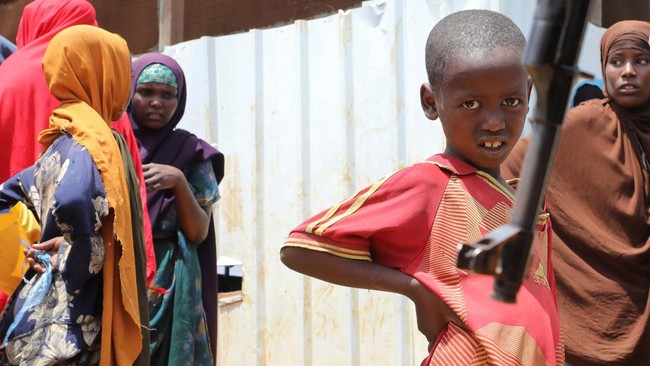
In Sudan, around 80% of wheat needs remain import-dependent, so price increases will directly affect communities. Meanwhile in Somalia, prices of essential commodities have risen by at least 20% since the conflict began, worsening the situation amid severe drought.
The crisis comes as WFP’s funding is significantly under strain, forcing the organisation to prioritise assistance tightly across regions. Without additional resources, the rising number of people at risk of hunger could trigger a humanitarian disaster in countries already teetering on the brink of famine.
On the other hand, conflicts disrupt global supply chains as major maritime routes encounter bottlenecks. The risks in the Strait of Hormuz and the Red Sea create a double bottleneck rarely seen on the world’s two most vital trade corridors.
These disruptions drive up shipping costs and the potential for renewed global inflation, including shortages of fertilisers crucial for the 2026 planting season. This is especially concerning for developing countries that rely on imports.
In another report, WFP has already delivered aid to tens of thousands of families affected by the conflict in the Middle East. The organisation has also mounted a major emergency response to keep aid distribution going amid increasingly complex conditions.
In Lebanon, food assistance and emergency supplies have been delivered to refugee families within hours of the first airstrike. Cash assistance programmes have also been implemented to help meet urgent needs and reduce pressure in shelters.
Meanwhile in Syria and Iran, WFP continues to expand aid to refugees and vulnerable groups affected by the conflict. However the organisation emphasises that sustained support is essential so that food aid can reach the most vulnerable amid the evolving crisis.
European households Waste Food
However, amid the threat of global hunger, the latest research from the University of Southampton shows that European households waste large amounts of food each year. Ian Williams, a Professor at the University of Southampton, in his piece ‘Why European households waste so much food - and how to reduce the pile of waste?’ published in The Conversation on 18 May 2026, notes that millions of households in Europe still waste substantial quantities of food annually. This situation stands in stark contrast to parts of the world, including conflict zones such as Ukraine and the Middle East, where millions of people
Source: jawawa.id (https://jawawa.id/newsitem/45-million-people-at-risk-of-acute-hunger-european-households-waste-food-1779531655)
Originally published by CNBC Indonesia (https://www.cnbcindonesia.com/news/20260523083811-4-737288/45-juta-orang-terancam-lapar-akut-orang-eropa-malah-buang-makanan), translated from Indonesian