
43,805 Indonesian Workers Laid Off, Labour Unions and Employers Reveal Unexpected Findings
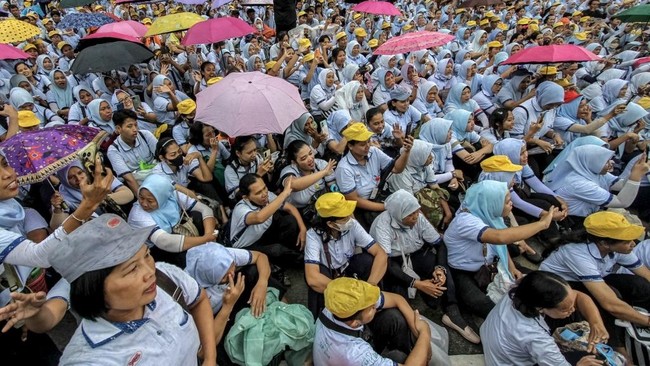
The Ministry of Manpower (Kemnaker) recorded that 43,805 workers were affected by termination of employment (PHK) throughout January–July 2026. West Java was the province with the highest number of layoffs, reaching 8,830 workers, or around 20.16% of the national total.
Nevertheless, the figure is not considered to necessarily reflect the actual layoff situation on the ground. Ristadi, President of the Nusantara Workers’ Confederation (KSPN), appreciated Kemnaker for regularly releasing layoff data but said there are still gaps in the data sources, especially from companies that do not report layoffs.
“I appreciate Kemnaker for regularly issuing layoff data; it just needs to fix the holes in its data sources, especially from companies that are unwilling to report layoffs,” Ristadi told CNBC Indonesia on Tuesday (25/8/2026).
According to Ristadi, the layoff data comes from claims under the Job Loss Insurance (JKP) programme. Yet not all workers are covered by the programme.
“The layoff data is reportedly based on JKP claims. As we know, one of the requirements for workers to receive JKP protection is being an active participant in all BPJS programmes with no contribution arrears,” he said.
Ristadi compared JKP coverage with the number of formal workers in Indonesia. He said BPS data recorded around 59.9 million formal workers in 2026. Meanwhile, BPJS Ketenagakerjaan reported around 47 million active participants, with only around 26 million active formal workers.
“BPJS Ketenagakerjaan also said that only around 16 million participants can be covered by the JKP programme,” Ristadi said.
From these figures, Ristadi believes there is still significant potential for workers to be laid off without being captured in data based on JKP claims.
“From that data we can conclude that the layoff data only draws from the niche of workers covered by JKP, namely around 16 million workers, and there is no breakdown of how many are formal, informal and construction services workers. Meanwhile, the larger pool of around 43 million workers out of 59 million formal workers is not recorded as having experienced layoffs. In fact, layoffs affect everyone, not only workers covered by JKP,” he explained.
“So I believe the layoff data is still less accurate than the reality,” he continued.
Beyond the data issue, Ristadi said the threat of layoffs will continue if structural problems in domestic industry are not addressed promptly.
“The wave of layoffs will increasingly threaten if domestic industrial technology is not updated soon, imports run rampant, and heavy cost burdens such as energy prices, taxes, raw materials and difficult, lengthy and expensive licensing policies continue,” he stressed.
He also argued that economic growth does not automatically make formal jobs easier to obtain. In his view, better growth is actually visible in the informal sector.
“Economic growth is not yet linear with the ease of finding work, especially in the formal sector. What is growing better is the informal sector, as BPS data reports. This means the informal sector places more emphasis on people’s ability to create their own jobs, rather than on the government’s role in providing broad employment,” Ristadi explained.
He therefore urged the government to seriously promote investment while protecting existing industries.
“The government must be serious from the central to regional levels in boosting investment, with cheap and fast requirements, while safeguarding and protecting industries that already exist. New investment must not end up killing old investment. Otherwise it will not do much to reduce unemployment, because some workers are absorbed while at the same time others are laid off,” he said.
Similarly, Mirah Sumirat, President of the All-Indonesia Workers’ Union Association (ASPIRASI), said Kemnaker’s layoff data is important as an indicator but is not sufficient to describe the real condition of the labour market.
“In my view, the layoff data presented by the Ministry of Manpower should be seen as an important indicator, but it does not necessarily fully describe the real layoff situation on the ground,” Mirah said when contacted separately.
She said the government also needs to look at the quality of jobs created, not merely the development of unemployment figures.
“What must also be a concern is that we should not only see the unemployment rate fall while at the same time formal jobs decline and more people enter the informal sector. For us, a falling unemployment rate does not automatically mean the quality of our labour market has improved. The measure must also be seen from job quality, wage levels, job security, social protection and workers’ ability to meet their living needs,” she said.
Mirah believes layoff risks still need to be watched in 2026, especially in labour-intensive sectors such as textiles, footwear and manufacturing.
“For 2026, we see that the layoff warning is still there. I do not want to say that a large wave of layoffs will definitely occur, but we must not close our eyes to the fact that pressure on industry is still quite high, particularly labour-intensive sectors such as textiles, footwear, manufacturing and other industrial sectors that are very sensitive to market demand, production costs, exports and people’s purchasing power,” she said.
She also asked the government to ensure that economic growth truly creates quality jobs.
“Regarding Indonesia’s current economic condition, I think the government needs to ensure that economic growth is truly felt in the real sector and creates quality jobs. Economic growth should not only be visible in macro figures while at the worker level layoffs, wage stagnation and informalisation are actually occurring,” she said.
Source: jawawa.id (https://jawawa.id/newsitem/43-805-indonesian-workers-laid-off-labour-unions-and-employers-reveal-unexpected-findings-1787644300)
Originally published by CNBC Indonesia (https://www.cnbcindonesia.com/news/20260824194129-4-762060/43805-warga-ri-kena-phk-buruh-dan-pengusaha-ungkap-hal-tak-terduga), translated from Indonesian